Saving pandas still a task
 |
|
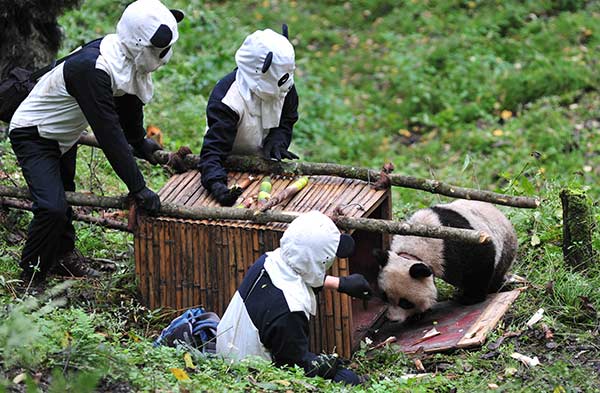
Researchers caught Tao Tao for physical examination in Wolong, Sichuan province in October 2012, a preparation for releasing it into the wild. Tao Tao is the first artificially-bred panda finishing its wild-environment adaption experiment. [Photo provided to China Daily] |
His death forced handlers to revise their approach to training pandas to survive in the wild.
They then started training female pandas to be released into the wild.
"Female pandas are more likely to integrate into the wild panda population. But releasing a captive panda into the wild cannot be hailed a success until the bear has been accepted by a wild panda, and has one or more cubs," says Zhang Hemin.
As for the other pandas released into the wild, there is Zhang Xiang.
In 2013, Zhang Xiang, a 2-year-old female, was released into Liziping.
Then, in 2016, researchers wanted to capture her for a checkup.
So, using information from a GPS tag on her neck, they managed to find her after trekking in the mountains for nearly three hours.
But she ran away at the sight of humans.
Although no physical checkup was conducted, she is believed to be in good health, said Zhang Guiquan, a senior panda expert at the center.
Meanwhile, Xue Xue, who was released in 2014, survived only 40 days.
Zhang Guiquan said it was likely she died of trauma from being caged for several days before the release.
But although two pandas died, the other five released into the wild are faring well.
Among the survivors is Tao Tao, a 2-year-old male panda from the center.
He was released into the wild in Liziping in October 2012, and was discovered in a tree on the plateau more than 3,000 meters above sea level on Oct 30, 2013.
A veterinarian tranquilized the frightened bear with a rifle dart, and Tao Tao fell into a net.
A blood test showed the panda was in good health, says Yang Zhisong, an expert in zoology at China West Normal University in Nanchong, Sichuan, who was on the scene.
Tao Tao weighed 42 kg when he was released in 2012. But when he was found a year later, he had gained at least 10 kg, says Yang.
It would have been close to impossible to release pandas into the wild if the center set up in 1980 under an agreement between the World Wide Fund for Nature, formerly the World Wildlife Fund, and the Chinese government had not resolved the difficulties in panda breeding.
In 1992, the center was home to only 10 pandas and it had to catch wild pandas for research.
But even after trapping captive pandas, it was difficult to get them to mate, and to keep the cubs alive.
As researchers worked to solve the problems from 1992 to 2006, the center built up the world's largest captive panda population.
"And it is now home to 234 captive pandas, while the whole world has 471 captive pandas," Zhang Hemin said.
Explaining how difficult the task was, Zhang Hemin says that researchers at first did not know panda habits.
So, thinking that they preferred a solitary life, researchers kept each panda isolated in a tiny den and fed them only bamboo.
As a result, the pandas became depressed and had difficulty becoming ruttish, he said.
Then, in the course of studies initiated in 1992, researchers provided captive pandas with more opportunities to communicate socially with each other and play.
Male and female pandas were then swapped into the dens of the opposite sex so that each would know the smell of the other.
"We also showed sexually mature pandas videos of their peers having sex," says Zhang Hemin who started studying pandas in 1983.
As for food, the researchers came up with other innovative ideas.
"In the wild, pandas eat bamboo. They seek out the best plants-the ones that receive adequate sunshine. But since we could not provide that kind of bamboo for the captive pandas, we created a biscuit rich in trace elements and vitamins for them," he says.
As for re-creating a more natural environment for the pandas, the researchers placed the biscuits in places the pandas could not find easily, aiming to get them to move around and be more active.
"Also, to make them play, we froze fruits before giving them to the pandas. So, they had to play with the fruits until they thawed if they wanted to eat them," Zhang Hemin said.
Another problem that had to be resolved was abandonment.
Abandonment used to happen because 50 percent of the newborns are typically twins and the mother would end up caring for only one.
"A mother panda would first try to care for both babies, but several hours later, when she realized she could not, she would abandon one baby. If she tried to support both, both would die. So the mother deserted one baby even if it cried," says Zhang Hemin.