Full Text: Human Rights in Xinjiang - Development and Progress
VI. Environmental Rights
Xinjiang upholds the basic national policy of conserving resources and protecting the environment. Giving priority to environmental protection, it pursues ecology-friendly and sustainable development on the path toward a future of economic development where life is prosperous and a healthy environment is conserved, so as to constantly promote harmony between man and nature and effectively ensuring the people's environmental rights.
Framework of eco-environmental protection has been further improved. Over 30 local regulations and rules, including the Regulations of Xinjiang Uygur autonomous regionon the Implementation of the Water and Soil Conservation Law of the People's Republic of China, and the Regulations of Urumqi City on the Prevention and Control of Atmospheric Pollution, Regulations on Wild Plants Protection, Regulations on Wetland Protection, and Regulations on the Environmental Protection for the Development of Coal, Petroleum and Natural Gas have been promulgated and implemented. The Regulations on Environmental Protection have been amended twice. Water Function Zoning of Xinjiang Uygur autonomous regionhas been implemented, and work on creating and revising the Environmental Function Zoning of Xinjiang has been accelerated, which will provide a basic technical foundation for the drawing of ecological red lines. A framework of ecological protection, pollution control, radioactive environment monitoring, and monitoring of hazardous waste and nuclear safety is in place.
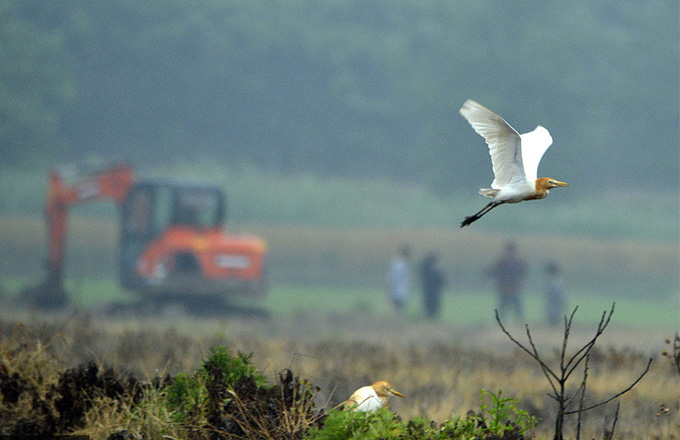
Solid progress has been made in ecological development. Xinjiang has carried out a number of projects, including natural forest protection, returning farmland to forest or grassland, returning grazing land to grassland, prevention and control of desertification, ecological management and restoration, and wildlife protection, to constantly improve the ecological environment and create secure zones for ecological security. Since 2016, projects involving high energy consumption, serious pollution, and high emissions have been strictly prohibited in Xinjiang. A "one-chop" examination system has been enforced for the development of energy and mineral resources before approval obtained from the government of the autonomous region, besides a "one-veto" system for issues concerning environmental protection. As of the end of 2016, oasis forest coverage had reached 24 percent, grassland comprehensive vegetation coverage had reached 41 percent, and the forest network was providing effective protection to 95 percent of the farmland. Every year, Xinjiang improves 20 million mu (approximately 1,333,333 ha) of grassland suffering from degradation, desertification and salinization, reducing the expansion of desertified land to 82.8 sq km a year. Of the 79 major rivers, 94 percent have high water quality. Wetlands total more than 3.94 million hectares in area. There are 29 state- and autonomous region-level nature reserves, 28 state-level wetland parks, and one world natural heritage.
Urban living environment continues to improve. Xinjiang has worked to promote urban ecological restoration in an all-round manner, to speed up construction of urban ecological gardens and urban wetland resources, and to continuously enhance the quality of urban green space and comprehensive service functions. As of the end of 2015, the greening rate of urban built-up areas had reached 35 percent, the green coverage rate had reached 37 percent, and per-capita park green area had reached 11.5 sq m. There are 20 state- and autonomous region-level garden cities, 44 state- and autonomous region-level green countytowns, and one state-level urban wetland park.
Effective measures have been adopted for pollution control. Xinjiang has intensified efforts in pollution prevention and control, strengthened water pollution prevention and control, and built centralized sewage treatment facilities in industrial agglomeration areas, as well as urban sewage treatment and recycling facilities. It has accelerated the pace of constructing waste disposal facilities, and improved the disposal capacity and level of up-to-standard discharge.
Obvious results have been seen in energy conservation and emission reduction. Xinjiang has actively adjusted and optimized energy consumption and the industrial configuration, and developed a circular economy and energy-conserving and environment-friendly industries. In 2016, its wind and photovoltaic generation capacity reached 17.75 million kilowatts and 8.93 million kilowatts, respectively, ranking second and first among China's provincial-level administrative divisions. A strict system for mothballing outdated capacity has been implemented, which has decommissioned a total of 21 million tons of outdated capacity in thermal power, iron and steel, cement, coking and other sectors, and saved energy equivalent to about 4.18 million tons of standard coal. During the 12th Five-Year Plan period (2011-2015), emissions of sulfur dioxide, nitrogen oxides, chemical oxygen demand, and ammonia nitrogen decreased by 39 percent, 38 percent, 44 percent and 43 percent respectively compared to the previous five-year plan period, showing that Xinjiang has achieved the national targets for controlling the discharge of these four major pollutants. Xinjiang has also given more financial support to energy conservation and emission reduction in industry, construction, transport, public institutions and other key sectors. A mandatory standard of 65 percent reduction in energy consumption has been followed for newly built houses, and 95 million sq m of existing residential buildings have gone through transformation in heating metering and energy conservation. Xinjiang has developed urban public transport, and encouraged residents to use green means of transport. It has strengthened energy efficiency supervision in large public buildings, and 59 public institutions have been included in the national list of energy efficiency demonstration units. A policy of special electricity prices for power plants with desulfurizing and dedusting equipment has been fully implemented. Xinjiang has launched a pilot program of paid use and trading of emissions permits, and actively explored a market regulation mechanism for paid use of environmental resources. In 2016 the Xinjiang Emissions Trading Reserve Center was formally established, marking institutionalization of the pilot work of the use and trade of emissions permits.
Mechanism of environmental monitoring has been improved. Since 2015, inspection of environmental law enforcement has been carried out in more than 30 percent of prefectures (districts or cities) and 5 percent of counties (cities or districts at the same level). A "grid" of environmental supervision has been established in which key objects for supervision are determined and levels of supervision are classified, and a system that supervisors shoulder a life-long responsibility for case quality has been established. Regarding environment-related complaints and reports, a responsibility system has been implemented, in which the first person who receives the complaint/report shall make sure the case is handled properly. A 12369 hotline for reporting environmental problems has been opened. A mechanism of exposing typical cases of environmental violation has been launched. Publicity concerning environmental credit evaluation and information about polluting enterprises has been strengthened, and information on rectification and enforcement actions against those violating laws and rules is regularly publicized.
Illegal activities detrimental to the environment are punished. Xinjiang has strengthened environmental protection responsibilities for government and enterprises, and strengthened the investigation and punishment of those responsible for illegal activities detrimental to the environment. It has conducted thorough investigations into and comprehensive clean-up of construction projects violating relevant laws and rules. It has established a joint meeting system between environmental protection departments and police, courts, procuratorates, and supervisory departments for joint investigation, case briefing, case transfer, and information sharing. It has also invited citizens, legal persons and other organizations to participate in supervision in relation to environmental law enforcement, making public the whole process of law enforcement.
- China offers new idea on human rights governance
- China issues report on US human rights
- Work together to promote and protect human rights
- Peace is fundamental premise, foundation for human rights protection: Chinese diplomat
- A Comparative Study on Human Rights Development Approaches in China and U.S.(Special Issue No.48 2016)