Class of '77 revels in memories of event that changed lives



 |
|
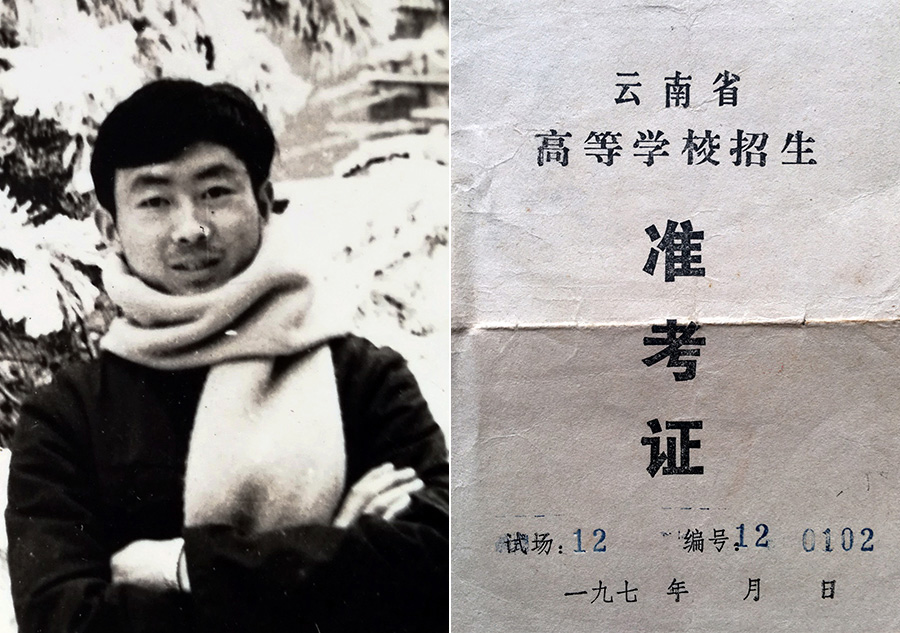
Luo Ren and his gaokao permit |
First Person: Luo Ren
'All I knew was my life would be turned upside down, in a good way'
Luo Ren, 64, took the gaokao in 1977 and was admitted to Beijing Forestry University. After graduation, he became a researcher at Chongqing Academy of Forestry and was later chief scientist for the Chongqing Forestry Science Society, leading several major projects. He retired in 2013.
The happiest day of my life was in March 1978, the day I received an offer of a place at university.
It was a Sunday, and I was in a remote village in the Xishuangbanna Dai autonomous prefecture, Yunnan province.
I had been sent there in 1971 as a 17-year-old as part of a campaign that saw urban young people quit school to live and work in rural areas during the "cultural revolution" (1966-76).
I was working as a lumberjack and construction worker. I got up early and went to do some lumber work, and then I headed to the nearest information center to find out whether I'd been admitted to college or not.
An acquaintance I ran into on the dirt road told me a friend had received an offer, and he asked whether I had too. I said not yet. Then, in the afternoon, I came across another friend who had also received an offer. But I still hadn't.
I'd spent my first two years in Xishuangbanna drinking beer, fighting or doing nothing, and by 20 I was feeling lost. I didn't want to spend the rest of my life in a remote area cutting down trees. My mother, a law professor before the "cultural revolution", encouraged me to keep learning, and my girlfriend, who was back in my hometown of Chongqing, said if I stayed in Yunnan, there would be no future for us. So I brought some books from home and began to study after work. The gaokao was to be my way out.
After the movie that night, I walked home, which was 5 kilometers away and usually took about an hour. I felt there was little hope, but I tried to comfort myself. It's normal to fail once, I thought to myself.
The road was covered with dirt, and there were no street lamps. It was dark; there was only the moon, stars and the glimmering light from my kerosene lamp. When I got close to home, I heard someone shouting: "Your offer is here. It arrived this morning."
My feelings were a mixture of ecstasy and relief. My neighbors rushed out of their rooms and wished me luck. After they left, I headed to my friend's place, which was 3 km away. I had the same kerosene lamp, but it didn't feel dark anymore.
My heart was pounding all the way. When I arrived, it was about 3 am. My friend was sleeping, but I shouted to wake him up: "I got my offer."
I telegraphed my parents and told them the good news. At the time, I didn't even know where my school was, or what major I would study.
All I knew was my life would be turned upside down, in a good way. I'd been given a gift.
Luo Ren spoke with Zhao Xinying.
Reporter's log: Nothing can replace knowledge and talent
Zhao Xinying
In China, the gaokao has long been called "the most important examination".
That was particularly true decades ago when the economy was underdeveloped and social resources were in short supply. Those who passed the exam in 1977 and attended college obtained decent, government-allocated jobs, becoming respected cadres and leading better-than-average lives.
But that's not the reason the revival of the exam, after a long suspension, deserves to be commemorated.
Instead, it is remembered because it reinforced people's faith in the power of knowledge and their respect for talent, which opened a new era of rapid economic and social development.
I think the sense of value reflected by the exam's revival is still meaningful, even though the country has become the world's second-largest economy and living standards have improved.
In recent years, there have been many media reports, online posts and much anecdotal evidence about people who had no higher education but still made big fortunes in business. Conversely, some people with master's degrees or even doctorates have failed to land well-paid jobs. That led some people to conclude that knowledge and academic qualifications are unnecessary for success.
In my opinion, that line of thinking is flawed.
Looking at the history of human development, we find that each economic development and example of social progress or technological innovation has been fueled by knowledge and talent. Many people believe that China's prosperity has benefitted greatly from faith in education and talent.
Can you imagine what the China of the future would be like if today's younger generation rush into business rather than going to school? Will the economy continue to develop? Will people's lives continue to improve?
Maybe for a short period, but not in the long run.
The significance of knowledge and talent may be overshadowed temporarily, but it becomes self-evident as time passes-that's the lesson I have learned from the revival of the gaokao 40 years ago.