Government leads in patriotic education
|
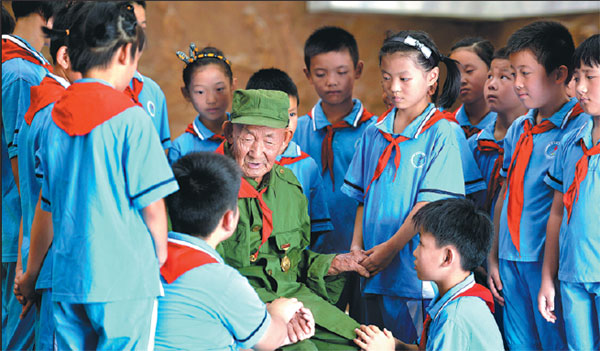
Students from a primary school in Nangong city, Hebei province, listen to Sun Yunbao, a veteran, at a local public cemetery honoring war martyrs. [Mu Yu/Xinhua] |
Efforts to boost patriotic education made by the authorities of the People's Republic of China can be dated back at least 35 years, when the country's constitution, passed in 1982, stated that Chinese citizens should "love the country and the people ... and receive education about patriotism, collectivism, internationalism and communism".
Apart from the constitution, other laws, such as those related to education, stipulate that the country must offer patriotic education to students at all levels. The Teachers' Law states that they have an obligation to conduct patriotic education for students.
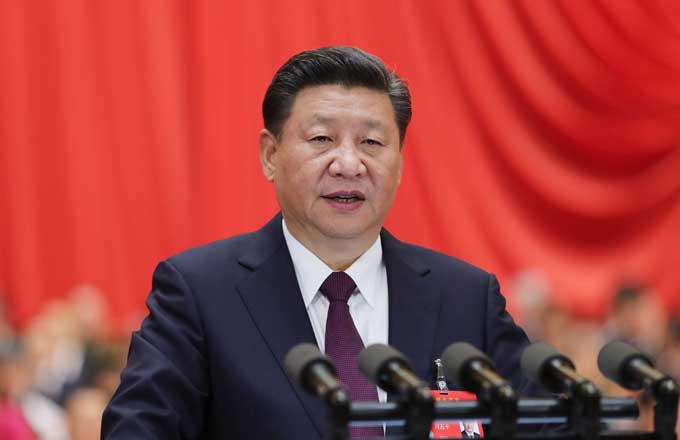
President Xi Jinping has also stressed the significance of patriotism on a number of occasions in recent years.
For example, in a speech delivered at a collective group study among the Political Bureau of the Central Committee of the Communist Party of China in December 2015, Xi said patriotism is the spiritual core of the Chinese nation and patriotic education should run through the nation's entire education system.
"Efforts should be made to enrich the form and content of patriotic education and ensure good results," he said, suggesting that the great achievements in China's reform and development, memorial activities for historic events, patriotic education bases, and traditional festivals and celebrations should be fully exploited to help people's love for the country to grow.
New understanding
At Lyu's school, patriotic education has been particularly stressed since January last year, when the Ministry of Education issued a series of guidelines in which it said patriotic education should be integrated with the design of the curriculum, textbook compilation and the examination and evaluation of subjects taught at schools.
"That inspired my colleagues and me to consider how we could make patriotic education part of our daily lessons, and make it easily understood and well-accepted by the students," she said. "If we simply tell students to love the country, it may be too abstract and abstruse for them to understand."
Some schools, such as Qianmen Primary School in Beijing, brought students to patriotic education centers such as the Red Star Education Center in Daxing district, where children can simulate walking the paths of the Red Army's Long March and gain elementary impressions of what patriotism might be about. However, Lyu and her colleagues finally decided to start with a more practical approach.
They guide students to do things they are capable of: To love their families, teachers and classmates; to love the school by maintaining a clean and tidy campus; to love the city by appreciating its beautiful scenery; and to love traditional culture by - for instance - learning about the origins of each traditional festival.
"We believe that patriotism is not complicated. It can be perceived or interpreted through one minimal thing or another so even primary school students can make some contribution," Lyu said. "In this way, we are transforming patriotism from slogans into action, turning patriotic education from cramming into a kind of experiential learning."
Zhao Zhiwei, an associate professor of Chinese language and culture at East China Normal University, praised Lyu's interpretation of patriotism.
"It's sensible to let students know that patriotism is not far beyond their reach," he said, adding that patriotism is not necessarily about sacrificing one's life to guard the country, a sentiment frequently heard during wartime.
He said that in today's China, doing the right thing and behaving oneself is also a way of showing love for the country, as this contributes to the national harmony and development.