Space-age rail network may be in pipeline
 |
|
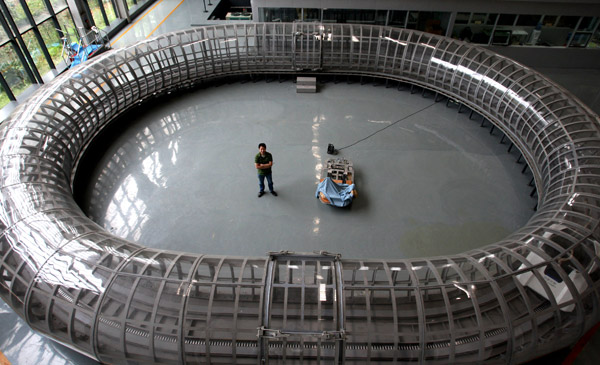
A scientist surveys a hyperloop used for trials of maglev vehicles at Southwest Jiaotong University in Chengdu, Sichuan province.[Photo/China Daily] |
Designers are investigating a revolutionary system that would employ magnetic levitation and hyperloops, as Zhao Lei reports.
A poll recently conducted by Beijing Foreign Studies University showed that the speed and convenience offered by high-speed rail, online shopping, shared bikes and mobile phone-based payment apps are the four things young expats in China view most favorably.
And of those four items, it seems likely that high-speed rail will remain on the list for a long time as the country works to retain its place as the home of the world's fastest trains. Now, Chinese designers are developing a bullet train capable of achieving a top speed of 400 kilometers per hour on conventional tracks, along with a magnetic levitation, or maglev, train that is expected to run at 600 km/h.
The country is even considering the possibility of building a system based on a transnational tube that would allow specially designed trains to travel at 4,000 km/h.
Last month, designers at China Aerospace Science and Industry Corp, one of the country's biggest space contractors, announced that they had started research and development work on a futuristic ultrafast transportation system popularly known as a hyperloop.
The CASIC hyperloop will see maglev lines running in partially elevated tubes or tunnels along which streamlined, engineless trains will travel at speeds of 1,000, 2,000 and 4,000 km/h, according to Mao Kai, chief designer of the system at CASIC. So far, there is no indication of how much such a system would cost.
By comparison, China's fastest wheeled train in commercial operation travels at about 350 km/h, while large commercial jetliners usually fly at 900 to 1,000 km/h.
The highest speed ever achieved by a railway vehicle was 603 km/h. That record was set during a test run of the Japanese L0 Series superconducting maglev in April 2015. However, the fastest operating speed of a commercial rail vehicle is 430 km/h, and was attained by the Transrapid maglev, developed in Germany, on a 30.5 km stretch of line that runs to the Pudong International Airport in Shanghai.
CASIC is the first Chinese enterprise to begin developing a hyperloop system capable of allowing trains to travel at 1,000 km/h or faster.
Depth of experience
The project will benefit from the company's experience in systems engineering and supersonic vehicles, CASIC said in a statement. The company is the third in the world to embark on such a venture, following Hyperloop Transportation Technologies and Hyperloop One in the United States.
Mao said CASIC is working with more than 20 institutes at home and abroad on the project and its technicians are striving to develop key technologies, such as those required to construct elevated hyperloop tube systems.
He added that once the project has been developed sufficiently, CASIC plans to construct a short line for trial runs for the 1,000 km/h version.
The 1,000 km/h and 2,000 km/h versions of the system would be used for intercity travel, while the 4,000 km/h version would form part of a transnational ultrafast transportation network, according to Mao.
"The reason we are eager to develop a 4,000 km/h version is that we believe such a line is technologically feasible, and that it will have business potential in terms of long-distance transportation in the future," he said. "Of course, safety and comfort will be at the top on our agenda when we develop hyperloop lines."
The maglev train's acceleration and deceleration within the tube would have to be relatively gradual and smooth to ensure passenger comfort, he said. Moreover, landforms and engineering considerations would determine what proportion of the line would be aboveground and how much would run underground.