A new way to save heritage houses
Faced with a lack of funds, one area is taking a fresh approach to protection
 |
|
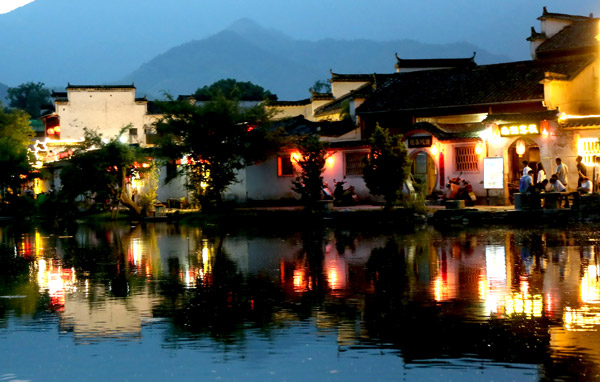
Traditional lanterns glow near centuries-old residences in Hongcun Village, near Mount Huangshan, Anhui province, in May. [Photo by WANG HAO/CHINA DAILY] |
Old houses in Huangshan, Anhui province, offer a unique insight into the centuries-old architecture of the Ming and Qing dynasties, but a lack of funding is making protection a challenge.
There are more than 6,000 Ming and Qing houses in Huangshan, a UNESCO cultural and natural heritage site; but, because of limited government funding, fewer than one-fourth - 1,325 - are under State protection.
Yet, all of these old houses, many of which once belonged to important people, are treasures in local residents' eyes. How to effectively protect these examples of cultural heritage has long been a challenge for inhabitants and authorities alike.
Many villagers work in cities as migrant workers, leaving their old houses behind, vulnerable to decay and collapse.
"There is a lack of money for the renovation of these houses, and it is a real shame to have to watch them collapse or fall into ruin. So we are encouraging people who are able to invest capital in repairing the old houses to make good use of them," said Hu Jianbin, Huangshan's culture bureau chief.
Urbanization is a significant factor. Increasing numbers of city dwellers, tired of the hustle and bustle of city life coupled with traffic congestion and air pollution, are turning to the countryside to escape. Preservation of old houses in Huangshan offers such people a glimmer of hope.
Clean air
Huangshan has many advantages to attract people escaping city life. Apart from its natural scenic beauty, the city is one of the cleanest in China. Last year, the number of days that air quality reached the national standards of "excellent" and "fairly good" hit 355 in Huangshan. It is also the cradle of Hui culture, which has inspired unique residential building designs since the Song Dynasty (960-1279).
Shu Qing is one of the people attracted to Huangshan.
Born in Yixian county of Huangshan, Shu worked as a journalist in Beijing for eight years before returning to her hometown.
"I liked strolling around the Lama Temple in Beijing, and loved all the small restaurants nearby. I dreamed of opening one in my hometown," she said.
In 2009, Shu, left the big city and returned to Yixian where she opened her own restaurant - The Hui House - in an old building near the former residence of Sai Jinhua, a woman of note in the late Qing Dynasty (1644-1911). The building is located near the townships of Xidi and Hongcun, two UNESCO cultural heritage sites.
Dream property
"The house had been left empty and had decayed wood that had been destroyed by termites," she said, recalling the first time she saw her dream property.
Five months of reconstruction and interior decoration have turned The Hui House into a cozy and elegant restaurant known for delicious food and attentive service. Only eight groups of diners are served each day.
"We carefully keep the old building in good condition according to government requirements, frequently repairing it," Shu said.
A lover of old architecture, she started searching for a suitable ancient house to live in with her husband. In 2012, she bought two adjoining Ming Dynasty (1368-1644) houses in a precarious state of disrepair. It took her three years to rebuild and decorate them.
"The project's plan and blueprint must be approved by the government first to prevent workers destroying any of the original structure. The Hui style of a house must be maintained, including the use of black tiles, high white walls and wall tops shaped like horse heads," she said.
The restored houses, which were completed in 2016, have eight tastefully designed rooms, equipped with modern amenities such as central air conditioning and heated floors.
"Since 2016, we have lived in the houses. In March this year, we began providing accommodations for travelers," she said.
Personal investment
Shu spent 1.5 million yuan ($225,520) buying the two old houses, and another 2.6 million yuan rebuilding and decorating them.
"Buying old houses is costly, and reconstructing them is not only costly but also time-and energy-consuming. If you are not really fond of them, you will destroy the houses," said Yu Biao, director of the cultural heritage protection office in Yixian.
"So we must supervise buyers' credit and their economic power, no matter what kind of old houses they want to purchase."
Fascinated with Hui culture, Huang Hua, president of Beijing Hua Sheng Hang International Cultural Development Co, specializes in Ming and Qing Dynasty furniture. Since 2003, he has made a living trading nanmu, a rare wood often used by Qing royal families.
In 2013, he came across an ancestral hall in Yixian.
"It was almost collapsing and was classified as dangerous. It would have been a shame to allow it to disappear," he said.
Win-win scenario
Because the hall is listed as a cultural relic, the Yixian government only leased it for 40 years. Huang rebuilt it over a period of two years, spending 3 million yuan. Now it is a museum for Ming and Qing furniture. Huang also exhibits his company's products.
In recent years, local governments have taken a series of steps to attract private investors like Shu and Huang to renovate the old houses in Huangshan. If the plan goes well, it will prove to be a win-win, sustainable way to preserve cultural heritage.
"We have a set of meticulous rules to ensure that only capable investors can rent the houses. Ownership stays in the hands of the government," said Hu, the culture bureau chief.



- Anti-graft pilot program will be spread nationwide
- Beijing publishes first aid treatment map on World Stroke Day
- New cargo route links Xinjiang with Ukraine
- China's elderly population to hit 400 mln by 2035: expert
- China's new top graft buster vows 'sweeping victory' against corruption