Land laid waste by coal is reborn as cultural garden
|
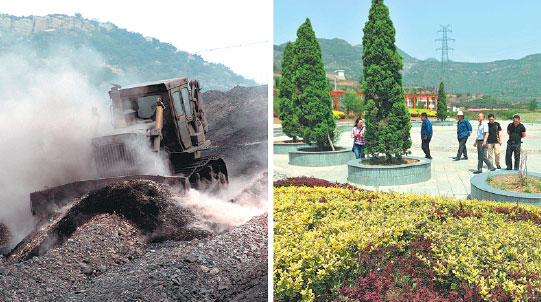
A coal mine waste dump in Yangquan, Shanxi province, before and after its cleanup. More than 20 such areas in the city have been turned into leisure parks since 2000. Xinhua |
Traditional mining area shifts its focus to improving environment
Longquan Buddha Cultural Garden is a cluster of temples, recreational areas and tree-filled fields about 9 kilometers from downtown Taiyuan, the largest city in coal-rich Shanxi province. It is a popular spot for residents to enjoy the outdoors on a sunny afternoon.
Seeing it today, it's hard to imagine that as little as five years ago the entire area was covered in toxic waste.
For five decades after 1962, the 14.3-hectare site in Shentanggou village was used to dump 4.5 million metric tons of waste from the Xiyu Coal Mine.
Spontaneous fires were common, while strong winds would often send dust flying and contaminating the air, water and soil, according to Wang Kechao, head of the mine, which is part of Shanxi Zhenghua Group.
In 2009, to bring the severe pollution under control, Wang said, the company teamed up with the Shanxi government in a cleanup drive that included compacting the waste, laying down clean soil and introducing seepage controls.
"The beautiful garden and new temples have been built for residents and visitors, making it a new attraction," Wang said, adding that visitors to the nearby hot springs have also increased since the cleanup.
This year, the government of Shanxi, the country's major coal supplier, said it plans to spend 2 billion yuan ($300 million) to start another 53 projects that will turn coal wastelands into desirable environments.
"Shanxi has imposed tougher restrictions and reduced the solid waste generated by industry, and is now recovering contaminated areas in order to protect the environment," vice-governor He Tiancai said on Sept 12 at the Trans-Century Tour of Chinese Environmental Protection, an event organized by the Environment and Resources Committee of the National People's Congress.
By the end of 2015, Shanxi had 270 billion tons of known coal reserves, accounting for 17.3 percent of the national total, the third-largest after the Inner Mongolia and Xinjiang Uygur autonomous regions.
Decades of mining and industrial production have generated huge amounts of solid waste, mainly coal gangue - a waste product from the extraction process - as well as slag, devulcanized gypsum and fine particles called fly ash that are expelled in flue gases, all of which get into the air, water and soil.
The province cut coal output by 143 million tons last year, which directly reduced coal gangue by 14 million tons, according to government data.
"We also saw 66.1 percent of solid waste processed in 2016, an increase of 44.1 percentage points from 2005," He said. "By 2020, it will rise to 70 percent."
Transforming waste piles into gardens is just one of the measures to deal with solid waste. Other major approaches include recycling and processing into construction materials, which transformed over 123 million tons of waste last year.
For example, 24.6 million tons, or 65 percent, of fly ash - mainly from coal-fired power plants - was used to make construction materials such as bricks and cement, said Zhang Zhanxiang, deputy director of the Shanxi Economic and Information Committee.
He added that 17 million tons, or 84 percent, of the slag - a byproduct of the smelting process at iron and steel plants - was processed and added to cement and other construction materials.
But the plants processing solid waste face problems such as low profits, a long wait for a return on initial investment and a lack of development momentum, making people reluctant to invest, according to the economic committee.
"No matter what we face, the controls on solid waste pollution will not be relaxed," the vice-governor said, adding that efforts to improve the environment will be stepped up because of increased attention from the public and the central government.
The State Council released a guideline on Sept 11 supporting the economic transformation of Shanxi. It states that by 2020, coal-related industries, including mining and rough cutting, will be reduced and strategic emerging industries will be increased with more investment in research.
It means the traditional coal industries - former economic pillars - will contribute less to the economy, while clean production is encouraged.
Shanxi will see an improving economic structure, which will provide residents with a better environment, He added.