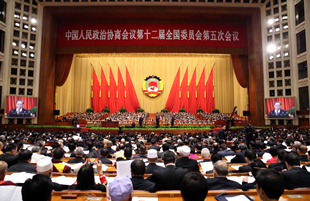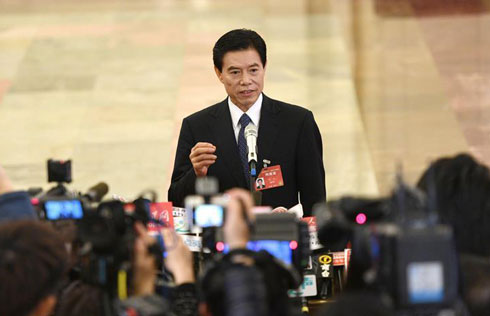



BEIJING - The Fifth Session of the 12th National Committee of the Chinese People's Political Consultative Conference (CPPCC) is set to convene Friday in Beijing, kicking off a political high season that will continue with the opening of the top legislature on Sunday.
More than 2,000 national political advisors are expected to offer proposals and insights for the government on running state affairs during this year's annual session. The event runs almost in parallel with the annual session of the National People's Congress (NPC), China's top legislature.
Together the dual meetings are dubbed colloquially as the "two sessions" in Chinese, and mark the most important two weeks in March on China's political calendar.
Following is a brief introduction to the CPPCC and its roles and functions on China's political stage.
-- What is the CPPCC and what are its functions?
In the words of top political advisor Yu Zhengsheng, the CPPCC is an organization in the patriotic united front of the Chinese people, an important organ for multiparty cooperation and political consultation under the leadership of the Communist Party of China (CPC), and an important means of promoting socialist democracy in China's political activities.
It is neither a body of state power nor a policymaking organ, but an important platform on which various political parties, people's organizations, and people of all ethnic groups and from all sectors of society work together in democratically participating in state affairs.
In practice, CPPCC members serve as advisors for the government and legislative and judicial organs, and put forward proposals on major political and social issues in the world's most populous nation and second largest economy.
The main functions of the CPPCC are to conduct political consultation, exercise democratic supervision and participate in the discussion and the handling of state affairs. Political consultation covers major principles and policies proposed by the central and local governments and matters of importance concerning political, economic, cultural and social affairs.
Democratic supervision means offering suggestion and criticism, as well as supervision over the implementation of the Constitution, other laws, regulations and major policies, and over the work of government agencies and their functionaries.
Participation in discussing and handling state affairs means organizing CPPCC members of various parties, people's organizations, people of various ethnic minorities and other social groups to take part in the country's political, economic, cultural and social activities.
-- Who are the members and how do they work?
CPPCC members come from China's various walks of life and ethnic groups.
At present, the CPPCC consists of representatives of the CPC and non-Communist parties, personages without party affiliation, and representatives of people's organizations, ethnic minorities and various social strata.
It also has the representatives of compatriots of the Hong Kong Special Administrative Region, Macao Special Administrative Region and Taiwan, returned overseas Chinese, and specially invited people.
Most of the CPPCC members are experienced political figures, social celebrities, and experts and scholars specializing in various fields.
They can put forward proposals to offer comments and suggestions on major political and social issues of the country to people's congresses and the government via the CPPCC.
A department in charge of handling proposals is obliged to give a reply to each proposal.
-- What is on this year's agenda?
Political advisors will hear and deliberate a report about the work of the Standing Committee of the CPPCC National Committee and a report on how the Standing Committee has handled proposals from CPPCC National Committee members since the previous session.
A political resolution is also expected to be adopted at the meeting.
The political advisors will be present at the fifth session of the 12th National People's Congress as non-voting participants, hearing and discussing a report on the work of the government and discussing a draft of the general provisions of civil law.
They will also hear and discuss work reports of the Supreme People's Court and the Supreme People's Procuratorate.
Related Stories