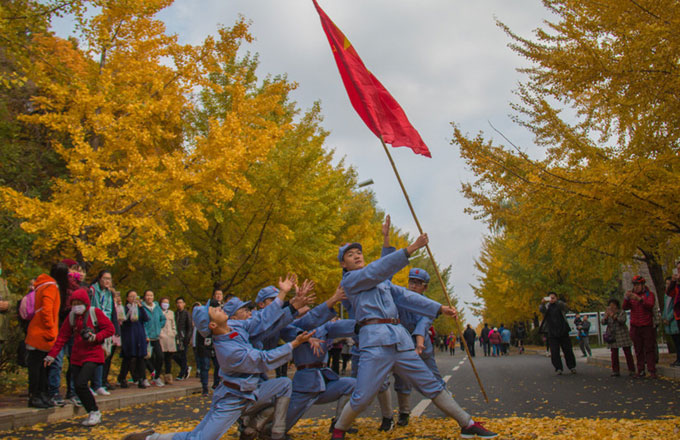


JINGGANGSHAN -- In front of Lai Puxiu's house, a group of "soldiers" in the octagonal hats and cloth shoes of the Chinese Workers' and Peasants' Red Army are pounding glutinous rice into a paste. A loudspeaker blasts out the revolution song "Ten farewells to the Red Army."
Nostalgia is in.
Lai, 58 and a villager from Jiangxi province, is preparing lunch for the "soldiers," all of whom are Communist Party of China officials on a team-building exercise.
"I charge each person 33 yuan ($5) for their meal," Lai, 58, said. "The food is simple and similar to that eaten by Red Army soldiers during the civil war."
The Red Army's Long March spirit -- working hard, fearing no sacrifice, and firm belief in communism and the ultimate victory of the revolution -- lives on in China and has become a mainstay of the new "long march" toward realization of the Chinese Dream.
A variety of public and private training agencies have sprung up in the heartland of the Communist Party of China's early revolutionary activities. They marshall officials, students and company staff from all parts of the country to take part in evocative activities in places like Jinggangshan, birthplace of the Red Army, and Ruijin, where the Long March began.
In Jinggangshan there are now more than 100 such agencies, bringing golden opportunities for people like Lai Puxiu who live hidden away in the remote Jinggang Mountains where tourists are hardly ever seen.
"In the past, we grew crops in a few fields and life was hard," Lai said. "But the agencies have brought so many visitors to our village that we started a catering business."
Jinggangshan's remote locale was a wartime advantage which later became a developmental stumbling block. In early 2014, the city had more than 17,000 people living under the poverty line, but as the training business booms, people are getting just a little bit richer.
Bashang Village where Lai lives received 3,000 visitors in 2012. This year it was more than 40,000. More than 13 million people visited Jinggangshan last year.
"WE ARE RED ARMY SOLDIERS"
Lai Puxiu get up early to buy ingredients from the nearest town, but also grows vegetables in her backyard.
"My husband and I usually prepare bamboo shoots, pumpkin, eggplant, fish and braised pork in soy sauce, Mao Zedong's favorite dish," Lai said.
While Lai prepares lunch, she has her visitors pound cooked glutinous rice into paste, a traditional way to make a local snack called "ciba." She charges each visitor 100 yuan for the privilege of making ciba and provides all the ingredients as well as the equipment for making it.
"Sometimes the visitors want to make lunch themselves, so we just let them," she said.
To add some razzmatazz to the visitor experience, Lai has decorated her house "Red style." Inside stands an old stove and a few rickety wooden tables. Outside, flutter a pair of duilian, hanging scrolls of inspirational couplets. In peak season, she can receive 40 visitors a day. This year, she has catered for about 900 visitors. Other families in Bashang have seen their income increase by an average of 18,000 yuan this year.
"We feel like real soldiers going through what the Red Army went through as they fought for our freedom," said a visitor on a management training event in the village. "These are things you can't get to experience in big cities."
Bashang is home to more than 630 registered residents, but about 400 of them are off seeking their fortunes in the big cities. The village's reinvention of itself as a training center has brought more than 100 of them back.
Understand the hardworking, selflessness spirit of the Red Army brings not only a better attitude to life, but is dragging people out of poverty.
By the end of 2015, China had 55.75 million people living in poverty, equivalent to the entire population of a medium-sized country and this month the State Council released a poverty action plan for the next five years, with a focus on old revolutionary bases.
Many villagers in Jinggangshan intend to take their businesses to the next level.
"I'm planning to accommodate people in my house, but it will take some time because I need to decorate the place first," said local villager Li Zhonglin. "I'm sure business in the village will just get better and better."