Comments
  Print
Print  Mail
Mail  Large Medium Small
II. Building and Development of China's Armed Forces
China's armed forces are composed of the People's Liberation Army (PLA), the People's Armed Police Force (PAPF) and the militia. They play a significant role in China's overall strategies of security and development, and shoulder the glorious mission and sacred duty of safeguarding national sovereignty, security and development interests.
Over the years, the PLA has been proactively and steadily pushing forward its reforms in line with the requirements of performing its missions and tasks, and building an informationized military. The PLA has intensified the strategic administration of the Central Military Commission (CMC). It established the PLA Department of Strategic Planning, reorganized the GSH (Headquarters of the General Staff) Communications Department as the GSH Informationization Department, and the GSH Training and Arms Department as the GSH Training Department. The PLA is engaged in the building of new types of combat forces. It optimizes the size and structure of the various services and arms, reforms the organization of the troops so as to make operational forces lean, joint, multi-functional and efficient. The PLA works to improve the training mechanism for military personnel of a new type, adjust policies and rules regarding military human resources and logistics, and strengthen the development of new- and high-technology weaponry and equipment to build a modern military force structure with Chinese characteristics.
The PLA Army (PLAA) is composed of mobile operational units, border and coastal defense units, guard and garrison units, and is primarily responsible for military operations on land. In line with the strategic requirements of mobile operations and multi-dimensional offense and defense, the PLAA has been reoriented from theater defense to trans-theater mobility. It is accelerating the development of army aviation troops, light mechanized units and special operations forces, and enhancing building of digitalized units, gradually making its units small, modular and multi-functional in organization so as to enhance their capabilities for air-ground integrated operations, long-distance maneuvers, rapid assaults and special operations. The PLAA mobile operational units include 18 combined corps, plus additional independent combined operational divisions (brigades), and have a total strength of 850,000. The combined corps, composed of divisions and brigades, are respectively under the seven military area commands (MACs): Shenyang (16th, 39th and 40th Combined Corps), Beijing (27th, 38th and 65th Combined Corps), Lanzhou (21st and 47th Combined Corps), Jinan (20th, 26th and 54th Combined Corps), Nanjing (1st, 12th and 31st Combined Corps), Guangzhou (41st and 42nd Combined Corps) and Chengdu (13th and 14th Combined Corps).
The PLA Navy (PLAN) is China's mainstay for operations at sea, and is responsible for safeguarding its maritime security and maintaining its sovereignty over its territorial seas along with its maritime rights and interests. The PLAN is composed of the submarine, surface vessel, naval aviation, marine corps and coastal defense arms. In line with the requirements of its offshore defense strategy, the PLAN endeavors to accelerate the modernization of its forces for comprehensive offshore operations, develop advanced submarines, destroyers and frigates, and improve integrated electronic and information systems. Furthermore, it develops blue-water capabilities of conducting mobile operations, carrying out international cooperation, and countering non-traditional security threats, and enhances its capabilities of strategic deterrence and counterattack. Currently, the PLAN has a total strength of 235,000 officers and men, and commands three fleets, namely, the Beihai Fleet, the Donghai Fleet and the Nanhai Fleet. Each fleet has fleet aviation headquarters, support bases, flotillas and maritime garrison commands, as well as aviation divisions and marine brigades. In September 2012, China's first aircraft carrier Liaoning was commissioned into the PLAN. China's development of an aircraft carrier has a profound impact on building a strong PLAN and safeguarding maritime security.
The PLA Air Force (PLAAF) is China's mainstay for air operations, responsible for its territorial air security and maintaining a stable air defense posture nationwide. It is primarily composed of aviation, ground air defense, radar, airborne and electronic countermeasures (ECM) arms. In line with the strategic requirements of conducting both offensive and defensive operations, the PLAAF is strengthening the development of a combat force structure that focuses on reconnaissance and early warning, air strike, air and missile defense, and strategic projection. It is developing such advanced weaponry and equipment as new-generation fighters and new-type ground-to-air missiles and radar systems, improving its early warning, command and communications networks, and raising its strategic early warning, strategic deterrence and long-distance air strike capabilities. The PLAAF now has a total strength of 398,000 officers and men, and an air command in each of the seven Military Area Commands (MACs) of Shenyang, Beijing, Lanzhou, Jinan, Nanjing, Guangzhou and Chengdu. In addition, it commands one airborne corps. Under each air command are bases, aviation divisions (brigades), ground-to-air missile divisions (brigades), radar brigades and other units.
The PLA Second Artillery Force (PLASAF) is a core force for China's strategic deterrence. It is mainly composed of nuclear and conventional missile forces and operational support units, primarily responsible for deterring other countries from using nuclear weapons against China, and carrying out nuclear counterattacks and precision strikes with conventional missiles. Following the principle of building a lean and effective force, the PLASAF is striving to push forward its informationization transform, relying on scientific and technological progress to boost independent innovations in weaponry and equipment, modernizing current equipment selectively by applying mature technology, enhancing the safety, reliability and effectiveness of its missiles, improving its force structure of having both nuclear and conventional missiles, strengthening its rapid reaction, effective penetration, precision strike, damage infliction, protection and survivability capabilities. The PLASAF capabilities of strategic deterrence, nuclear counterattack and conventional precision strike are being steadily elevated. The PLASAF has under its command missile bases, training bases, specialized support units, academies and research institutions. It has a series of "Dong Feng" ballistic missiles and "Chang Jian" cruise missiles.
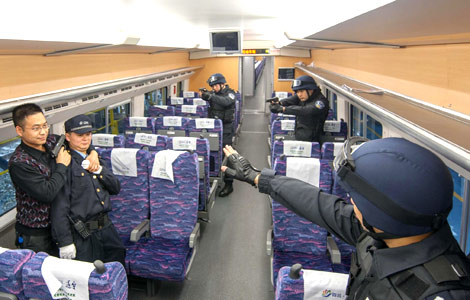
In peacetime, the PAPF's main tasks include performing guard duties, dealing with emergencies, combating terrorism and participating in and supporting national economic development. In wartime, it is tasked with assisting the PLA in defensive operations. Based on the national information infrastructure, the PAPF has built a three-level comprehensive information network from PAPF general headquarters down to squadrons. It develops task-oriented weaponry and equipment and conducts scenario-based training so as to improve its guard-duty, emergency-response and counter-terrorism capabilities. The PAPF is composed of the internal security force and other specialized forces. The internal security force is composed of contingents at the level of province (autonomous region or municipality directly under the central government) and mobile divisions. Specialized PAPF forces include those guarding gold mines, forests, hydroelectric projects and transportation facilities. The border public security, firefighting and security guard forces are also components of the PAPF.
The militia is an armed organization composed of the people not released from their regular work. As an assistant and backup force of the PLA, the militia is tasked with participating in the socialist modernization drive, performing combat readiness support and defensive operations, helping maintain social order and participating in emergency rescue and disaster relief operations. The militia focuses on optimizing its size and structure, improving its weaponry and equipment, and pushing forward reforms in training so as to enhance its capabilities of supporting diversified military operations, of which the core is to win local wars in informationized conditions. The militia falls into two categories: primary and general. The primary militia has emergency response detachments; supporting detachments such as joint air defense, intelligence, reconnaissance, communications support, engineering rush-repair, transportation and equipment repair; and reserve units for combat, logistics and equipment support.

Copyright 1995 - . All rights reserved. The content (including but not limited to text, photo, multimedia information, etc) published in this site belongs to China Daily Information Co (CDIC). Without written authorization from CDIC, such content shall not be republished or used in any form. Note: Browsers with 1024*768 or higher resolution are suggested for this site.
License for publishing multimedia online 0108263 Registration Number: 20100000002731