Comments
  Print
Print  Mail
Mail  Large Medium Small
Look at any survey on global financial or business centers and you will find Hong Kong, Singapore and Tokyo along with New York and London among the top 10.
"Each one has its own unique set of characteristics," says Doug Ferguson, partner in charge of KPMG's Australia China practice.
Hong Kong with its low tax, legal structure, yuan offshore services and ease of doing business has become the listing center for Chinese companies.
Tokyo, despite its low growth and the country being pushed into third place by China in terms of the size of its economy, is still home to some of the world's biggest banks and corporations.
 |
|
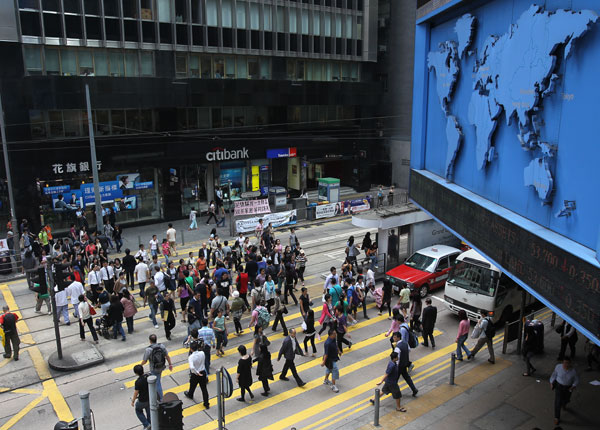
People crossing a street in Hong Kong's Central, where many offices of international banks are located.[Photo/China Daily] |
Singapore, for its part, sits just behind Switzerland as the world's second-largest global wealth management and private banking center.
A report prepared by the City of London on the challenges posed by Asian financial centers says the "international center of gravity is moving towards Asia".
Over the 15 years since the return, Hong Kong has not only maintained its competitive edge as Asia's leading financial center, it has, for the first time, eclipsed global giants UK and US in the World Economic Forum's Financial Development Report.
In survey after survey, Hong Kong, Singapore and Tokyo are never out of the world's top 10 centers for business and finance.
 |
In the Economist Intelligence Unit's recent Global City Competitiveness Index, Asia had three cities in the top 10 most competitive global cities in the world.
Singapore was third followed by Hong Kong in fourth place while Tokyo was placed eighth.
According to the EIU, since competitiveness is a "holistic concept", the findings went beyond economic strength, financial maturity and physical capital. Five other factors - institutional effectiveness, social and cultural character, human capital, environmental and natural hazards and global appeal were also taken into consideration for the overall ranking.
Between them, Hong Kong, London and New York control around 70 percent of the world's equity trading, according to GFCI.
Joseph Cheng, a political scientist with City University of Hong Kong, says the rise of China and subsequent growth in Asia has benefited all three Asian financial centers of Hong Kong, Singapore and Tokyo.
"I don't think anyone could deny that," he says. "Hong Kong, with its excellent legal and professional services, has probably been the biggest beneficiary while Tokyo still maintains strong economic ties to the region.
"Singapore has done well from China's boom but it has not been easy as it lacks that enormous economic hinterland (the Chinese mainland) which has been Hong Kong's distinct advantage."
K. C. Chan, Hong Kong's secretary for financial services and the treasury, was recently quoted as saying: "We are working very hard to maintain Hong Kong's competitive advantages and increase its capital markets.
"In the future years, developing Hong Kong's yuan business will give our financial center an additional boost."
KPMG's Ferguson says that since 1997, "China has confirmed Hong Kong's position as a leading international financial center and a safe place to do business".
He says China and Japan the second- and third-largest economies in the world in terms of their gross domestic product are a "massive pull for investor capital".
"While Hong Kong is seen as the center for Chinese IPOs it is also attracting mining companies from places such as Mongolia and Kazakhstan wanting to raise capital," he says.
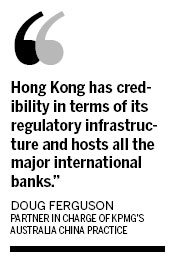
"Hong Kong has credibility in terms of its regulatory infrastructure and hosts all the major international banks. It has rule of law, low personal and corporate tax and no capital gains tax. All these add to Hong Kong's attractiveness."
Ferguson says another sign of Hong Kong's growing success since the return has been the number of European and US law firms setting up in the special administrative region.
"Evidence of that is the vacancy rate for A-grade commercial office space in Hong Kong, which is less than 2 percent," he says.
Tokyo is still an important financial center and Japan still has some of the world's biggest banks and corporations, he says.
"It is still a very high turnover/volume market, so there is still a strong reason for being there. The Tokyo exchange may not be as international as that of Hong Kong but it is still a powerhouse that cannot be ignored ... It is part of the establishment."
Singapore, he says, has had to fight very hard to establish itself as a competitor to Hong Kong.
"Singapore has achieved great success in certain industries such as property, transportation and high-tech manufacturing. And it has followed Hong Kong with low tax rates, low levels of regulatory oversight and a listing process that is quite simple."
karlwilson@chinadailyapac.com

 World's oldest male panda celebrates 30th birthday
 Rolls of grass: a beautiful landscape in Xinjiang
 Korla takes on a new look under ecological progress
 Villagers scoop up big profits by drying fish
 Seven killed as rainstorm triggers landslide in SW China
 People visit museum to mark 'Sept 18 Incident'
 Swans in Bayanbulak Wetland to start annual migration
 Fishing season begins in East China Sea
Copyright 1995 - . All rights reserved. The content (including but not limited to text, photo, multimedia information, etc) published in this site belongs to China Daily Information Co (CDIC). Without written authorization from CDIC, such content shall not be republished or used in any form. Note: Browsers with 1024*768 or higher resolution are suggested for this site.
License for publishing multimedia online 0108263 Registration Number: 20100000002731