

 Comments()
  Print
Print  Mail
Mail  Large Medium Small
BEIJING - As world waits anxiously for the true dawn of the global economic recovery, restoring stable growth has become the main topic at the ongoing Group of 20 (G20) summit. And to make this happen, it is more imperative than any other time for fair trade to be maintained.
In a speech delivered at the G20 summit, President Hu Jintao called for the resolution to create a free, open and fair global trade environment and oppose all types of protectionism.
 |
|
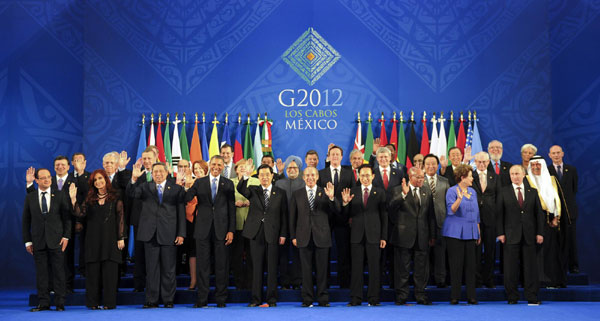
Leaders of the G20 nations pose for the family picture in Los Cabos June 18, 2012. [Photo/Agencies] |
"Efforts must be made to keep bilateral and regional trade open and inclusive, and safeguard the multi-lateral trade system," Hu said.
China's firm stance on fair trade is reasonable, as fair trade can fall by the wayside during economic crises, and this has indeed happened since 2008.
According to a World Bank report, protectionist measures surged as the financial crisis hit the global economy. Between November 2008 and March 2012, world governments adopted more than 1,000 discriminatory trade measures, of which most of them were G20 members.
China has become the biggest victim of international trade frictions for 17 consecutive years, a view given by the Chinese government and echoed by the Global Trade Alert, an independent think-tank on global trade. China has also come under repeated attacks on the issues of intellectual property rights and renminbi exchange rates.
The phantom of protectionism looms even larger this year, as the trade remedy investigations into Chinese goods increased 80 percent in the first three months compared to last year.
For the highly-integrated global economy, nations should bear in mind the "all in the same boat" psyche in this time of crisis. But instead, major western economies have resorted to protectionist measures to impair free trade -- giving the lame excuse of opposing inequality.
No doubt the prolonged sluggishness in the US and European economies and their high unemployment rates have brought about intense domestic pressure, notably in an election year for many countries. However, this should not be the rationale for raising trade barriers.
While the western economies have found faults with China's trade activities, they have selectively forgotten that they are the beneficiaries of trade with China, as the complementary trade structure has produced immense mutual interests.
According to a 2000-11 report released by the United States-China Business Council, US exports to China jumped more than five-fold over the period to $103.9 billion, while the growth rate for exports from China to other countries merely averaged a growth of 80 percent.
The report noted even in the worst days of the crisis, US exports to China recovered faster than those to other countries.
The same has happened between China and eurozone countries. EU officials expect China to overtake the United States and become the European Union's largest export partner. In 2011, China's exports to the EU grew 14.5 percent, while EU's exports to China increased 25.6 percent.
It is safe to say that China's fast and stable growth has empowered the global economy when the crisis hit. China has determined to transform its economic structure to make growth sustainable, with new energy and other emerging industries on the government's priority list.
However, China's moves have been harassed by protectionism. The latest example was the US government's anti-subsidy and anti-dumping probes into made-in-China solar panels, the first clean energy case that received trade remedy investigations.
As the architect of the current trade rules, the United States and EU enjoy abundant benefits while developing nations are relatively disadvantageously placed. They should be treated fairly and should not fall into victim of faulty rules.
The outlook of global economy is hard to say given the persistent European debt woes. In a time of crisis, fair trade is needed to get growth back on track.
Copyright 1995 - 2010 . All rights reserved. The content (including but not limited to text, photo, multimedia information, etc) published in this site belongs to China Daily Information Co (CDIC). Without written authorization from CDIC, such content shall not be republished or used in any form. Note: Browsers with 1024*768 or higher resolution are suggested for this site.
License for publishing multimedia online 0108263 Registration Number: 20100000002731 
