Comments
  Print
Print  Mail
Mail  Large Medium Small
|
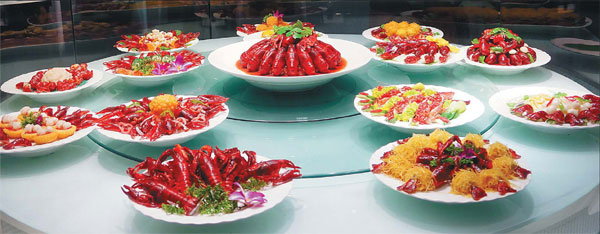
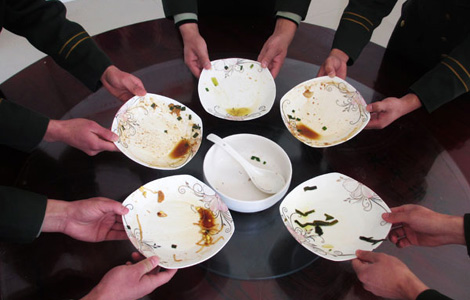
A crayfish feast on display at the Xuyi Crayfish Museum. Photos by Ye Jun / China Daily |
|
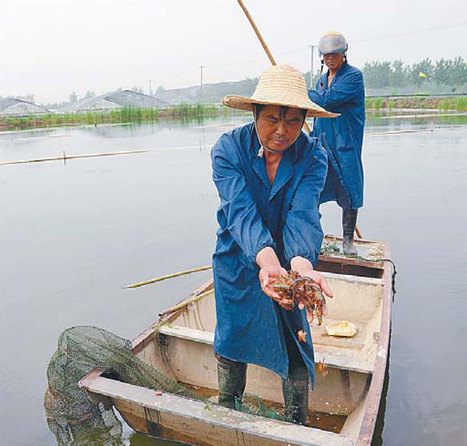
Xuyi has more than 13,340 hectares of crayfish farms. |
They are called crayfish, crawfish or yabbies, depending on where you come from, but in China they are celebrated as "little lobsters" and enjoyed across half the country. Ye Jun looks at the popular delicacy.
It is mid-June, and there are 10,000 eager diners gathered around a huge city square at the foot of Duliang Mountain in Xuyi, Jiangsu province. They are there to eat crayfish, the petite crustaceans that the Chinese call "little lobsters" or xiaolongxia.
At Xuyi, it is the start of the annual crayfish festival, which will last until the end of June. It has been held every year since 2000, and it is the residents' way of celebrating a produce that gives much of the population a steady income.
They have found fame as well as fortune. In 2008, 15,600 people seated around 2,380 tables consumed huge amounts of crayfish in the festival square, and created a Guinness world record.
The crayfish festival is very much like Spring Festival for local farmers and residents, and everyone from around Xuyi will come into the city specially to eat crayfish.
"Little lobsters" have become a major source of revenue here. Twenty percent of the average income, which is about 2,000 yuan ($326) a year, comes from crayfish farming and its supporting industries.
With a population of 780,000, more than 100,000 Xuyi residents are involved in the production and preparation of crayfish, with a turnover of more than 2 billion yuan ($330 million) per year.
The success of the crayfish industry in Xuyi has much to do with the invention of shisanxiang, "13 fragrant spices", a combination of herbs that are used to cook the crayfish, much like the lobster boil mix in the West.
Shisanxiang includes spices such as cinnamon, star anise, dried tangerine peel, Sichuan pepper, galangal and fennel among others. These spices are normally used in Chinese cuisine to flavor meat, and they are supposed to warm the stomach, countering the "chill" of seafood.
The flavors also whet the appetite, making diners want more.
The special cooking method, along with the spice mix recipe, has made crayfish chefs from Xuyi very popular exports to other parts of China, and the city has pressed this advantage by building training centers - both for farmers, and chefs.
Xuyi farms crayfish on a large scale, with more than 13,340 hectares of crayfish ponds. It is also helping authorities set up national benchmarks for crayfish farming. A traceable system is being implemented so consumers can find out where the crayfish they are eating comes from, and when they were harvested.
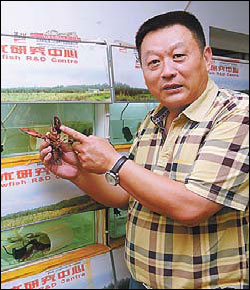
"At the farm ponds we do not need use any pesticide," says Lu Wei, general manager of River Red, a crayfish farm in Xuyi that produces 250,000 kilograms of crayfish. "That's because the crayfish has a strong constitution, and can resist natural calamity."
|
Lu Wei, is the general manager of River Red crayfish farm. |
"Crayfish have strong survival instincts and can live in poor conditions in small ponds. That gives rise to the misconception that crayfish live in unsanitary
"But only farmed crayfish that grow in clean water get big enough for the market." Liu manages a research center at River Red farm. Many big crayfish farms in Xuyi cooperate with professional research institutes like Liu's in Jiangsu. He says crayfish feed on aquatic plants, small fishes and snails. Crayfish farmers supplement feed with soybean cake, potato and corn. The crustacean is omnivorous and aquatic, and has relatively low mobility. They are active mostly within a small area and live in small caves on sloping banks where they dig holes as deep as 50 cm, to "get married". Besides farmed crustaceans, there are also crayfish that are caught from lakes and rivers in Xuyi. In other parts of the country, crayfish are raised in rivers and lakes. Liu says farmed crayfish have a clean and shiny belly. Crayfish is best prepared when very fresh, and one indication of freshness is when their tails are tightly curled up. Those with roe are always in great demand. Dong Keping, Beijing-based gourmet, says the crayfish was introduced to Japan by Americans, then brought to China by the Japanese in 1929. "It was used to feed bullfrogs, which the Japanese ate," he says. In China, crayfish farming didn't start until in the 1990s although it has now become a culinary favorite in Hunan, Hubei, Jiangxi, Anhui and Jiangsu provinces. Crayfish are best from May to October, but farmers in Xuyi have learned to coax them into production all year round, with the building of special greenhouses over ponds in the cooler seasons. Xuyi is currently China's biggest distribution center for crayfish and it expects its farms to up production to 10 billion yuan a year, and increase to 20,000 hectares over the next three years.
 Hani Rice Terraces wins World Heritage status
 Students sleep in gym to avoid heat in dorms
 'Americans In China' fashion show
 Couple's trip of seeking dreams
 Heavy rainfall floods SW China city
 Rehab helps prepare for life after addiction
 Ceramics for Chairman Mao auctioned for $1.5m
 Dog Meat Festival sparks concerns
Copyright 1995 - . All rights reserved. The content (including but not limited to text, photo, multimedia information, etc) published in this site belongs to China Daily Information Co (CDIC). Without written authorization from CDIC, such content shall not be republished or used in any form. Note: Browsers with 1024*768 or higher resolution are suggested for this site.
License for publishing multimedia online 0108263 Registration Number: 20100000002731