|
On the reform road to rural areas
2008-10-28
China Daily
|
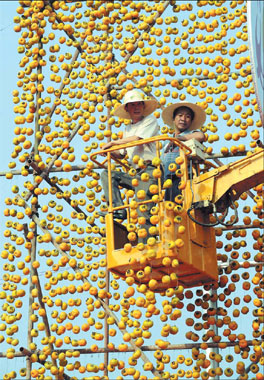
Villagers tend to persimmons hung up to dry from a bamboo scaffolding in Gongcheng, the Guangxi Zhuang autonomous region. [Xinhua]
|
The central leadership has promised longer-term land use rights and very tight land acquisition regulation to farmers as part of its rural reform. The proposals, still to be written into law, carry forward China's comprehensive land reform that began in the late 1970s with the dismantling of the commune system.
The intervening years have seen many rural youths join the workforce, driving the country's economic growth and making it the fourth largest economy in the world. But rural China is still home to 55.1 percent of the population, for whom land remains the greatest source of economic security.
Desperate move
The first stage of rural reform was implemented between 1978 and 1979. The process that continued for three decades saw the transformation of many a poor village into success stories.
Farmers responded with spontaneous initiatives to overcome the commune system's consequences, such as poverty and hunger. They leased out farmlands under their collective management to individual households, creating the concept of household contract responsibility system.
An agricultural boom followed, prompting the central government to introduce farm contract system across the country in 1982. As a system, it accorded due rights and rewards to farmers who produced more.
The Western media tended to call it "decollectivization" without realizing that the community ownership of land was never abolished. What was transferred for private control was the management right.
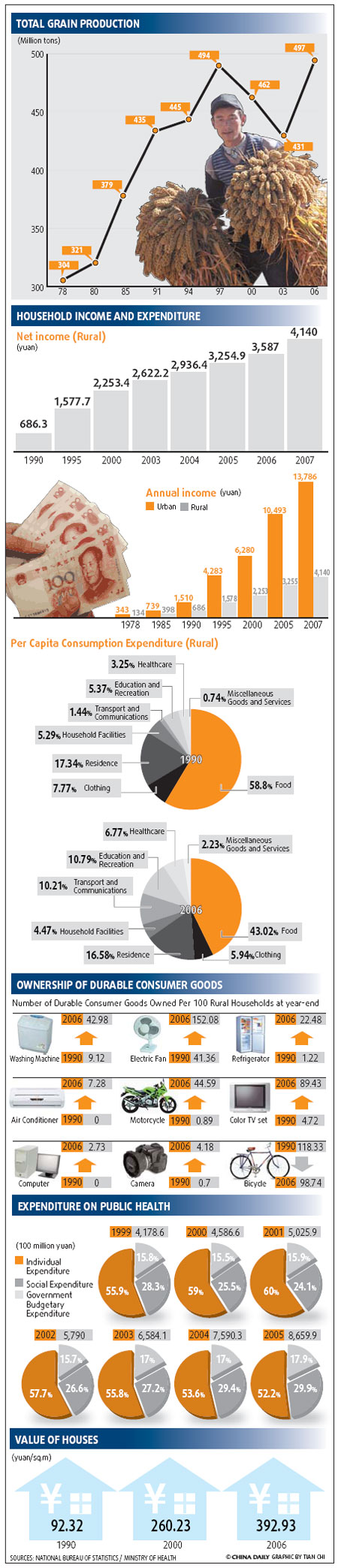
Agricultural production in the first half of the 1980s reached a rate several times higher than the average of many previous decades. Grain output touched 407 million tons in 1984 after a net increase of more than 100 million tons in just six years. Thus, feeding China, the world's most populous nation, no longer posed a problem.
Rural income, too, rose during the period. With a 150 percent increase in the average price of farm products, farmers began seeing up to a 250 percent rise in their per capita cash income.
But then oversupply caused a major setback in 1985. That caused a 6 percent drop in grain output and slowed down farmers' income, making farming a less profitable job.
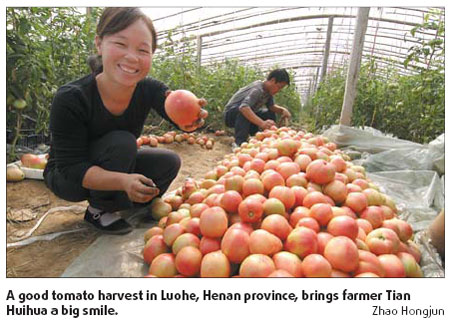
To further develop rural China, the government shifted its rural reform focus to creation of off-farm jobs in industrial units, run by village communities. Such units were called township and village enterprises (TVEs). Since TVEs were mostly small and flexible in organizational structure, they could compete quite easily against the then highly bureaucratized State-owned enterprises, especially when it came to meeting consumers' demand.
Quite a few Chinese consumer brands were set up by the TVEs in the 1980s, with most of them being based in the Pearl River or Yangtze River delta regions. Such brands include Konka TV sets, Midea electric cookers and Kelong refrigerators,
But the dream run of TVEs ended in the mid-1990s with the tightening of macro-economic control to curb the runaway economic growth. Most of the TVEs had to close shop. According to some estimates, about 30 percent of them went bankrupt, and many others, originally funded by community money, were restructured into private or joint-stock companies to build a more competitive ownership structure. Those that survived the credit crunch were the most competitive ones.
City rush
Though TVEs are largely a thing of the past now, they opened the road for rural people to get urban jobs. Youths from rural areas began flooding into cities in the mid-1990s, even though they faced a lot of restrictions and difficulties. Some estimates say about 200 million such people are now employed on long-term or short-term bases in cities.
After almost a decade, the hard-working and desperate people who leave their villages for "greener pastures" have started enjoying better social security benefits in the cities. Some of them can even admit their children to city schools and depend on local governments to get their wages and guarantee their medical insurance.
But compared to the blistering urban economic growth, rural development still has a long way to go. The urban-rural gap has been widening, and rural production has begun to stagnate. Rural communities have been complaining about insufficient input, and a large number of laborers in rural areas don't have jobs.
That's why the administration has launched a full-fledged reform plan for rural areas with the funds acquired from three decades of fast-paced industrialization.
New countryside
To tackle the problem, the central government quintupled its spending from 2002 to 2007 to boost rural infrastructure. Under its "new countryside program", it abolished the centuries-old rural agriculture tax, made the nine-year compulsory education free for rural children and subsidized agriculture production. All these have lifted farmers' living standards and provided them better social security.
Thanks to such efforts, the country saw four successive years of good harvest, a rarity since the middle 1980s. This is a boon today when global food prices are rising rapidly and an increasing number of non-farm units are eating up into the country's arable land.
Millions of farmers have achieved breakthroughs in political life. Direct elections at the grassroots level to choose village leaders have become stronger since the early 1990s. Villagers today have a stronger desire to promote self-governance. The practice, legalized in 1998, has been adopted by more than 80 percent of China's villages, with villagers choosing more than 611,000 committee leaders.
Many rural areas have also joined the reform for household contract system of the collective ownership of forest land. Forest cover across the country has increased rapidly, after the State Council guaranteed people longer-term ownership and decision-making rights last year.
Added to these, the central leadership's new proposals to carry forward rural reforms is likely to make life more comfortable for farmers and lift their living standards.
|


.gif)



.gif)

