
Great Wall without hordes
Updated: 2006-11-17 09:07
For many, a visit to China is not complete without stepping foot on the Great Wall. Over the years,the Wall has not only become a national patriotic symbol promoted by Deng Xiaoping's 1984 campaign, "Love China,Restore the Great Wall," but also a global symbol of humanity's capabilities and flaws. Due to its rich history and mythical status as the longest man-made structure (at 4,500 miles), the Great Wall has become an almost required sight-seeing stop for all travellers to China. With 4 million visitors a year, the irony is not lost in knowing that a Chinese fortification built for the purpose of protecting dynasties from tribal raids,now specifically caters to invading hordes of foreigners through tours and kitschy merchandise, such as "I climbed the Great Wall" t-shirts.
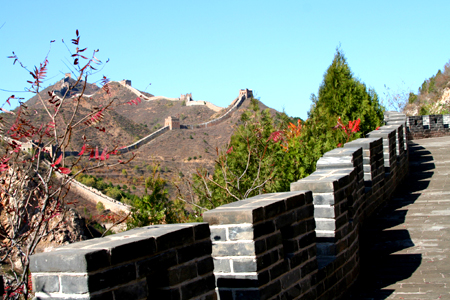 Picture taken on October 28, 2006 at Simatai. [Photo by Chinadaily.com.cn] |
Unique design
In China's haste to accommodate millions of visitors, great efforts are being made towards physical restoration, but frequently a sense of history becomes lost in the renovation process. For anyone intent on experiencing a section of the Great Wall that retains a more antiquated air, the Great Wall at Simatai remains one of the best options for spectacular views that preserve a sense of historical context.
Located in the north of Miyun County,130 kilometres northeast of Beijing, Simatai has been designated as a World Cultural Heritage site by UNESCO and has been described by some as the "best of the Great Wall." Originally built during the Northern Qi Dynasty (550-577) and then rebuilt during the Hongwu years of the Ming Dynasty (1368-1644) by Qi Jiguang,this section of Wall is known for its inimitable,unique design as one of the few areas to retain the original features of the Ming Dynasty Great Wall.
Simatai Great Wall is separated by the Miyun Reservoir into eastern and western parts. The western part is a comparatively moderate hike with 20 well-preserved watchtowers, while the eastern section with 16 watchtowers is much steeper with rocky terrain that makes hiking a more de-manding experience.
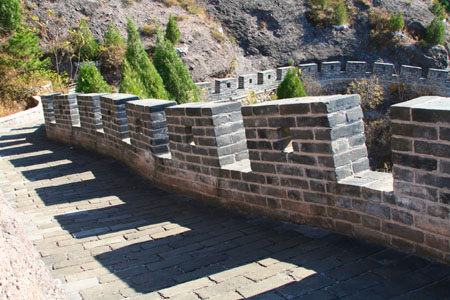 Picture taken on October 28, 2006 at Simatai. [Photo by Chinadaily.com.cn] |
Close to the Wall
Despite enduring two hours of petulant behaviour from my taxi driver - who never failed to remind me how far Simatai was or how he wished he was driving me to the much closer section of Badaling, the fresh air, stillness of the countryside, and breathtaking sight of the wall snaking into the mountainous distance made the drive immediately worth it. In addition, the Great Wall at Simatai was relatively people-free;I could count all the other travellers I saw the entire day on one hand. Granted, I went on a weekday; weekends are said to be more crowded due to tour groups that now frequent the Simatai section.
Hawkers, as in most places, are an inevitable problem, and I soon found myself with a personal entourage of three middle-age women trying to sell picture books and collect empty water bottles from me. They also imparted to me remarkable bits of wisdom such as, "this wall is very very old," and "there are many steps on the Great Wall," information that I hoped I would not have to financially compensate them for later.
Future travellers going to Simatai should be warned that revealing any Mandarin-speaking abilities (however small) will inevitably lead to having to listen to stories of hardship from locals for your entire hike; it's best to keep silent and just enjoy the view.




|
||
|
||
| Eating out:
Arriba arrives in the Wu
Bars&Cafes: Mare's milk a-go-go Weekend&Holiday: Ancient sites re-open after renovation Shopping: Jimmy Choo comes What's on: New shows on stage |
|
||
| Eating out:
Moroccan roll
Bars&Cafes: A boonna in training Weekend&Holiday: Pop power Shopping: LV boutique in E. China closed for disqualification What's on: Jazz-infused journey through Kunqu Opera |