Work needed to bridge wealth gap
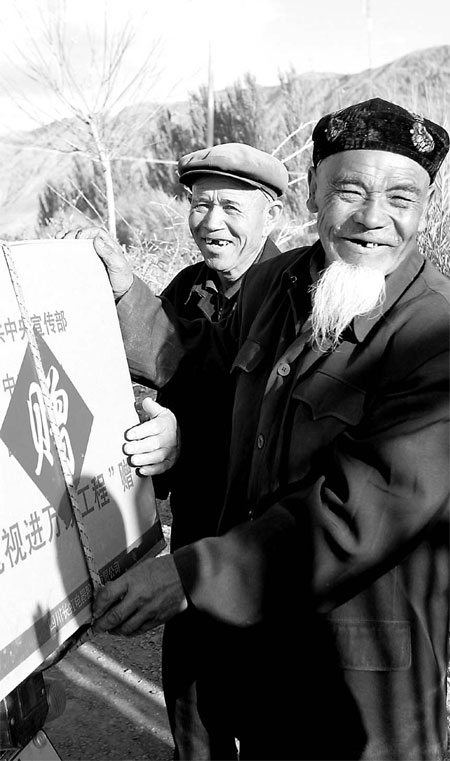 |
| Farmers in Hami, Northwest China's Xinjiang Uygur Autonomous Region, receive free TV sets on Thursday. A total of 1,000 free TVs have been given to poor local farmers and herdsmen in the Hami area.Zhu Zhenghua |
Meanwhile the Party's goal is to create a harmonious society by 2020.
That is to say, the next 13 years will see massive measures to remove "barriers and challenges" against social harmony. Leading domestic scholars say the starting point of every policy to achieve these goals should emphasize ensuring better livelihoods for all, especially the have-nots.
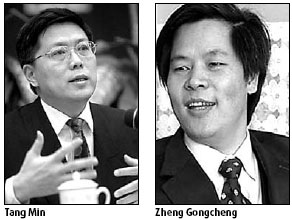
During an exclusive interview with China Daily, Tang Min, deputy secretary-general of the China Development Research Foundation, and Zheng Gongcheng, professor with Renmin University of China, both agreed that generating more jobs and bringing everybody under the social security umbrella should top the CPC and the government's agenda.
"The measures will help narrow the widening wealth gap between the rich and poor, which is the biggest threat to social harmony," said Tang, who moved to the foundation in August from a position as chief economist with the Asian Development Bank in China.
Holding a position as member of the Standing Committee of the National People's Congress, China's parliament, Zheng said "only by keeping the mission of ensuring a better livelihood for all in mind, can we help solidify the foundations of the Party."
Zheng said better livelihoods had different contents as time has moved on. In the 1980s or 90s when China's national strength was still relatively poor, better-off livelihoods mainly meant ample food and clothes. Now a better livelihood goes beyond that.
"At least basic education should become a right of all," said Zheng.
Zheng's suggestion coincides with the recent proposal from Tang's organization to redefine poverty and the poverty line. In China's anti-poverty report released last month, about 30 economists suggested the government raise its poverty line and include basic expenditure on education and medical services in the calculation.
Preliminary estimates have found China's poverty line - including annual average expenditure on education and health - should be around 1,100 yuan ($147) instead of the current 683 yuan. The current amount is the yearly sum needed to buy minimal food and clothing for survival.
Using the new standard, about 85 million Chinese are still in poverty, rather than the official figure of 23 million. "We should ensure people have basic education and healthcare," said Tang.
Tang said the country now has the capacity to redefine poverty and invest in the poor.
Zheng also suggested the leadership should change from the mindset that there is no economic gains when pouring financial investment into basic education and social security.
"Social gains will come in the long run: we changed the poor into potential human capital, and they will now contribute to society, making society more stable," said Zheng. "We need to promote this kind of cycle to realize social harmony."
Since 1978, China has used a package of measures to reduce poverty. Today the nation's 23 million poor people, a decrease from the 218 million in 1980, mainly live in mountainous regions and along the borders.
Meanwhile 70 percent of farmers are covered by a cooperative medical insurance network, according to the Ministry of Labor and Social Security. However, farmers on an average still have to shoulder at least half of their medical costs.
Zheng and Tang urged the country's leadership to adopt more concrete measures and ensure their implementation to curb destabilizing factors such as the growing income gap, which endangers social stability and public security.
The gap between rural and urban incomes has continued to widen despite rural income per capita rising by more than 6 percent annually in real terms.
China's Gini coefficient, an internationally accepted measure of income equality, was estimated by some research organizations at 0.47 this year. The "alarm boundary" is 0.4. The coefficient was 0.3 in 1982 and 0.45 in 2002.
"Inequality is evident and concrete help should be immediately extended to those on the lower levels of the social ladder," said Tang.
(China Daily 10/15/2007 page19)