Notes on a new agenda for moral education
The recent earthquake in Sichuan province and the preceding unpleasant events surrounding the Beijing Olympic torch relays abroad have undoubtedly aroused great patriotic passion in the Chinese public, which is finding its varied expressions in words, moods and deeds.
After the major earthquake, tens of thousands of volunteers flocked to the afflicted regions to offer their help, buttressed by echoing online sentiments from even a greater number of people from all walks of life. And during the earlier torch relays abroad in April, numerous Chinese students studying abroad and people from the overseas Chinese communities gathered to protest against anti-China deeds and to lend their moral support to Beijing, to China, for that matter.
If we allow our memories to go further back , we could trace this passion all the way to the beginning of this year, when unprecedented snows and an icy weather shrouded a greater part of southern China. During that period too all kinds of help and support came to the afflicted regions from all over the country, and even from the overseas Chinese. All of these amounted to a special kind of nobility of the heart - love and care for one's country and for one's fellow countrymen.
Here a question presents itself. Could such nobility be a sort of spiritual energy that finds continual and natural release during days of less stress, less difficulty, i.e. in ordinary days which make up most of our lives? In other words, could a noble character become part of the commoner's inner being, of his nature? That is evidently a useful and meaningful question that demands thoughtful answers.
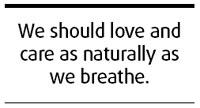
No doubt, crises tend to throw people together to act in unity. But compared with days of major crises such as the ones mentioned above, most of our days are normal, peaceful, and even boring. But even during such ordinary days, we need the spirit and love and care to best discharge our duties and fulfill our obligations. The idea of a harmonious society implies that we should love and care as naturally as we breathe.
Take a much-criticized example. We learn through media reports that once in a certain city, an aged man fell on the ground and lost consciousness or otherwise injured himself. A kind-hearted young man came along to help and deliver him to the hospital for treatment. But upon recovery, the injured person accused the helper of having deliberately pushed him over and injured him, demanding large amounts of financial compensation. In the ensuing lawsuits, the poor kind young man, who could not produce enough evidence to prove his innocence, lost the case. Since negative news tends to spread faster and wider than positive news does, such incidents, though rare, once reported, really chill the hearts of many otherwise compassionate people. Should they encounter similar situations, some of them might step back and decide to help in a guarded way, and thus miss the best chance to rescue those in urgent need.
Reading such accounts occasionally, one is tempted to ask such a question. Are our people not able to love and care in all circumstances? Do they not subscribe to the ideal of charity? Of course they potentially have the ability to love and care. Of course they believe in charity. One glance at the innumerable scenes on TV featuring the help offered to the people rendered homeless by the earthquake and you will believe what I say. But the question remains and haunts us: how do we make sure that the same kind of spirit manifests itself as frequently and naturally during "normal" circumstances?
Perhaps the riddle can be unraveled through tackling our way of moral education. Some scholars and education experts point out that we should modify the current method and order in which moral education is imparted. Little children should begin by learning the basic rules governing daily life, which may help them form healthy habits and cultivate a fundamental respect for life and for others - in short, to love oneself and others; secondary-school students can learn about the duties of a Chinese citizen, including the duty to love one's country; college students can be taught to sacrifice themselves for the good of others - a truly noble ideal. But this should be a process in which the elementary ideals enlarge themselves to include the higher ideals. Ordinary virtues attainable by everybody should not be neglected; noble virtues attainable through painstaking efforts should not be overly magnified; while "godly" virtues attainable only by a few people with special moral gifts through extraordinary sacrifices should not be overly promoted. Otherwise, some people in society might be confused as to what should be their moral and spiritual guide for action.
If we could follow the above-mentioned process of moral education and begin cultivating healthy and responsible habits of daily living among little children, we can better count on their growing up to be responsible citizens with a sense of national mission in general and a sense of compassion for other lives in particular.
Certainly, this is easier said than done. But education begins with a message, followed by a role model, both of which, once combined, may amount to a kind of spiritual power. Choosing the right message and right model for the right group of targets is very important. The media and educators can begin by "telling" the stories of heroes basically on a par with the target audience, who should then feel that it is possible to emulate such examples. Organized actions should then be taken in "doing" good deeds in the spirit of the heroes. Finally, and most decisively, the spirit of the heroes needs to be internalized by the educated as a part of their "being". Only in such consummation of words into actions and understanding do we fulfill the highest goal of moral education - to let nobility become our nature.
In a book entitled Reviving the National Soul: Communication Campaigns and National Integration in China's Market Economy Era, the author argues that when the "physical being" of an individual, an institution or a nation is bruised or wounded (such as the recent case in which China was hurt by the major earthquake), his/its "soul" or "spirit" tends to be bared and revealed.
To our comfort, the recent cases of Olympic torch relays and the rescue after the earthquake have demonstrated that the Chinese nation and the Chinese people have a healthy and strong "soul" and a loving and caring "spirit." This should be magnified in ways easily understandable by ordinary people so that in the days to come, such a spirit can be woven into the skein of our daily lives during ordinary, uneventful days and become part of our inner being, which will manifest itself without major external stimulations such as a shock or a quake.
The author is a professor with Xiamen University
(China Daily 06/19/2008 page8)