Costa Rica leap-frogs competition in ecotourism
|
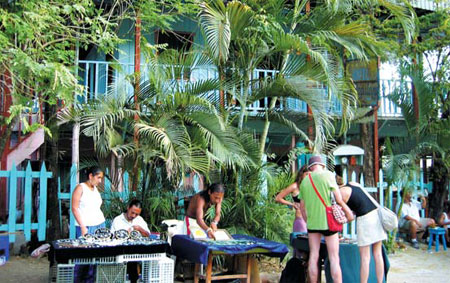
Tourists at a small stand at the resort of Montezuma in Costa Rica. DPA |
PUERTO VIEJO DE CARAPIQUI: A world leader in ecotourism, Costa Rica is a country that promotes nature conservation instead of the ruthless exploitation of natural resources, and wildlife-watching instead of competitive drinking at the side of hotel pools.
The Central American nation is considered a role model in this respect, and its many natural treasures - including crater lakes, smoking and dormant volcanoes, Pacific and Caribbean beaches, and rain forests with howler monkeys, toucans and sloths - attract more tourists every year.
Even little creatures are big stars in Costa Rica. Take, for instance, a red poison dart frog spotted in the bushes by the Sarapiqui River. It looked up to see two cameras pointed in its direction. Barely as big as a thumb, the pipsqueak puffed out its throat mightily.
Two tourists from Germany, along with the rest of the small group, heeded the advice of Karla Barquero, their guide: They kept still and photographed without flashbulbs. The brightly colored amphibian, normally quite shy, seemed to appreciate this behavior and did not bound away.
A 28-year-old biologist, Barquero pursued university studies in the German city of Ulm and now offers night tours for bat-watching. She stopped at a suspension bridge spanning the river and pointed downward. There in the rain forest, amid the wild orchids, aerial roots and ferns, hung a sloth on a branch of a giant, moss-covered tree.
Its claws gripped the branch firmly, and its eyes were closed. Living up to its name, the animal did not let the intruders disturb its nap. The tourists were impressed.
"This is better than at the zoo," said a teacher from Rome.
A two-hour riverboat trip that began at the town of Puerto Viejo de Sarapiqui presented animal highlights every minute. Howler monkeys, defending their territory, whooped and hopped from branch to branch. The head of a caiman poked out of the water, and a pair of toucans displayed their yellowish-green bills in the verdant treetops.
Juan Arrieta, the boat's captain, could see that his passengers were satisfied. But he had a mild complaint. "Nowadays," he said, "I've got to start the boat earlier - about 7 or 8 am - to show as many animals as I used to." The riverbank was much more pristine 15 years ago, before the construction of various houses and huts.
Residents confirmed that toucans, at least, could be seen in greater numbers before. Some of the exotic birds have retreated from this section of river to quieter areas. They have plenty of space: About 30 percent of the "Rich Coast," the English translation of the Spanish name "Costa Rica," is protected by law.
The Sarapiqui district, which can be reached from San Jose, the Costa Rican capital, via a road through Braulio Carrillo National Park, lies in a fertile lowland plain. Cattle graze on the pastures, and mangoes, avocados, papayas and plantains thrive in the gardens and on the plantations. There are also areas where pineapples are grown.
Prudent "Ticos," as Costa Ricans call themselves colloquially, as well as some foreigners operate eco-lodges and hotels that use solar energy, convert refuse into biogas, and filter water for reuse.
At the Tirimbia Rainforest Center, west of Puerto de Sarapiqui, Willy Aguilar carefully used a knife to cut four yellowish green cacao pods from a cacao tree. Aguilar, 28, and his team at the non-profit center show visitors how the region's original inhabitants produced cocoa drink and raw chocolate 500 years ago. Harvesting and roasting cacoa seeds is a time-consuming process.
"The sweetest experience in the rain forest" is an enticing slogan, but many visitors grimaced at the first taste. Cocoa in its early stages is grainy and not sweet. A second version, with sugar added, was more in tune with what modern palates expect.
The Tirimbina staff have their hands full. So do their colleagues at the nearby La Selva Biological Station, which provides accommodation - mainly to people interested in science - for a night, a week or even a year.
For its part, the Sarapiqui Conservation Learning Center has programs geared to women's groups, schools and kindergartens, among others.
Apart from ecologically-oriented activities, plenty of fun and sporting adventures await tourists in Costa Rica. Hikes to volcanoes, kayak trips and white-water rafting are just a few of the many possibilities.
DPA
(China Daily 02/02/2009 page10)