Asia-Pacific has vital role in climate change
US President Barack Obama laid out his ambitious three-point plan to revitalize America before the Congress on Feb 24. The policy, in which a "new energy strategy" tops the agenda, aims to break Europe's dominance over the climate change framework and assume for the US the leadership of the global green movement. In short, it is expected to create a new world green order.
Obama's new policy is likely to create fundamental changes and opportunities for the Asia-Pacific region, offering a new threshold for energy technological structure. Changes in the technological structure are closely linked to the global division of industries and labor, and would trigger a shift in international geopolitics.
The US' four leading energy technologies - nuclear, solar, biofuel and dumping carbon dioxide (CO2) underground - will create new opportunities for Asia Pacific in global industrial competition. A new energy system is likely to take shape in the Pacific Rim as Washington implements Obama's green policy, especially after the formation of US-led international nuclear energy cooperation. But establishing a new world environmental order led by the Asia-Pacific region will depend a lot on how China's environment market and innovative technologies are explored and how a Sino-US strategic partnership in new energy is built.
Obama's "green policy" is based on his keen observation of global climate politics. He devised his strategy to fight climate change in the new era during his election campaign by emphasizing long-term investment and research in new and clean energy, and promising to enforce competitiveness and regain the leadership in this field.
His policy is based on three factors that would ensure a strategy to fight climate change. The first is to set mid- and long-term goals: reducing greenhouse gas (GHG) emission by 14 percent by 2020 and by 83 percent in the next 30 years. Second, it makes 2005 - and not 1990 as set by the European Union (EU) - the base year for reduction of GHG emission. Third, it sets the upper limit for GHG emission and a fixed timetable for its reduction.
Obama expects to introduce the carbon cap and trade system, and have it in place by 2012. And he hopes to make the government financially sound to support research in and development of low carbon fuel by auctioning the US' emission trading credits.
Based on the Bali roadmap, approved by the 2007 UN Climate Change Conference, the agreement to replace the Kyoto Protocol after it expires in 2012 will be finalized at the Copenhagen conference at the end of this year. The Dec 7-18 conference will map out the post-Kyoto emission reduction plan, too. The negotiations in Copenhagen are important because they will throw up the leader in the post-Kyoto era, and the winner would be a country with a sound climate policy and emission reduction plan. Obama's move seems to be targeted at the Copenhagen conference, for he has already put forward a mature plan highlighting US characteristics and demonstrating his ambition of regaining the leadership of the world environmental movement.
Former US president Bill Clinton signed the Kyoto Protocol on behalf of his government way back in 1997, but he had to withdraw his assent after the House of Representatives vetoed it. The EU was prompt to step into the void created by the US' withdrawal and became the leader in the fight against global warming.
The EU started setting its own environmental regulations in the late 1990s. It began challenging the US' international quality standard by launching its own certification system for production, commerce, investment and other activities. And it initiated the EU Emission Trading Scheme in 2005, replacing the US dollar with the euro as the only currency to be used.
Two years later, it took advantage of being the host of the G8 Summit and tried to make its CO2 emission standard applicable across the world. For example, it declared that aircraft and ships that didn't meet EU environmental standards would not be allowed to land and dock in Europe.
Obama now intends to reverse the situation and break EU's dominance of the climate change framework through his three-point plan. First, he wants to replace the emission reduction base year of the EU by his own. Second, he advocates the use of US dollars as the currency of trade. And third, he expects to auction the US' emission credits and continue innovating low-carbon technology to threaten the EU's leadership. All this makes a US-EU tussle inevitable.
After the economic flu spread to Europe, especially after its major countries were hit by depreciating currencies, falling productions and surging deficits, the EU-dominated climate framework started weakening. Countries like Italy and Germany, which used to pride themselves as pioneers in reducing emissions, suddenly began giving the environment the short shrift and started helping high-emission industries at home, thus putting the EU framework at stake.
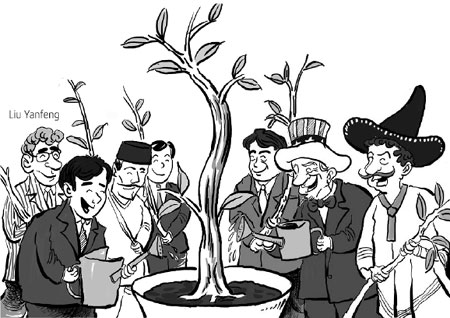
Since Asia Pacific has begun to create a bigger impact on the politics of climate change, a Sino-US collaboration based on mutual benefit could make it possible for the region to lead the fight against global warming.
The author is a researcher with the China Institute of Contemporary International Relations.
(China Daily 04/10/2009 page9)