Price hike right move to save water resources
When tap water first came to Shanghai in 1883, it was given the name zi lai shui, meaning pretty much water that comes naturally and without cost.
But some 20 million local residents are now going to learn that tap water not only costs money, it is also expensive.
Ever since the municipal development and reform commission announced last week two proposals to raise tap water prices, all eyes have been on the public hearing over the issue scheduled for April 27 to be attended by 21 representatives, including 10 local residents and officials from the local People's Congress, consumer rights association and trade unions.
There is no doubt that the timing for the proposed price hike is much less than ideal, considering how many local residents are feeling the pinch of economic hardship brought about by a global recession. A price hike is the last thing people would expect.
Of course, Shanghai is not alone. Several other Chinese cities, such as Nanjing, Tianjin and Lanzhou, have raised tap water prices in the last few months. Several others, such as Guangzhou and Shenyang, are also planning to do so in the coming months.
At the moment, Shanghai's tap water price is the lowest among 36 major Chinese cities. The current price of 1.84 yuan per cubic meter was set in 2001, while in Beijing it costs 3.70 yuan.
Shanghai did try to raise water prices for institutional users previously. But the arrest of former Shanghai Party secretary Chen Liangyu in September 2006 has slowed down a number of related measures up for discussion.
The concern and opposition from local residents on hiking water prices or other commodities are both predictable and understandable, but raising the price of tap water - a scarce resource in China - is truly based on solid rationale both in Shanghai and other cities.
It is not just because many waterworks are operating under great financial strain, making production expansion and technical facelifts more difficult, it is also that, like many Chinese cities, Shanghai is a city short of quality water to sate our thirsty throats and irrigate our farmland, despite the fact that the city sits along the Yangtze River and is bisected by the Huangpu River.
Nationwide, the situation is much more appalling. About two-thirds of Chinese cities suffer from a shortage of water. Each year the shortage across the country amounts to 40 billion cubic meters. About 200 million Chinese still do not have access to safe drinking water. And drought hits large areas of farmland in north China annually, according to data from a national water resources conference in mid-February.
"The dire situation requires us to impose a stringent management system of water resources," said Minister of Water Resources Chen Lei at the meeting.
A low tap water price surely will only encourage those people and institutions that waste water resources, simply because it comes naturally and comes at no or little cost. Just imagine how many people still do not turn off the tap while brushing their teeth, or how much water is squandered at car wash stations and bath houses. Even our toilets are often flushed with more water than what is necessary.
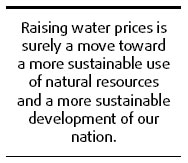
So raising tap water prices would make more people think twice about using - or wasting - this scarce and valuable resource. This is surely a move toward a more sustainable use of natural resources and a more sustainable development of our nation.
But even with a sound rationale, higher water prices, which could be raised as much as 50 percent in Shanghai this time according to the proposal, should not strike a hard blow to the normal life of the majority of local residents, especially underprivileged families.
That is why a tiered pricing system, one of the two proposals by the municipal development and reform commission, should be welcomed. It allows the majority of local families who use less than 15 cubic meters of tap water to feel less pressure from the hike, while major users have to pay more. In fact, tap water for car wash stations, bath houses and luxury hotels should be made much more expensive in order to send a clear signal to society - that wasting water resources is a crime committed not just against our nation now, but to our future generations as well.
By raising prices, the Shanghai water authorities should be able to do a better job in providing cleaner and better drinking water. This will help create a win-win situation for residents, water authorities and our country.
(China Daily 04/16/2009 page8)