World faces more pressing problems than emissions

Media organizations in wealthy countries regularly send forth reporters to find "victims of global warming". In dispatches from the Pacific islands, Bangladesh or Ethiopia, journalists warn of impending calamity. Global warming is the most horrific challenge facing these regions, we are told. Its resolution is vital.
But seldom do we hear from the local people who are said to be in danger. These people are not voiceless; we just pay no attention to what they say.
The Copenhagen Consensus Center set out to ask people in global-warming hot spots about their fears and hopes. In Mojo, central Ethiopia, our researchers met Tadese Denkue, a 68-year-old former soldier with no regular income. "I never know when I will be able to buy myself some food," he said. "I only know that I suffer a lot. This is not a decent life."
Tadese has never heard of global warming. When it is explained to him, he is dismissive. He has more immediate concerns: "The first thing I need is food, and then a job."
Tadese is suffering from his second bout of malaria this year. He has lost count of how many times he has contracted the disease. Our researcher accompanies him to a free clinic. The electricity is not working. A doctor concedes that most patients are sent home without testing or treatment; the clinic has run out of medicine.
The threat of more malaria has been used to argue for drastic carbon cuts. Warmer, wetter weather will improve conditions for the malaria parasite. Most estimates suggest that global warming will put 3 percent more of the earth's population at risk of catching malaria by 2100.
The most efficient, global carbon cuts - designed to keep temperature increases under 2 C - would cost $40 trillion a year by 2100, according to research by Richard Tol for the Copenhagen Consensus Center. In the best-case scenario, this expenditure would reduce the at-risk population by only 3 percent
In comparison, spending $3 billion a year on mosquito nets, environmentally safe indoor DDT sprays, and subsidies for effective new combination therapies could halve the total number of those infected within one decade. For the money it takes to save one life with carbon cuts, smarter policies could save 78,000 lives.
Of course, malaria is far from the only reason we worry about global warming. Twenty kilometers from Mojo, our researcher met Desi Koricho and her eight-month-old son, Michel. Every two weeks, Desi walks four hours to take Michel to a health center. After two months of malnutrition treatment, Michel has grown a lot but remains half the normal size of a child of his age.
Michel is not Desi's biological child. She took him in after his father committed suicide and he was abandoned. Desi is likely to be suffering from undiagnosed malnutrition herself. It is rife here. There are no roads, electricity or other infrastructure. Conditions are cramped and unhygienic. "We need everything," Desi said. Solving the malnutrition challenge would be a good start.
Campaigners across Europe and the US use the threat of starvation to argue for drastic carbon cuts. For most regions, weather changes will increase agricultural productivity. Cruelly, this is not the case for parts of Africa that are already suffering from hunger.
But, as with malaria, all the evidence shows that direct policies are much more effective than carbon cuts. One effective, under-appreciated intervention is providing micronutrients to those who lack them. Providing Vitamin A and zinc to 80 percent of the 140 million or so undernourished children in the world would require a commitment of just $60 million a year. For $286 million, we could get iron and iodine to more than 2.5 billion people.
The choice is stark: for a few hundred million dollars, we could help almost half of humanity now. Compare this to the investments to tackle climate change - $40 trillion a year by the end of the century - which would save a hundred times fewer starving people (and in 90 years!). For every person saved from malnutrition through climate policies, the same money could have saved half a million people from micronutrient malnutrition through direct policies.
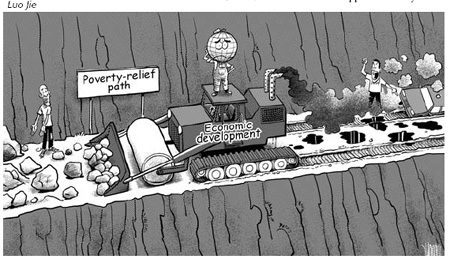
Some argue that the choice between spending money on carbon cuts and on direct policies is unfair. But it is a basic fact that no dollar can be spent twice. Rich countries and donors have limited budgets and attention spans. If we spend vast amounts of money on carbon cuts in the mistaken belief that we are stopping malaria and reducing malnutrition, we are less likely to put aside money for the direct policies that would help today.
Indeed, for every dollar spent on strong climate policies, we are likely to do about $0.02 of good for the future. If we spend the same dollar on simple policies to help malnutrition or malaria now, we could do $20 or more good - 1,000 times better, when all impacts are taken into account.
On Mount Kilimanjaro in Tanzania - where the effects of global warming can already be felt - our researcher encountered 28-year-old Rehema Ibrahim. Rehema was divorced by her husband and disowned by her family after she failed to give birth to children. To find out if she was the cause of the infertility, she started sleeping with other men. She is now HIV-positive, an outcast in a terribly poor society.
Rehema has noticed changes in the weather. She says that the snow and ice have been melting. She knows what our researcher means by "global warming". But, she said: "The issues I am experiencing have greater priority. HIV and the problems it is causing are greater than the (receding) ice."
Campaigners for carbon-emission reductions regularly highlight the melting snow and ice of Mount Kilimanjaro. But we need to pay as much attention to the people living in the mountain's shadow.
The author is director of Copenhagen Consensus Center and author of Cool It: The Skeptical Environmentalist's Guide to Global Warming. Project Syndicate.
(China Daily 12/01/2009 page9)