Financial reform necessary for change

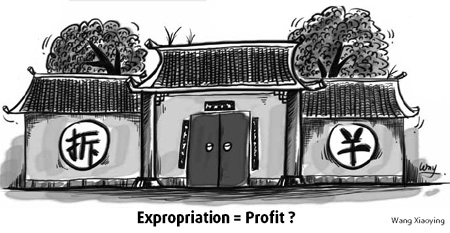
The expropriation of real property has become a major obstacle in the country's march toward building a harmonious society. Some local governments and real estate developers have been infringing upon property owners' rights and interests, which has led to violence and created social tension.
The Law on Urban Planning (LUP), and the Urban Housing Demolition and Relocation Management Regulation, promulgated by the State Council in 1991, began the institutional building of the demolition process. But the regulation has created controversy from its very inception.
Moreover, after being revised in 2001, the regulation has deviated further from the law and the Constitution, resulting in a number of violent incidents after people could not get reasonable compensation for evacuating their houses.
The problem of the demolition regulation or even the demolition system, however, is not very complex. In fact, after the promulgation of the Real Right Law in 2007, Wang Guangtao, then minister of construction, said the demolition regulation was not in line with the relevant provisions of the new law.
Regulations that conflict with the basic law have no validity. The huge land-based revenue and rapid development of the profit-churning realty market have increased the pace of house demolitions in urban areas.
People get excited while talking about the possible abolition of the demolition regulation by the State Council. But I think it is not enough to just revise or abolish the regulation, because it is only one of the causes behind the demolition chaos.
A legal system should contain multi-layered norms, and the demolition and relocation system does have them in terms of the Constitution, law, rules and regulations. And even though the demolition regulation, as a core administrative rule, is inconsistent with higher norms including the Constitution, the infringement upon property owners' rights cannot be blamed solely on the wrong provisions in the regulation.
Provisions in some other laws and regulations are unconstitutional and disadvantageous to homeowners, too. For example, take the case of Tang Fuzhen, who self-immolated herself in Chengdu. The local authorities applied the LUP and the Law on Urban and Rural Planning (LURP) to not only declare as illegal her building, which was built before the LURP was promulgated, but also to get a demolition permit from the government in order to avoid judicial examination as required by the LUP.
The LURP's 31st provision, which stipulates that old urban areas with dilapidated buildings and backward infrastructure could be demolished, gets around the limitation of the Constitution and other laws. This has led to more and more large-scale demolition and rebuilding in old city zones.
There are two reasons why the rule of law in China cannot protect people's property rights in case of expropriation.
First, some local officials believe in the wrong notion that "government manages cities". They pay no attention to people's lawful rights and don't help them share the fruits of development. Instead, such officials overdraw on their credibility to carry out large-scale demolitions in order to earn huge sums through land auctions. They thus need the demolition regulation as their "talisman".
Behind the so-called "demolition according to law" premise is the local governments' scramble to make money at the cost of the people. This is the main reason why the real property expropriation system has not yet normalized.
Second, with preferential policy support, the real estate sector has become the pillar industry of the national economy, giving rise to a very powerful interest group. Regardless of disturbing residents' normal life and wasting huge resources, such groups control city planning to serve their own interests. Not surprisingly, house demolitions have constituted 40 percent of the basic needs of the real estate market.
Therefore, I believe it is not enough to only revise the demolition regulation, as some scholars have suggested. Instead, we should change the entire real property expropriation system in order to promote reform in the political system.
First, we should abolish the Urban Housing Demolition and Relocation Management Regulation and formulate a "real estate requisition law" in line with the Constitution. The Law of Land Administration, Law on Urban Real Estate Administration and the LURP should be revised, too, according to the Constitution and the Real Right Law to make it difficult for local governments to make huge profits by demolishing buildings and selling the vacated land. And while enacting new regulations, the authorities should pay more attention to their enforcement aspects.
Second, the powers of local officials have to be curbed and local authorities should seriously put the scientific outlook of development into practice and enforce the law for the people. And people's right of self-defense should be protected and forced demolitions prevented.
Third, the idea and practice of land-based revenue and "government managing cities" should be abandoned and the finance and taxation system reformed to reduce the impulse of grassroots governments to demolish houses to make money.
The author is head of Beijing-based Cailiang Law Firm.
(China Daily 12/22/2009 page9)