Free trade easy to swear by but hard to pratice
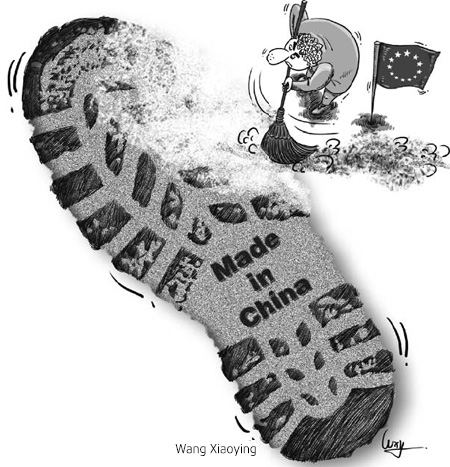
There have been countless appeals that all countries should practice free trade for the common interest of the world. But we still see global trade frictions caused by trade protectionism. Since China is a fast developing nation, it suffers a lot from protectionist measures adopted by other countries.
So why is it easy to swear by free trade but hard to follow its rules? Economists who support free trade always use comparative advantage as a weapon against protectionism. Every country has its comparative advantage in producing some specific product or the other. If a country focuses on producing goods with comparative advantage and then exchanges them with others, it will benefit from trade. On the contrary, any restricted policy against free trade will harm others without benefiting that country.

But the truth is that the theory works only if several assumptions are met. The crucial assumptions of this theory are: the international market should be a perfect competitive market, and price should be the only factor influencing competition. But we know reality is different.
Transnational enterprises are always affected by other factors. Competitions of national interests play an important role in international trade, and it is not rare to see political or military intervention.
Why does free trade face such difficulties? First, even if free trade is a mutually beneficiary and multi-win game, there will be tough negotiations on prices among different sectors. And even if all trade participants can benefit from exchange, the proportion of interest each of them can gain is crucial. That's why the question "who will gain more from the trade?" leads to endless bargaining among traders.
The results of talks always depend on the negotiating skills of each country, which are directly determined by their relative strengths. And restrictions on imports are usually the most powerful weapon in negotiations, given that governments can easily use it to intervene in the market.
Second, free trade may be a double-edged sword for developed countries. It's true that developed countries can benefit from it. But compared with developing nations, it could undermine their relative advantage.
Free trade creates opportunities for developing countries to learn and catch up. It is just like a communicating vessels' system: Without any barrier, the per capita income gap among countries will gradually reduce. Although the developed countries also benefit from it, there is always a chance that the developing countries will gradually catch up with them.
Generally speaking, a country's development has two main goals. 0ne is the absolute increase in national income. The other is its relative advantage compared with other countries. When it comes to the latter, some countries may not support free trade wholeheartedly.
At an individual level, free trade could harm the interest of some people despite increasing a country's well being as a whole. Importing products from other countries could cause the death of related domestic enterprises and raise the number of jobless people in a country. So domestic companies and labor unions put pressure on their governments to stop such imports or impose high tariff on them, and thus become obstacles to free trade.
Moreover, free trade can easily fall into the classic "prisoners' dilemma". Take the agricultural products issue as an example. In recent years, the US has repeatedly demanded that other countries open their agricultural markets to American products by slashing import duties on them. The European Union, Japan and India strongly oppose the US' demand and in reply have asked it to slash the subsidies it grants to its agricultural sector.
Though countries fully understand the benefits of free trade, none of them wants to take the first step, because they doubt that the other side may not keep its promise. And since more countries are involved in negotiations nowadays, it has become even harder to reach a consensus. This dilemma, too, hinders the development of free trade.
The developing countries have their own concern. Many of them are worried that they may be caught in the comparative-advantage "trap". In international division of labor, the developed countries have always had industries with higher added values, because they have mastered more advanced and sophisticated technologies.
On the other hand, the developing countries mainly focus on simple and elementary industries, because of which their comparative advantage is almost always cheap labor. Hence, they are worried that they may keep languishing at the bottom of the international division of labor if they abide by the static principle.
That's why from the 1960s to 1980s, Japan and "the four Asian tigers" decided to protect their domestic infant industries. Their move has actually helped them to upgrade their status in the international division of labor.
Everybody knows free trade is good for humanity, but there are countless factors that impede its development. I always compare free trade with paradise: Everybody loves it but no one wants to go there early. In such a situation, we still have a long way to go before seeing free trade being practiced.
The author, a doctorate in economics, is a macroeconomics observer.
(China Daily 12/29/2009 page9)