Drug firms face monopoly fines
|
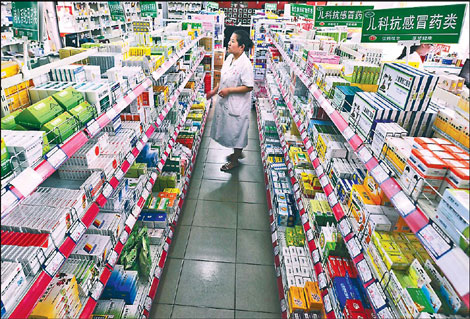
An employee checks inventory at a drugstore at Zouping county in Shandong province. More than 10 million patients, mostly in the low- and middle-income groups, use reserpine tablets in China, with between 8 and 9 billion pills taken annually. Dong Naide / For China Daily |
BEIJING - The National Development and Reform Commission (NDRC) said on Monday it would impose large fines on two domestic drug companies for monopoly pricing, the first heavy anti-monopoly penalty in China.
Analysts said the case signals that the government plans to standardize the price-setting system for drugs and crack down on monopolies.
The fines were set at 6.877 million yuan ($1.08 million) for Shandong Weifang Shuntong Pharmaceutical Co Ltd and 152,600 yuan for Shandong Weifang Huaxin Medicine Trade Co Ltd, and their illegal gains will be confiscated in line with the anti-monopoly law.
An investigation by the NDRC's price supervision and anti-monopoly department found that the companies controlled the raw material supply for compound reserpine tablets, a treatment for high blood pressure that is on China's essential drug list.
The NDRC said that the two companies, which do manufacture some drugs but do not produce the medicine involved in this case, acted as distributors for the raw materials.
They forced makers of the drug to buy higher-cost raw materials and told the actual manufacturers what retail price to charge patients for the tablet, said the NDRC.
The department said that the behavior constituted a monopolistic practice and inflicted great harm on the medicine-pricing system.
On June 6, Shuntong and Huaxin signed sole-agent agreements with two national providers of pro-methazine hydrochloride, a raw material used to make compound reserpine tablets.
Shuntong and Huaxin stipulated that the two suppliers couldn't sell the substance to any other company without their permission.
Four large domestic companies make these tablets, supplying about 75 percent of the market. When the four were unable to get the necessary raw materials, they were forced to turn to Shuntong and Huaxin.
The two Shandong-based companies would only supply the drugmakers if they agreed to increase the price of compound reserpine tablets to 5 to 6 yuan a bottle - containing 100 pills - from the original 1.3 yuan a bottle, according to Wan Jiang, an official of the bureau.
The retail price is only 0.08 yuan a tablet.
More than 10 million patients, mostly low- and middle-income people, use this medicine in China. About 8 to 9 billion pills are taken annually.
Calls to Shuntong for comment were not answered. A man surnamed Ma at Huaxin, who declined to give his full name, said that he had no comment on the NDRC's penalty.
China introduced a price-setting system for its essential drug list. The reform aimed to cut costs for patients and insurers.
However, some pharmaceutical companies use various tactics, such as raw material monopolies, to force the price of medicines on the list to surge, thwarting the government's cost-reduction efforts, said Jiang Linkui, general manager of Harbin Pharmaceutical Group Holding Co Ltd.
"The penalty is an obvious sign that the government has decided to standardize the price-setting system, a positive sign to law-abiding domestic and foreign pharmaceutical companies," said Lydia Xu, an industry researcher at the Samsung Economic Research Institute.
"Stricter execution of government regulations will help players compete on a fair platform."
China has been strengthening its crackdown on monopoly practices recently.
The NDRC said on Wednesday that it was probing the nation's two telecom giants - China Telecom Corp Ltd and China Unicom (Hong Kong) Ltd - for allegedly taking advantage of their dominant positions in broadband access to suppress competition from rivals and charge high fees.
Li Shuguang, a professor at the China University of Political Science and Law, said that the cases indicated that China is to improve its anti-monopoly legislation. "It's a good start," he added.
Chen Keyu contributed to this story.
China Daily
(China Daily 11/15/2011 page15)