System to offer accreditation for MBA programs
|
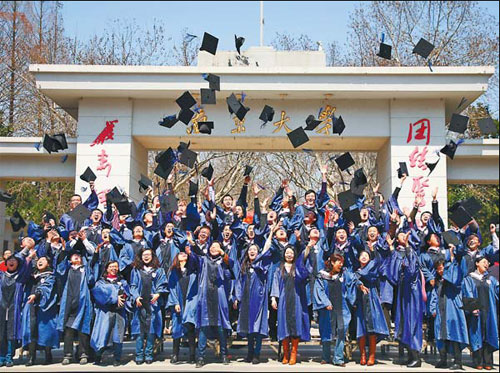
Master's of Business Administration graduates celebrate in front of the gate of Nanjing University in Nanjing, Jiangsu province, in March. To ensure the education represented by the degrees retains its high standard, China plans to introduce a system for granting accreditation to schools that offer MBAs. Nine business schools have already applied for the distinction. Zhong Shan / For China Daily |
In China, few things are regarded as being both so practical and useless, so admirable and contemptible, and as being both the key to success and the beginning of a boring life, as a master's degree in business administration.
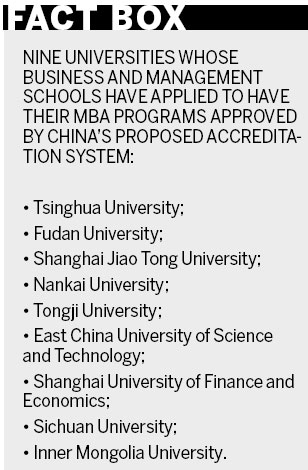
But to ensure that the degrees represent an education of the highest possible quality, authorities now plan to adopt a system to accredit schools that offer MBAs. Those who will oversee it said nine business and management schools have already applied for the distinction.
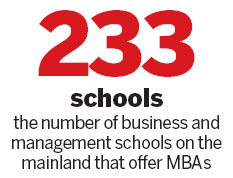
MBA degrees are now being offered in 233 business and management schools on the mainland. So far, though, only a dozen or so Chinese business schools have obtained the blessings of two global organizations that specialize in accrediting such programs.
The quality of Chinese MBAs was called into question in September 2011 in a series of critiques published by the newspaper Guangming Daily. They accused business schools of charging students too much, adhering to poor recruitment standards and doing little more than being social clubs for the rich.
Two months later, the China National MBA Education Supervisory Committee, an organization overseen by the Ministry of Education and the State Council's Academic Degrees Committee, announced that it would introduce an accreditation system in 2012.
Tong Yunhuan, secretary-general of the supervisory committee, said: "To start with, we are planning to work with the first group of nine universities and to proceed from there to establish a Chinese MBA accreditation system."
The goal of the system, he said, will be to establish "a long-lasting, scientific mechanism to improve the educational quality of MBA programs".
MBA programs first came to the Chinese mainland in 1991, when 94 candidates for the degrees were recruited. Two decades later, nearly 200,000 people have obtained an MBA.
"With improvements in the quality of education, some business schools have attained world-level accreditation," Tong said.
But among the schools that offer MBAs, "there is still a considerable difference" between the world-class institutions and those that are not in their league, Tong said.
John Quelch, vice-president and dean of the China-Europe International Business School, expressed willingness to help the country establish an accreditation system.
A good system, he said, can help promote high-quality programs that will guide students toward making wise choices and prevent them from wasting time and money on obtaining credentials of dubious value.
Quelch said it's less important to develop an accreditation system that includes some schools and excludes others. He said quality can be best controlled with the use of a three-level system that will allow colleges that offer the basics to receive at least stage-one recognition and to start on a path toward obtaining full stage-three accreditation.
"It is the responsibility (of China-Europe International Business School) to contribute to framing the domestic MBA accreditation standards," he said. "We stand ready to assist the Ministry of Education if called on to do so."
In recent years, more than 20,000 students have been recruited into MBA programs in China each year.
"Once we were for the chosen few," said an unnamed education expert in one of the Guangming Daily articles. "Now we are offering our program like a discount item in the mass market."
Some short-term training courses have been offered in the guise of MBA programs and then turned out to be mere moneymaking schemes. Such programs have tarnished MBA education in China, Tong said.
That makes it all the more necessary, Tong said, to emphasize on the criteria schools must meet, to insist on standards being upheld, to share information and to establish an evaluation system by borrowing practices from recognized MBA accreditation systems from around the world.
Eileen Peacock, senior vice-president and chief officer with the Association to Advance Collegiate Schools of Business (Asia Pacific), said five institutions on the mainland have been accredited by the association and another 11 in are in different stages of obtaining that distinction.
"China's MBA education essentially follows the American model," Peacock said. "There are many international alliances between schools which enhance the efforts toward globalization."
She said the association's process takes into account peer reviews, promotes collaboration and learning opportunities and opens up opportunities for schools to establish global partnerships.
Peking University's Guanghua School of Management is in the last stage of gaining accreditation from the association, according to Mo Shujun, director of the school's international relations office. She said the Association to Advance Collegiate Schools of Business (Asia Pacific) requires a business school to have "really clear logic" about its management - about what strategies it has to follow to accomplish its goals.
She said Guanghua is working to strengthen its relations with international accreditation systems, saying such systems are well-established and widely recognized in the world.
Guanghua and eight other schools on the mainland have already received accreditation from the European Quality Improvement System, another accreditation system for business schools.
"Although Guanghua is in no hurry to attain domestic accreditation, I think the new standard will help improve business schools' services across the country, especially for schools that are not yet ready for international accreditation," Mo said.
Despite the doubts about the quality of MBA programs, few people disagree with the proposition that professional managers will be widely needed at a time when the country's market economy is flourishing.
A recent article on MBAChina.com, a Chinese website, said the salaries of MBA holders will increase in accordance with the demand for managerial talent in China.
(China Daily 07/17/2012 page13)