Companies try to avoid corporate culture shock

|
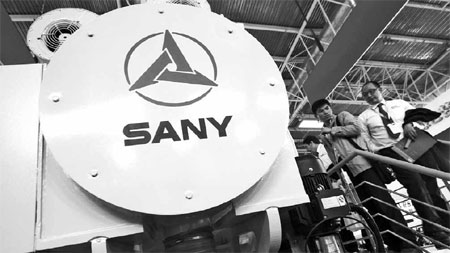
The construction-equipment maker Sany Group purchased the German concrete pump maker Putzmeister in January in one of the biggest Sino-German transactions. More than a quarter of all Chinese investment in Germany since 2003 has been in the automotive, industrial machinery and equipment sectors. Nan Shan / for China Daily |

What is the trickiest issue for Chinese companies when they take over a local company in a developed economy? The answer, most experts would say, is dealing with the staff of the acquired company.
The Chinese company Weichai Power Co Ltd emphasized that it will honor all existing agreements related to collective labor deals, bargaining and workers' participation in management in its deal with the German forklift truck maker Kion Group GmbH.
The deal, which was made on Aug 31, marked the largest Chinese direct investment in Germany to date.
Weichai Power, which belongs to Shandong Heavy Industry Group, said it will invest 738 million euros ($967 million) in Kion Group. Besides paying 467 million euros to take a 25 percent stake in Kion Group, it also agreed to take a 70 percent stake in Kion hydraulics, a unit of the Wiesbaden, Germany-based Kion Group.
The deal is expected to close in the fourth quarter of this year. Kion's current owners are the private-equity arm of Goldman Sachs and the buyout firm KKR.
Kion Group is the world's second-largest forklift truck maker after Toyota Industries Corp, with annual sales of 4.4 billion euros and brands including Linde Hydraulics, OM Still, Fenwick, Baoli and Voltas.
According to Jens Assmann, deputy director of the international department of the Hamburg Chamber of Commerce, the key for a successful M&A by a foreign company in Germany is to maintain the qualified staff, R&D center and sales channels.
"Though the cost of maintaining those experienced craftsmen and middle management may be a bit high, you will find it's worth it," Assmann said.
Weichai's commitment will ensure the long-term job security of all employees of Linde Hydraulics worldwide. And all issues regarding the future partnership in the hydraulics business will be discussed with Kion employee representatives, according to their agreement.
"The Chinese company should be very careful about German management, including the executive management, normal staff and the works council," said Axel Neelmeier, a lawyer with the Hamburg-based law firm Schulz Noagk Barwinkel.
The law firm advised a Shanghai-based company on its takeover of a listed German company, the first case in Germany.
According to Cui Zhicheng, general manager of Beijing No 1 Machine Tool Plant, building up mutual trust between local employees and the top management, and localization are critical for the success of a cross-border acquisition.
The company took over Germany-based Waldrich-Coburg in 2005. Three years after the acquisition, the German company's staff, including both management and workers, is 100 percent German and its payroll has increased 40 percent. There are only three coordinators from China.
The company's profit, Cui said, is more than four times higher than before the acquisition.
But the first step for a successful M&A, said Neelmeier, is to find the right target.
"Chinese enterprises usually look for enterprises close to insolvency or already insolvent. However, such companies in the EU are not good choices for a potential M&A, as Chinese companies are not familiar with the local situation," said Neelmeier.
"I would suggest Chinese companies seek (financially solid) companies. Though the purchase price will not be cheap, it is more likely to be a successful investment," he added.
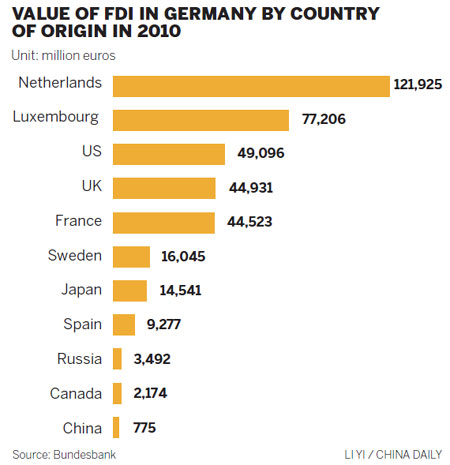
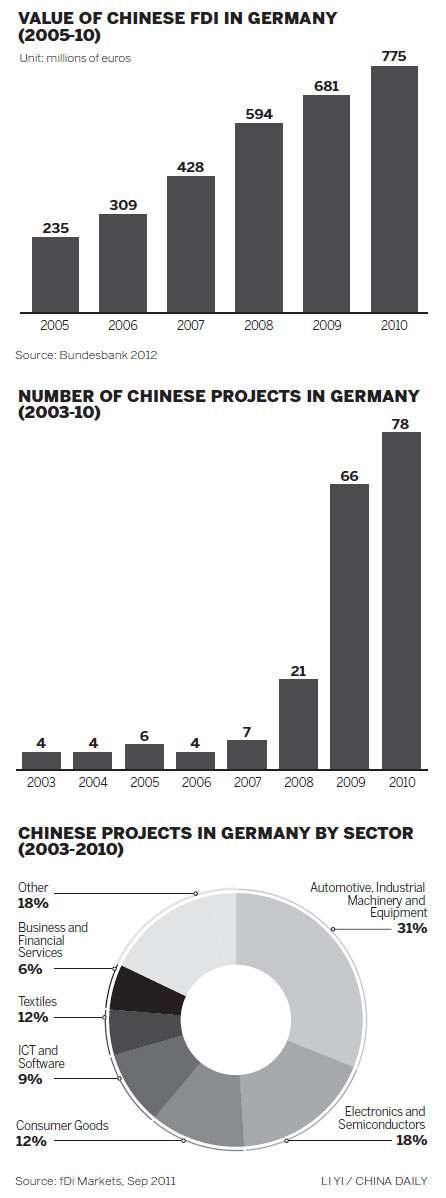
According to Germany Trade and Invest, Germany has been the top destination for Chinese enterprises' investment in Europe since the outbreak of the global financial crisis in 2008.
In 2011, a total of 827 enterprises from 33 countries made investments in Germany, among which 158 were from China - the biggest single investor.
The automotive, industrial machinery and equipment sector have accounted for more than a quarter of all investments since 2003.
"Moreover, what is particularly important for a Chinese company is to establish a good relationship with a German bank to finance the target company after the M&A. And an effective way to achieve that is to submit a convincing business plan to the German bank after the acquisition," said Neelmeier.
More M&As
Besides M&As driven by big Chinese companies, such as Lenovo Group's acquisition of Medion and Sany Group's takeover of Putzmeister, more acquisitions and investments were initiated by Chinese SMEs in Germany.
Chen Mang, chairman of Caissa Tourist Group, said dozens of M&As have been initiated by Chinese enterprises in Germany, but most of them are really low profile.
Having lived in Germany for 24 years, and also the executive president of the German Chinese Business Association, Chen has witnessed the rapid expansion of Chinese enterprises in the EU over the past few years.
"Recently, a growing number of medium-sized private enterprises have come to Germany seeking M&A opportunities. They mainly eye German companies' business know-how instead of seeking a market share here," Chen told China Daily. "Most of them are in the manufacturing industry."
For Chen, it is critical for Chinese businesses, especially medium-sized ones, to hire a good consulting company before their M&A.
"Meanwhile, they'd better contact the local Chinese embassies, commerce associations and local Chinese businesspeople beforehand," he said.
Cassia aims to expand in the culture sector, and Chen said it is looking for merger and acquisition opportunities in this field.
According to Wang Zhile, a researcher at the Chinese Academy of International Trade and Economic Cooperation, Germany is a good investment destination for Chinese businesses as the country boasts a large amount of small and medium-sized enterprises with cutting-edge technology and a favorable investment environment.
"It is a win-win deal. Chinese enterprises can improve their technological and management capacities by acquiring German companies. Meanwhile, they can also create job opportunities and increase the taxation income for the German government," said Wang.
Stefan Matz, director of international business of HWF Hamburg Business Development Corp, said 15 Chinese companies settled in Hamburg in the first half of 2012.
"All of them are small and medium-sized enterprises, and most of them are doing business in the trade and logistics sector," Matz said.
"The ongoing debt crisis in the EU so far hasn't affected our business."
Last year, around 30 new Chinese enterprises came to Hamburg.
Assmann from the Hamburg Chamber of Commerce said an increasing number of German enterprises are willing to usher in foreign investment, including merger and acquisitions.
"The trend is quite clear, even though Germany is not seriously affected by the EU debt crisis," said Assmann.
On the policy side, there are no barriers to hinder any merger and acquisition initiatives by foreign companies, according to Joern Rohde, head of the East Asia Division of the German Foreign Ministry.
"And we take a welcoming attitude toward Chinese investment in Germany," Rohde told China Daily.
More branding
Another important issue, according to Chen, is that when Chinese enterprises go overseas, they do not attach enough importance to branding.
"Even for those enterprises that are pretty strong in branding at home, their branding commitment in Germany is much weaker," said Chen. "But branding is critical to improve a company's public image, especially when they expand overseas."
Some Chinese businesses, in fact, have noticed that and are working to change foreigners' misconceptions about Chinese products.
Oliver Rootsey, key account manager with Lenovo (Germany), has been with the company for seven years and is now in the company's commercial business sector.
According to Rootsey, after Lenovo acquired the PC business of IBM, some of its clients did wonder whether Lenovo could deliver high quality products.
"We lost some of our clients at the very beginning, but most of them came back later when they recognized that it was a 'soft merger' and we lived up to their expectations for high-quality products," said Rootsey.
huyuanyuan@chinadaily.com.cn
(China Daily 09/18/2012 page13)