Index shows wealth gap at alarming level
|
A beggar, with a feather duster in hand, loiters among heavy traffic in Beijing, offering "cleaning services" in exchange for money. China's miraculous economic growth in past decades has left an increasing number of people behind financially. Mao Yanzheng / China Daily |

Experts suggest social equality has been sacrificed for growth
An index that monitors the gap between the rich and poor has reached what experts consider an alarming level in China.
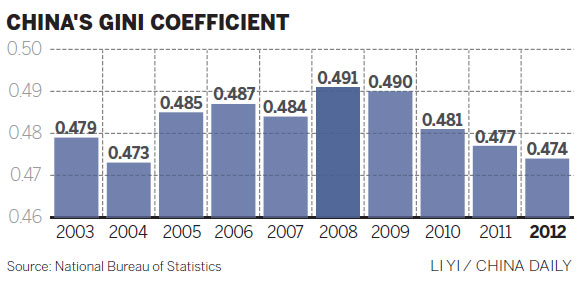
The Gini coefficient hit 0.474 in China in 2012, higher than the warning level of 0.4 set by the United Nations, the National Bureau of Statistics said on Friday.
But there are still doubts whether the index has accurately reflected the widening social disparity in the country.
According to data provided by the bureau, China's Gini coefficient has been retreating gradually from a peak level of 0.491 in 2008, Ma Jiantang, China's top statistics official, told a press conference in Beijing.
The Gini coefficient ranges from 0, which represents perfect equality, to 1, for absolute inequality.
The index stood at 0.473 in 2004, but after the financial crisis in 2008, it gradually dropped from its peak of 0.491 that year "as the government took measures to bring benefits for its people", Ma said.
"But China's Gini coefficient, between 0.47 and 0.49 during the past decade, was still relatively high, indicating the country must accelerate its income distribution reform to narrow the rich-poor gap," he said.
The Gini coefficient provided by the NBS presented a similar trend to that provided by the World Bank, but was much lower than a result from a private survey by Chengdu's Southwestern University of Finance and Economics published last December, which put the country's Gini coefficient at 0.61 in 2010, which prompted a huge reaction among netizens.
Commenting on the disparity, Ma said both official data and private surveys are "part of the statistics system, and serious private surveys should be an important and good supplement to government data".
He said the official figure was calculated using a new approach to review statistics tracked back to 2003.
Gan Li, in charge of the Southwestern University of Finance and Economics research, said on his micro blog that he expected the NBS to publish the original data behind its calculations.
Cai Zhizhou, a researcher with the Center for National Accounting and Economic Growth at Peking University, called the NBS research credible as it was in line with his center's research, and a narrowing gap was the result of the growing pay levels of lower-income groups.
However, "it may not be a precise figure, because most residents surveyed, especially higher-income groups, may not reveal their true income".
Nevertheless, Cai said, an undeniable fact was that China's Gini coefficient has been rising from around 0.3 in the 1980s to the current level above 0.47.
"China has been sacrificing social equality for its economic growth, and now it's time to make more effort to pay it back.
"Although the separate Gini coefficients in the cities and rural areas may not be as high, a major issue is the huge gap between urban and rural incomes," Cai said.
According to Ma, urban households earn three times as much as rural ones, and higher-income groups earn four times as much as lower-income groups.
Gan said such inequality was the reason for the inadequate purchasing power in China, and that a narrowing pay gap would boost consumption and help facilitate the country's ongoing economic transformation.
China vowed to double the country's GDP and per capita income for both urban and rural residents from the levels of 2010 by 2020, according to a report released after last year's 18th National Congress of the Communist Party of China.
But Ma said that doubling the GDP and the per capita income was not enough.
"The country should do a better job at income distribution and strive to make the incomes of low- and middle-income residents grow faster."
weitian@chinadaily.com.cn
(China Daily 01/19/2013 page9)