Cameron voices regret for massacre
|
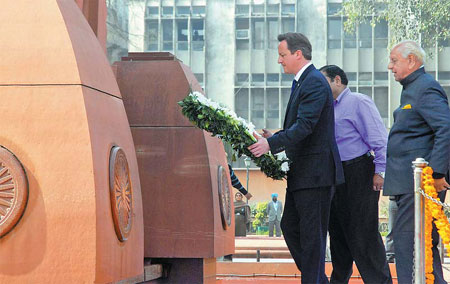
British Prime Minister David Cameron lays a wreath at the site of a notorious 1919 massacre of hundreds of Indians by British colonial forces, in Amritsar, India, on Wednesday. He became the first serving British prime minister to voice regret about one of the bloodiest episodes in India, during British colonial rule. Associated Press |
PM rues 'deeply shameful event' in Amritsar, but doesn't apologize
David Cameron on Wednesday became the first serving British prime minister to voice regret about one of the bloodiest episodes in colonial India, a massacre of unarmed civilians in the city of Amritsar in 1919.
The killings, known in India as the Jallianwala Bagh massacre, were described by Mahatma Gandhi, the father of the Indian independence movement, as having shaken the foundations of the British Empire.
A group of soldiers opened fire on an unarmed crowd without warning in the northern Indian city after a period of unrest, killing hundreds.
Cameron's visit and expression of regret for what happened stopped short of an apology - but made clear he considers the episode a stain on Britain's past.
Dressed in a dark suit, he laid a wreath at a memorial to the massacre, a terracotta-colored stone obelisk. He then stood in front of the monument in silence for a few moments.
"This is a deeply shameful event in British history, one that Winston Churchill rightly described at the time as 'monstrous'," Cameron wrote in a visitors' book, referring to the former British leader.
The gesture, coming on the third and final day of a visit to India aimed at drumming up trade and investment, is seen as an attempt to improve relations with Britain's former colonial possession and to court around 1.5 million British voters of Indian origin ahead of a 2015 election.
Before his visit, Cameron said there were ties of history between the two countries, "both the good and the bad".
"In Amritsar, I want to take the opportunity to pay my respects at Jallianwala Bagh," he had said ahead of the visit. Cameron also visited Amritsar's Golden Temple, Sikhism's holiest shrine.
The British report into the Amritsar massacre at the time said 379 people had been killed and 1,200 wounded. But a separate inquiry commissioned by the Indian pro-independence movement said some 1,000 people had been killed in the city in Punjab.
Brigadier-General Reginald Dyer, who gave the order to fire, explained his decision by saying he felt it was necessary to "teach a moral lesson to the Punjab".
Some in Britain hailed him "as the man who saved India", but others condemned him. India became independent in 1947.
Many historians consider the massacre a turning point that undermined British rule of India. It was, they say, one of the moments that caused Gandhi and the pro-independence Indian National Congress movement to lose trust in the British, inspiring them to embark on a path of civil disobedience.
'Monstrous event'
Other British politicians and dignitaries - though no serving prime minister - have expressed regret about the incident before.
In 1920, Churchill, then the secretary of state for war, called the Amritsar massacre "a monstrous event", saying it was "not the British way of doing business".
On a visit to Amritsar in 1997, Queen Elizabeth II called it a distressing episode, but said history could not be rewritten. However, her husband, Prince Philip, courted controversy during the visit when he questioned the higher Indian death toll.
Before he became prime minister, Tony Blair also visited, saying the memorial at Amritsar was a reminder of "the worst aspects of colonialism".
In recent years, British leaders have begun to apologize for some of the excesses of the empire.
When in office, Blair apologized for the 19th century Irish potato famine and for Britain's involvement in the slave trade, while Gordon Brown, his successor, apologized for the fact that British children were shipped to Australia and other Commonwealth countries between the 1920s and 1960s.
Sunil Kapoor, 36, whose great-grandfather was killed in the massacre, said he was pleased Cameron had come but said he would have liked a formal apology - feelings echoed by some Indians on Twitter.
"We have been waiting for justice from the British and Indian government for 94 years," said Kapoor. "If they think it's shameful, why shouldn't they apologize?"
He said he was disappointed that Cameron had not met some of the descendants of those killed who had come to talk to him.
Reuters
(China Daily 02/21/2013 page12)