Yasukuni visit exacerbates wounds
|
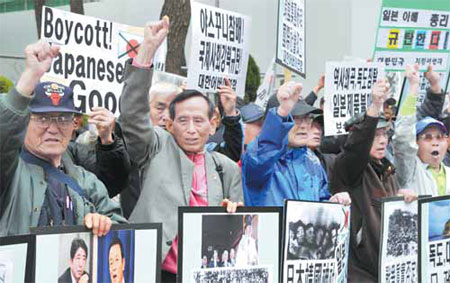
South Korean protesters shout slogans against the Japanese lawmakers' visit to the Yasukuni Shrine, in front of the Japanese embassy in Seoul on April 24. Provided to China Daily |
Tribute at memorial threatens stability of ties in East Asia
The mass visit by Japanese parliament members to the Tokyo-based Yasukuni Shrine in April, the largest in recent memory, exacerbated the historical wounds their nation left on neighboring countries such as China and South Korea. The shadow of Yasukuni continues to pose a threat to long-term progress and stability of Japan's relations with those countries.
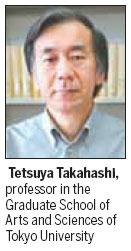
"Japan can't build relations of trust with China and South Korea if the Yasukuni worship by Japanese leaders continues," Tetsuya Takahashi, a professor at the Graduate School of Arts and Sciences of Tokyo University, said in an exclusive interview with China Daily.
Takahashi, a philosopher and best-selling author of the book Yasukuni Problem, which was published in Japan in 2005, said Japanese leaders' visits to Yasukuni are nothing but a thorn in Japan's strained relations with China and South Korea.
By paying tribute at Yasukuni in April, Japanese Deputy Prime Minister Taro Aso has kept the shrine, where some 2.5 million of Japan's war dead including 13 Class-A war criminals are enshrined, as a severe problem in Japan's diplomacy.
"It is understandable that worship by Japanese political leaders at Yasukuni is seen by China and South Korea as their neglect of the verdicts by the International Military Tribunal for the Far East and Japan's war responsibility," Takahashi said. "It causes distrust among the people of Asia, including China and South Korea."
Japan's former prime minister Yasuhiro Nakasone's Yasukuni pilgrimage in his official capacity on Aug 15, 1985, invited protest from China and, for the first time, thrust the shrine to global prominence as a diplomatic issue. Japan's war criminals were enshrined at Yasukuni Shrine in 1978. Since then, the Class-A war criminals who were executed have been honored publicly in the same way as the country's war dead.
Former Japanese prime minister Junichiro Koizumi's frequent visits to Yasukuni sent Sino-Japanese relations to a record low since the two countries restored diplomatic relations in 1972.
"When Koizumi was in office, Japan's general public knew nothing about the Yasukuni issue. Many people didn't know why a Japanese prime minister's Yasukuni worship would be a problem. But they cared about Japan's relations with China and South Korea," the philosopher said.
Takahashi's Yasukuni Problem was released at the right time to publicize the issue. Some 300,000 copies were sold.
But the Yasukuni issue is a hard sell.
Japan is different today from the country the Koizumi administration ruled. More people are claiming that their prime ministers' Yasukuni worship is a sovereignty issue and protests from China and South Korea interfere with Japan's internal affairs.
"The Abe cabinet, with many right wing members, is more conservative than the Koizumi administration," Takahashi said.
Aso, who is also Japan's finance minister, said he intends to bring Yasukuni back under state control.
Yasukuni was built in 1869 as a "Shrine to Invoke the Spirit of the Dead" by the order of Emperor Meiji to worship his soldiers fallen in the civil wars as "gods". It was renamed Yasukuni Shrine in 1879.
During the Meiji era (1868-1912), Japan waged wars with Russia and China's Qing Dynasty (1644-1911). Though scoring successes, many Japanese were killed. They were enshrined as "gods" in Japanese religion Shinto or "glorious spirits" at Yasukuni Shrine.
"Yasukuni, a shrine built in Japan's civil wars, was immediately turned into a place where the soldiers fallen in Japan's wars with the rest of the world were enshrined," Takahashi said.
Yasukuni is more than the issue of Class-A war criminals. It was a state-sponsored shrine for the Japanese imperial army until Japan's surrender in 1945. So it was a symbol of militarism. After Japan's defeat, Yasukuni was separated from the state and turned into an autonomous religious institution, he said.
China blames the Class-A war criminals for waging the aggression, not ordinary Japanese.
"Japan should know that its war responsibility starts with the early Meiji Era when it launched wars with Asian countries," Takahashi said. "And Yasukuni Shrine began enshrining the war dead in overseas battles at that time."
If Japan's prime minister and cabinet members don't set foot in Yasukuni's grounds, it will help diplomatic efforts, Takahashi said.
caihong@chinadaily.com.cn
(China Daily 06/19/2013 page10)