Chinese telecom companies call on Myanmar

|
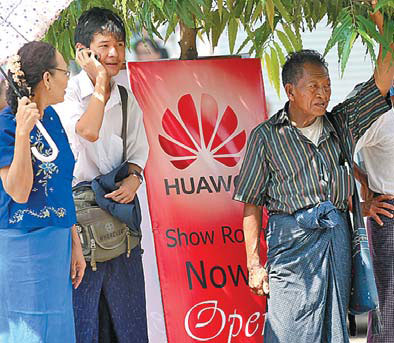
Even monks were not immune to the excitement when Huawei's showroom opened in Yangon, Myanmar. The company's handsets are the most popular in Myanmar, garnering a market share of more than 60 percent. The company plans to open 40 to 60 flagship showrooms in the country this year, offering smartphones and other high-tech products. Zhang Wei / China Daily |

|
People waiting outside the first flagship showroom of Chinese telecom giant Huawei in downtown Yangon, Myanmar, in early May. The showroom attracted huge attention from consumers and media. Zhang Wei / China Daily |
Huawei, others aiming to boost one of the most underdeveloped markets in Asia
Editor's note: China Daily continues its coverage from neighboring countries in an effort to shed light on topics of significance to China. In the fourth and final installment of our series on Myanmar, we report on Chinese investment in telecommunications.
Chinese telecom companies are enthusiastic about Myanmar's efforts to boost its underdeveloped telecom market, said a high-level manager at the Myanmar branch of a top Chinese telecom company.
"The inflow of top telecom operators from all over the world creates a brilliant opportunity to upgrade the country's telecom sector," said Ren Geng, managing director of Huawei Technologies in Yangon.
Huawei is now the world's second-largest provider of telecommunication gear and mobile phones. It has established an excellent cooperation model with the world's major operators and it can replicate the successful model in Myanmar, he said.
After spending a decade cultivating the Myanmar market for 10 years, Huawei opened its first flagship showroom in downtown Yangon in early May. It attracted huge attention from local consumers and media.
Huawei's handsets are the most popular brand in Myanmar, garnering a market share of more than 60 percent. The mission for the company's Myanmar branch this year is to open 40 to 60 flagship showrooms around the country, which will provide smartphones and other high-tech products, Ren said.
Though it has a population of more than 60 million, the number of telecom customers in Myanmar is comparatively low at about 3.5 to 4 million, which is why the Myanmar market is so lucrative to international companies, experts said.
"Basically the only way to go with telecoms in Myanmar is up. This is one of the last remaining untapped markets," said a Bangkok-based telecom analyst in a Financial Times story.
Thomas Liu, managing director in charge of Huawei's Southeast Asia region, expects the number of mobile users in Myanmar to reach 30 million within five years, based on its young population.
But the growth in numbers will not be easy without making the dream of owning a handset cheaper and more affordable. It costs $200 to buy a SIM card in Myanmar.
In late May, the Myanmar telecom regulator announced that it was selling 350,000 SIM cards for the price of K1500 (around $2). As a tentative step in telecom reform, the cards were sold lucky-draw style.
In the case of Mandalay, Myanmar's second-largest city, local residents began lining up at 5 am and waited as long as three hours to get their hands on the much cheaper card.
In addition to the shortage of handsets and the expense of SIM cards, the development of Myanmar's telecom infrastructure is far from adequate, and this is another sector urgently needing international cooperation, industry insiders pointed out.
"The number of (mobile) towers in the country is still not enough," Htay Win, chief engineer of Myanmar Post and Telecommunication, the state-owned telephone service provider, told media in April. The government will build more towers with the money it gets from selling SIM cards to local mobile users.
MPT is currently working with companies such as Huawei, ZTE and ASP to build the towers across the country.
At the moment, around 90 companies worldwide are vying for a piece of the pie from this sought-after new market.
The Myanmar government announced in January that it would grant two licenses, each with initial terms of 15 years, in an effort to liberalize its underdeveloped market, according to local media.
The application list includes 22 international telecom companies, and the two successful bidders will be announced by the end of June.
Thin Thin Swe from Myanmar television station MI told China Daily that Chinese products, such as Huawei's, are very popular in Myanmar because of their high-tech quality and affordable price.
Mya Than Zaw, head of Truly Myanmar Travel Agency, said the people of Myanmar are looking forward to using a low-cost SIM card without limitations, and they expect a better service.
qinzhongwei@chinadaily.com.cn
(China Daily 06/21/2013 page10)