Mobike faces mobile unlocking court battle
Lingyun Technologies alleges bike-sharing company, among others, has used its protected designs without permission
While the convenience of scanning a QR code on a Mobike frame to unlock the vehicle has partially contributed to the growing popularity of the brand, the technology has locked the Beijing-based bike-sharing company in a legal wrangle with a company from a different line of business.
Lingyun Technologies, a digital lock developer headquartered in Shenzhen, Guangdong province, filed a complaint against Beijing Mobike Technology with the Beijing Intellectual Property Court in March, claiming the leading bike-sharing service provider infringed on one of its patents related to access control.
Lingyun also lodged an enforcement request against Mobike with the Beijing IP Office for another patent, which concerns authorization and access control technologies.
|
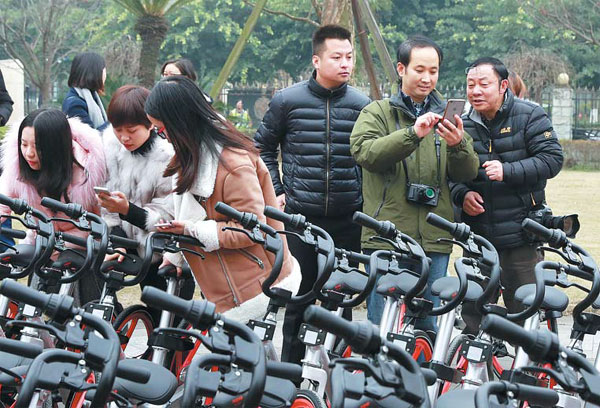
People in Chengdu, Sichuan province, scan QR codes to use Mobikes. Luo Guoyang / For China Daily |
Both the court and the office decided on March 7 to take up the investigation.
"While many companies - not just in the bike-sharing service sector - have infringed on our patents, it is out of the question to sue them all," Cheng Yue, co-founder of Lingyun and also one of the inventors of the patented technologies involved, told Sznews, a Shenzhen news portal.
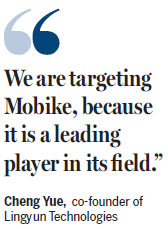
"We are targeting Mobike, because it is a leading player in its field," he said, asserting that his company holds seminal patents vital to cellphone-lock technologies.
More than 1 million Mobikes are in service in 34 cities across the country. Beijing, Shanghai, Guangzhou and Shenzhen host more than 100,000 each, Caijing, a business magazine, quoted Cao Guoxing, the company's chief public relations officer, as saying.
Zhang Yaoguang, chief technology officer of Lingyun and also a co-inventor of the patented technologies, told the magazine that unlike previous direct links between access control equipment and mobile terminals such as smartphones, the patented technologies involved in the dispute enable a change in data transmission paths, traveling from a user to a cloud server before the feedback returns to the user. That is the key to this form of remote unlocking.
"Our key technologies concern the process of a cloud server verifying user information," Zhang said.
Lingyun and Mobike are not competitors, as they focus on different businesses. Cheng compared the patent dispute between them to that between chip developer Qualcomm and electronics maker Apple.
"We want to warn other companies through this case," he said, adding that his company may continue to initiate legal procedures against others, if it can prevail over Mobike in the current case.
Except for the bike-sharing service sector, Lingyun's cellphone-lock patents can be used in other industries including security and telecommunications, he said.
Li Zhanke, an attorney representing Lingyun, told Chinese media: "With increasing use of smart-lock technologies, Lingyun will take a series of legal actions against suspected patent infringements to defend its rights."
In response, Mobike said in a statement that it has long been dedicated to promoting technological innovation, and respecting and protecting IP. Based on preliminary analysis, the company said it cannot agree to the plaintiff's assertions and will seek legal solutions to address the dispute.
Mobike filed a request with the Patent Reexamination Board of the State Intellectual Property Office in late March, seeking invalidation of one of the two involved patents.
Hu Weiwei, founder of Mobike, said in an earlier public speech that her company has made enormous efforts in research and development. The company's CEO Wang Xiaofeng also noted that the current focus of Mobike is market expansion and technology upgrades.
SIPO's patent search system shows Mobike has filed 32 patent applications in China, with the filings showing that 12 utility models and five industrial designs were granted.
In contrast, Lingyun has 10 applications, with one invention, four utility models and one industrial design granted.
Liu Yinliang, an IP professor at Peking University Law School, said the media's intense interest in the case shows rising protection awareness among Chinese companies and the public, China IP News reported.
"No matter what the final result could be, this will help the industry to recognize the significance of enhanced IP protection," Liu said.
zhuanti@chinadaily.com.cn
(China Daily 04/13/2017 page17)