As China's engagement in Africa grows over the years, there have been various accusations about the dealings.
Among them include allegations that China is a "rogue donor", operating completely outside the rules. Chinese have been condemned as providing aid only to countries with rich natural resources and questionable governance.
Related: My 30 years with Lang Lang
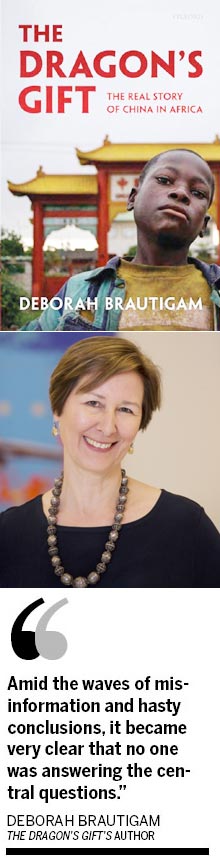
Deborah Brautigam, professor of international development at the School of Advanced International Studies, Johns Hopkins University, published a book, The Dragon's Gift: The Real Story of China in Africa, to address these accusations. The book, which was based on her research, aroused a strong response after it was published. It is now available in Chinese.
"Amid the waves of misinformation and hasty conclusions, it became very clear that no one was answering the central questions," Brautigam says in an e-mail reply to China Daily on the motivation behind her book.
In The Dragon's Gift, Brautigam opined that much of the "conventional wisdom" about China's engagement in Africa is "overstated or simply wrong".
She attempted to answer questions such as: What are the Chinese doing in their new wave of aid and economic cooperation across Africa? What will this mean for poverty and development in Africa? What will it mean for the West and our own approach to development and aid?
Roger C. Riddell, author of Does Foreign Aid Really Work? considers The Dragon's Gift as a path-breaking book that was urgently needed and deserves to be widely noticed and read.
Related: I'm Lu Xingyu, not Lu Meimei
"It not only provides an in-depth analysis of contemporary relations of China with Africa, located within their proper historical context, but meticulously presents, critiques and successfully challenges the array of myths, fears, and misinformation which abound in both press reports and some academic studies of China in Africa," Riddell comments.
For Brautigam, the book also addresses issues that first engaged her when she taught English in Bangkok and Taiwan more than 30 years ago, and later when she did surveys in rice-growing villages of West Africa as a graduate student.
In the late 1970s, she spent a year and a half in Hong Kong and Taiwan to learn Chinese. She visited the Chinese mainland in 1980 and still remembers the dozens of small gray villages and miles of rice paddies that the train she traveled in passed by that would later become Shenzhen, the special economic zone in Guangdong province.
She went on to study international development at graduate school and read a lot about Africa in classes. It was then that she knew China had a foreign aid program, but without more detailed information, prompting her to do extensive research on Chinese foreign aid in African agriculture for her PhD dissertation.
She spent one and a half years doing fieldwork in Africa in the 1980s, which later led to her first book on China's foreign aid in Africa - Chinese Aid and African Development: Exporting Green Revolution.
For The Dragon's Gift, she went back to many countries where she had done research before: to countries where China's presence was longstanding (Tanzania and Zambia), to resource-rich countries (Zimbabwe and Nigeria), to countries recovering from war (Sierra Leone and Mozambique) and to countries with better governance (Mauritius and South Africa).
She visited dozens of Chinese projects and investments sites, interviewed Chinese and African officials and talked to Chinese aid workers and ordinary Africans.
She also sifted through the dusty files of the ministries that partnered China in the aid projects and combed through whatever Chinese literature she could find on China's foreign aid.
Besides that, she had a team of research assistants collecting data to draw a broad portrait of the scope of aid in Africa over time and to test some of the common assumptions about Chinese aid.
She says the case study and data evidence has allowed her to dispel many of the myths. The "conventional wisdom" that China gives aid to gain access to resources is at best a partial and misleading answer.
Like the United States, China gives aid for three reasons: strategic diplomacy, commercial benefit, and as a reflection of societal ideologies and values. But the Chinese aid and economic cooperation programs attach more emphasis to infrastructure, production and university scholarships, while the traditional Western donors downplay all of these.
Brautigam points out that although China has become increasingly transparent about many aspects of its governance and policymaking, aid figures remain State secrets and it is the secrecy that has fueled misunderstandings, rumors and speculations.
She suggests that it might help to expand China's involvement in a positive way - Chinese construction companies could improve their corporate social responsibility in Africa, and China could partner with other development and relief organizations with good reputations.
yangguang@chinadaily.com.cn
|
|
|
|
|
|
|
|

Copyright 1995 - . All rights reserved. The content (including but not limited to text, photo, multimedia information, etc) published in this site belongs to China Daily Information Co (CDIC). Without written authorization from CDIC, such content shall not be republished or used in any form. Note: Browsers with 1024*768 or higher resolution are suggested for this site.
License for publishing multimedia online 0108263 Registration Number: 130349 














 Raymond Zhou:
 Pauline D Loh:
 Hot Pot
 Eco China
 China Dream
 China Face