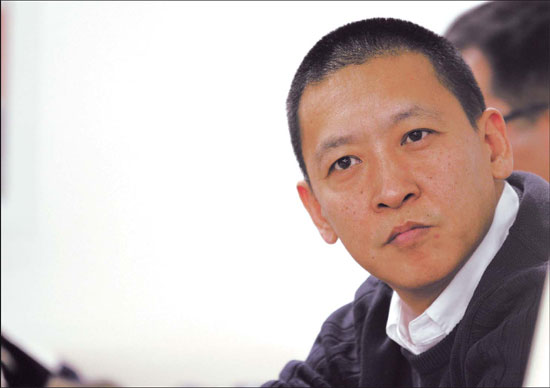
After almost two decades as a news journalist, Miao Wei finds solace in creative writing. Zhang Kun reviews his first novel.
Miao Wei was already a name in the publishing industry before his first novel Gua Ren You Ji was published in late 2012. The 44-year-old Beijing native is the deputy editor-in-chief and columnist at Life Week, one of China's most successful weekly journals. He will be the editor of a new magazine, titled Wissen (German for "knowledge"), to be launched in March.
Miao borrowed the book title Gua Ren You Ji from the writing of Mencius, in which an emperor used the words "gua ren you ji" - meaning "I have an illness" - to confess to Mencius that he has a weakness for beauty.
The book consists of three stories. The first is set in the Tang Dynasty (AD 618-907), an age of prosperity in the Chinese history. It tells the story of Lu Zhaolin, a poet, who suffers from leprosy. Lu seeks help from Sun Simiao, the legendary master of medicine. Although Sun cannot cure Lu, the latter finds consolation from Sun's philosophical teachings.
The second story happens in the Song Dynasty (960-1279), before the Mongolians come into power to form the Yuan Dynasty. It is about a doctor who tries all means to stop a fatal plague in Kaifeng, Henan province. Although he manages to halt the plague, he cannot stop the invasion of the Mongolian soldiers who kill many civilians.
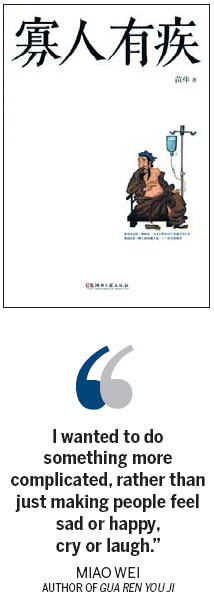
The third story is set in the early 20th century. The protagonist Da-peng is born to a family of traditional Chinese medicine doctors. He returns from the United States with a medical degree to serve the public healthcare sector. His new experimental treatment not only fails to cure his father from Alzheimer's disease, but instead accidentally electrocutes the old man.
The three stories are all about diseases and the failed attempts for cure. By mixing historical events, characters, documents, and medical information with fictional stories, Miao reveals some of the real problems faced by Chinese people and culture.
"We are all ill, aren't we?" the writer says.
Instead of hiding moral metaphors between the lines, the author ridicules phenomena such as vanity, snobbishness and lack of intelligence. The satire reminds readers of The Scholars, a novel written by Wu Jingzi in the 18th century.
A keen reader of Western literature, Miao used to read translated books to help him establish his own narrative. But in Gua Ren You Ji, he found his voice in traditional Chinese storytelling.
Miao writes so well that "you can't help feeling high when his narration reaches a climax point", says Shanghai writer Xiao Bai, adding he is intrigued by Miao's flexible narrative style.
Huang Yuning, a columnist, translator and editor in Shanghai, says, "Miao is growing into a mature writer, showing great skill in creating a world, and you can tell that he enjoys the process."
There are some surrealistic elements in the novel, and the author manages to balance them well, Huang says. "This is one of the few books that I had so much fun reading. And it has plenty of room for interpretation, too."
According to publisher Lu Jinbo, China's new and younger generations of writers, such as Miao, are increasingly replacing their predecessors.
Miao's previous work, a collection of essays and two collections of short stories, received good reviews from critics and won him a large number of faithful readers.
 |
Although Miao's collection of short stories won him good reviews, Miao was still dissatisfied. To him, it was not enough to simply evoke emotional response from readers.
"I wanted to do something more complicated, rather than just making people feel sad or happy, cry or laugh," he says.
Miao moved to creative writing as he was no longer satisfied as a journalist and columnist. At first he posted his short stories on his blog because "I cared a lot about the immediate response from the readers, and didn't have much confidence".
As a veteran journalist-turned-editor and columnist in one of China's best-selling weekly magazines, Miao has been surrounded by news events.
The year 2008, when he turned 40, was especially exciting. There was the Beijing Olympics and Sichuan earthquake, among many other major news.
"But, I no longer enjoyed the media work, and didn't want to communicate with the public", especially when he saw some media manipulating the public's feelings, Miao recalls.
He realized that he was suffering from midlife crisis: There was a huge gap between all his social roles and his true self.
He diverted his energy into novel writing, which succeeded in pulling him out of the crisis.
Gua Ren You Ji has sold about 40,000 copies.
Contact the writer at zhangkun@chinadaily.com.cn.
|
|
|
|
|
|
|
|


Copyright 1995 - . All rights reserved. The content (including but not limited to text, photo, multimedia information, etc) published in this site belongs to China Daily Information Co (CDIC). Without written authorization from CDIC, such content shall not be republished or used in any form. Note: Browsers with 1024*768 or higher resolution are suggested for this site.
License for publishing multimedia online 0108263 Registration Number: 20100000002731 
















 Raymond Zhou:
 Pauline D Loh: My Chinese Kitchen
 Ye Jun:
 China Face
 Hot Pot
 Eco China