Save the word
 |
|
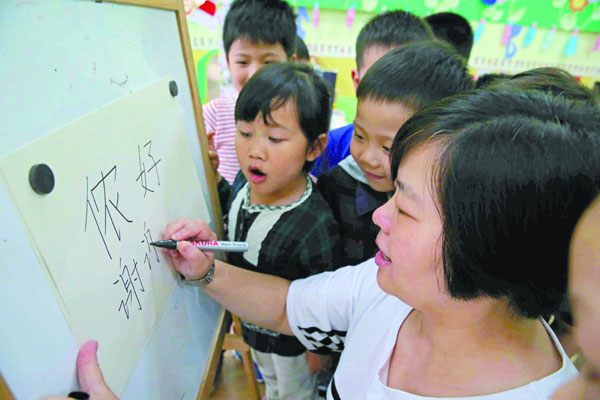
Local dialect is taught at some kindergartens in Shanghai as part of a pilot program to preserve the language. Gao Erqiang / China Daily |
Education authorities worry over native tongue's extinction and are taking action, Wu Ni reports in Shanghai
Children in Shanghai will be expected to learn the local dialect in kindergarten, as the city's education authorities plan to enhance folk culture education among the youth.
Qian Cheng, a political adviser in Shanghai, made a proposal earlier this year to introduce Shanghai dialect education to kindergartners.
Qian, who is also deputy director of the Shanghai Comic Troupe and has performed many plays in the local dialect, said he's worried about the endangered situation of the city's mother tongue.
"In the primary schools where I give voluntary Shanghai dialect classes, most pupils either speak it broken or cannot master the language at all," he said.
"The Shanghai dialect is the pillar of Shanghai's culture," he added. "How can we protect and pass down the culture if we lose our mother tongue?"
Qian found that many children can speak some of the dialect before they enter kindergarten. However, after speaking Putonghua, or Mandarin, regularly in class, they get in the habit of speaking it at home, which influences parents to adopt the language as well.
The case is true for Shanghai native Shen Yanwei and his family. His 6-year-old daughter can hardly speak the dialect now.
"My daughter speaks Putonghua in kindergarten. The cartoons and TV programs she watches are all in Putonghua. Gradually, we have begun to speak Putonghua with her," Shen said.
He added that he did not believe that the loss of the dialect is an issue as most parents attach more importance to their children's ability to speak English.
China began to promote Putonghua in 1992, in a nationwide campaign that strongly encouraged the use of Putonghua in classrooms. But many schools, according to Qian, have extended the use of the language to after-school activities.
Qian suggested that public kindergartens spare an hour a day to offer children games, storytelling and ballad singing in the local dialect, because children ages 3 to 6 are free of academic burden and in an important period for language acquisition.
Meanwhile, Shanghai's universities can help by contributing teachers who are experts on preschool education as well as the Shanghai dialect. Qian also suggests inviting linguists and scholars to write a textbook suitable for preschool children about grammar and pronunciation as well as the history and culture of the local dialect.
The Shanghai Municipal Education Commission, according to Qian, has acknowledged the proposal and will start a pilot program bringing the Shanghai dialect into a test group of kindergartens and eventually to all when enough experience is gained.
Some of the city's kindergartens have already introduced the Shanghai dialect to their curriculum.
The Modern Baby Kindergarten in Shanghai's Pudong New District gives classes in Mandarin, but uses the Shanghai dialect in other activities and class conversations, said Zhu Jianmin, director of the kindergarten.
Every Friday of the week is "dialect day" when teachers and children only speak the local dialect. The kindergarten also organizes regular trips to the city's historical sites, teaching about them in the Shanghai dialect. Nursery rhyme-singing contests in the local dialect are often held, according to Zhu.
"Children in our kindergarten master the local dialect well, but if primary and middle schools don't offer an environment in which it is spoken, it is possible that they may forget it," she said.
Cao Yanmei, a mother from Suqian in Jiangsu province who has settled her family in Shanghai, sent her 3-year-old son to a kindergarten in Zhabei district in September. She is happy to see that he has learned to sing some nursery rhymes in the Shanghai dialect.
"The teachers are Shanghai natives and they speak the local dialect during games and daily conversations," she said.
"Since my son will live in Shanghai, his mastery of the dialect will help him communicate with the local community and blend in better with society. Moreover, it shows respect to the local culture".
Qian Nairong, director of the Research Center of Linguistics at Shanghai University, said that the loss of a local dialect's popularity with the younger generation means a loss of culture.
"The most vivid words and lively expressions are all born from the local dialect, which is the source of cultural creativity. Protecting the dialect is a key to maintaining cultural diversity," he said.
Qian, who has studied the Shanghai dialect for nearly 50 years, said that most of the city's post-1990 generation has lost the ability to speak in the local tongue.
A report released by Shanghai Academy of Social Sciences last year showed that only 60 percent of Shanghai native students can fully understand their local dialect and only half of them speak it at home.
There are 129 languages in China and 117 are endangered, according to the book China's Languages published by the Chinese Academy of Social Sciences in 2008.
Li Lan, a linguist in dialect studies with the CASS, said most of the endangered dialects are spoken by ethnic groups. But the nine non-Mandarin dialects still have hundreds of millions of speakers. The Wu dialect, for example, has around 70 million speakers in Shanghai, Zhejiang and Jiangsu.
|
|
|