Weaving clouds of color
One major hurdle was finding the appropriate loom.
Zhou Shuangxi, the youngest member of the restoration team, explains that they found two looms at one household and had them resembled, but they were very worn out and the wooden parts had become moldy.
 |
|
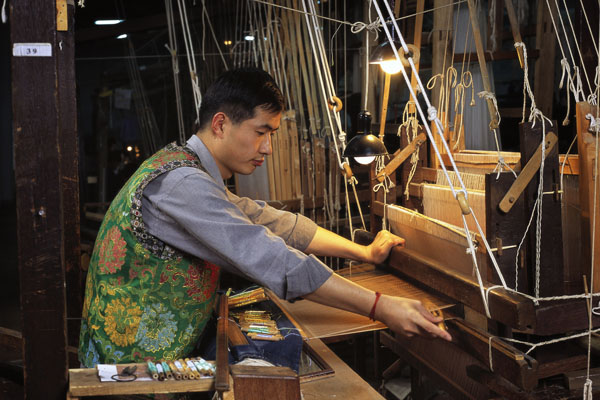
Cai Xiangyang, once a law graduate, is an apprentice to a master artisan in Nanjing Brocade Research Institute.Provided to China Daily |
A yunjin loom is a large and complicated piece of machinery. It measures 5.6 meters long, 1.4 meters wide and 4 meters high, and is made up of 1,924 small components. It is manually operated by two weavers and involves a distinctive technique to make the jacquard patterns.
This is a weaving process that dates back to the 1700s, named after its French inventor, Joseph Marie Jacquard. Jacquard weaving cannot be done on modern machines.
Zhou, now 58, has since seen more masterpieces replicated from excavated brocade items. He was named the chief intangible cultural heritage craftsman after yunjin was inscribed by UNESCO on its representative list in September 2009.
UNESCO's record of intangible heritage crafts was created to demonstrate the diversity of such heritage and to raise awareness of their importance. Other skills from China on the list include calligraphy and shadow puppetry.
A broad range of skills and knowledge are required from the weavers, as Zhou explains.
"I need to know everything about brocade making," he says. "From assembling the loom, dyeing silk threads with natural dyes, designing the patterns and drawing the blueprint, loading the loom with thread and lining up the warps, to the final weaving."
Zhou says great patience and meticulous care is required.
The weaver handles the shuttle and pedals on the loom's footboards, and keeps in mind how to arrange the colors. Creating the brocade is a slow and intricate process requiring considerable attention to detail.
An experienced craftsman can weave about five centimeters in one day at most. If the weaver has finished one piece of brocade and move to a new pattern, the loom has to be reloaded and readjusted.
Zhou's fascination with brocade making was not love at first sight.
As a high school graduate he was assigned to the weaving workshop, and was concerned that he would be looked down on for doing a woman's job. Job-hopping was unheard of at that time, and carried little appeal because the salaries of different jobs were almost all the same.
"The old weavers were all men; illiterate and poor. They learned the weaving formulas by heart," Zhou says.
He acknowledges that work conditions for the weavers have improved greatly.
"In the old days, weavers endured hot summers and freezing winters. There was no air conditioning. They could neither use electric fans in summer nor build a fire to keep warm in winter, for fear that the threads would get knotted up or get burnt," Zhou says.
His confidence was boosted during exhibitions abroad, where the audience showed deep interest and respect for the skills of the weavers. Zhou left one loom each in Belgium and Norway, at the request of locals who offered to keep the apparatus and arrange further exhibitions.
Zhou's main responsibility now is to train more young people although he says reliable and committed apprentices are in short supply.
He understands that young people today face more distractions and pressure to climb the social ladder and make money, rather than throw their college degree away and start all over again to learn the basics of weaving.
"College degrees are almost irrelevant in learning the weaving techniques," he says. "Many young graduates came to me with high expectations and soon found the job was boring, and no match for their degrees. I have seen many leave after a few months or a year, to look for better-paying jobs."
Cai Xiangyang, 33, is Zhou's favorite trainee and the only apprentice that Zhou recognizes.
Cai had a bachelor's degree in law when he joined the Nanjing Brocade Research Institute in 2004. He later completed a master's degree in intangible cultural heritage protection.
Cai's persistence and diligence have won the trust of the institute officials.
"I can sit at a loom for 10 hours a day, and I keep practicing through Saturdays and Sundays. The job calls for scrupulous attention and the ability to resist distractions and loneliness," he says.
Cai has followed Zhou's steps and hopes to succeed Zhou as the inheritor of the intangible cultural heritage one day.
"For Master Zhou's generation, their job has focused on preserving the traditions and repeating the conventional patterns, such as dragon, phoenix and peony flowers," Cai says. "The ambition of the younger generation is to master the ancient skills and experiment with new ideas, to make these formerly exclusive dresses accessible to the public."
|
 |
 |