 |
|
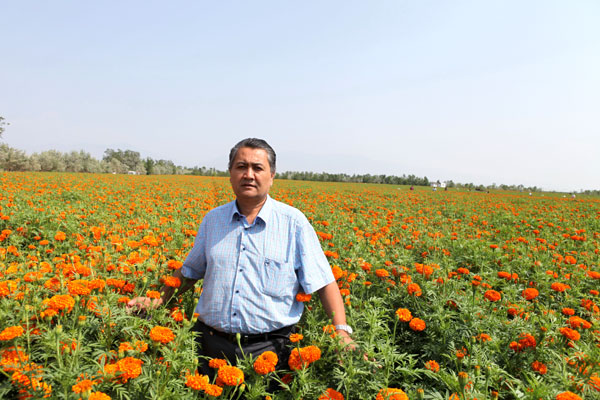
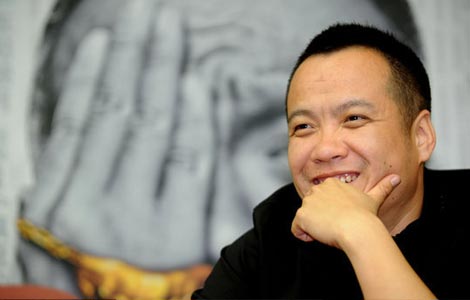
Author Alat Asem draws inspiration from his life in Xinjiang and experiments in combining the cream of Chinese and Uygur languages in his works. Photos Provided to China Daily |
Thanks to his rich experience, diligent studies and daring explorations, Uygur writer Alat Asem has become an eloquent spokesman for his people, Liu Jun reports.
One midnight in 1994, someone woke Alat Asem up at his office. Musa, the powerful leader of a coal mining team, wanted a drink with him.
"Brother, don't go," advised the mine's Party secretary in Ili Kazak autonomous prefecture, northwestern Xinjiang Uygur autonomous region. "What that man wants is not a drink. He has eyes inside his eyes."
Alat Asem, a Uygur official at the prefecture government, was sent to the mine to accumulate experience. He soon realized that the centuries-old mine was bogged down in power struggles.
Undaunted, he jumped in the truck and arrived at a pitch-dark village. He chewed on three chunks of fat before touching liquor - a secret that helped him survive, and socialize, in a society where drinking is a matter of reputation.
Upon the third cup, Musa collapsed.
"The new Party secretary is like a fridge - a whole box of liquor does nothing to him," Musa told his followers. "Let it be, stop playing with him."
With such obstacles gone, Alat Asem was able to fund orphans to school, befriend miners and delve into the history of the mine.
Refreshing writing
Over the years, anecdotes like these have enabled Alat Asem to create believable characters across the social strata and become a leading author in Xinjiang.
His eloquence in both Uygur and Chinese has put him in a unique position to introduce the region to the wider world.
 |
|
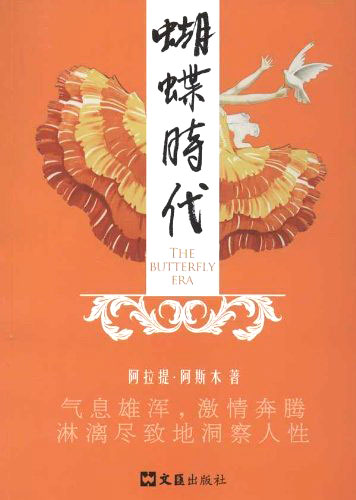
Alat Asem's novella collection The Butterfly Era is published in Chinese |
In June, the new bilingual literary journal Chutzpah! carried his novella Sidik Golden MobOff in English, the first of his works to be introduced to an international audience.
Translator Bruce Humes, whose rendition of Chi Zijian's Last Quarter of the Moon (Harvill Secker, 2011) has won wide acclaim, added a valuable third dimension to the story in his faithful translation of the author's "earthy Xinjiang Mandarin".
"It is indeed a somewhat odd sensation to find yourself in a world populated solely by Uygurs whose innermost thoughts are described in a distinctive Mandarin with a Xinjiang feel that occasionally approaches stream-of-consciousness prose," Humes said in an e-mail interview from Antalya, Turkey, where he is studying Turkish.
The story is about Sidik, an upright but arrogant intellectual who dies of mysterious causes at 75. As his friend, the narrator, queries Sidik's foes in his search for a possible culprit, the author takes readers ever deeper into "the intestines inside the intestines" of Uygur society.
"I found Sidik a compelling character," Humes says. "While I didn't share the narrator's obsession with getting to the bottom of his death, I truly wanted to read the tale through to the end because Sidik's mania for calling a spade a spade, in the most public manner that results in massive losses of face, is recounted with great relish, imagination and detail."
Like many of Alat Asem's stories, the men all have a peculiar nickname such as Momin Back 'n' Front, Madame Munir and Father-in-Law Yalkun.
"The names are key because they are uniquely Uygur in sound and meaning, and because Sidik made a name for himself by creating insulting monikers that were too memorable to be ignored," Humes says.
Even today, when new technology is turning the world's myriad cultures into a blurry mix, Uygurs have maintained their unique way of life.
Unlike the action-packed narration commonly seen in contemporary Han Chinese writers, Alat Asem habitually breaks into long, poetic and philosophical musings in the middle of his tales.
"In the long history of the Uygurs, literature, especially poetry, has always been essential to our culture," he says. "Epics, legends and ballads permeate our expressions of daily life."
|
|
|
|
|
|
|
|


Copyright 1995 - . All rights reserved. The content (including but not limited to text, photo, multimedia information, etc) published in this site belongs to China Daily Information Co (CDIC). Without written authorization from CDIC, such content shall not be republished or used in any form. Note: Browsers with 1024*768 or higher resolution are suggested for this site.
License for publishing multimedia online 0108263 Registration Number: 20100000002731 














 Raymond Zhou:
 Pauline D Loh: My Chinese Kitchen
 Ye Jun:
 China Face
 Hot Pot
 Eco China