 |
|
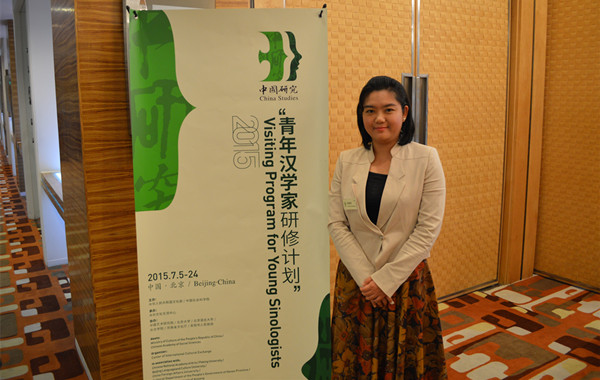
Thai Sinologist Panthipa Asavatheputhai in Beijing, July 7, 2015. [Photo by Jiang Wanjuan/chinadaily.com.cn] |
Mandarin Chinese is gaining popularity in Thailand. Courses have been set up from kindergartens to universities and many government organizations, as well as businesses, offer long and short-term programs for their staff to learn the language. Many Thais regard this as an opportunity to improve job prospects and also a window into new China.
Thais who learn Chinese often feel the grammar of the language is much easier than English, the first foreign language of Thailand. The four tones are not a stumbling block, for both Chinese and Thai are tonal languages. However, complex Chinese characters have driven many Thais into a nightmarish experience of memorizing and writing.
Thailand has welcomed Chinese immigrants since the 16th century. They came for various reasons: to do business, reclaim wasteland, make a living and, in the early days, people attempting to restore the Ming regime fleeing the persecutions of the Qing government.
The economic boom of Thailand in the 19th century drew more waves of Chinese immigrants and until the end of the 19th century, Chinese people could be seen everywhere in the country.
Chinese Thais have shaped society in many ways. The Thai language incorporated many Cantonese words, because the majority of immigrants were from present-day China's southeast Fujian and Guangzhou provinces, where Cantonese is spoken. For instance, the Thai word Mee is borrowed from the Cantonese 面 (noodles), and therefore very much resembles its Cantonese counterpart in pronunciation.
In the early 20th century Chinese Thais set up the first Chinese schools in Thailand wanting to strengthen education in the mother tongue. At that time, Chinese schools taught only Chinese culture, and the administrative as well as teaching staff was all Chinese. However, the development of Chinese education soon encountered setbacks, first due to the government's policy of ethnical assimilation and later the ideological differences between the two countries. Though there was progress during these stagnant periods, Chinese education was almost fully discarded in Thailand by the 1960s.
Chinese schools began to revive when China and Thailand established diplomatic relations in 1975. After China's reform and opening-up the country's overall national strength and its international status have both improved and Sino-Thai economic and tourism ties were further strengthened. With Mandarin Chinese an important tool for Thailand to expand its international business and trade, the Thai government gradually relaxed its restraints on Chinese schools and institutes. Nowadays, Chinese is the second foreign language in Thailand and many top universities offer a bachelor's degree in the subject.
In 1992, the Chinese Association in Thailand (Chong Hua) established the Chong Hua Chinese Center, the first Chinese school allowed by the government in more than 40 years. The Tai Hua Cultural Foundation followed to establish the Oriental Culture Academy in 1993, inviting many senior teachers from the Chinese mainland. Encouraged by the success of the two universities, the Chinese communities as well as educational groups set up Chinese institutes. Now there are more than 150 in Thailand.
Mandarin will remain popular among Thais in the future. The economic as well as cultural exchanges between the countries are becoming more frequent, and an increasing number of Chinese tourists are visiting Thailand. More Thais want a good command of the language to bring more possibilities for their jobs. Also, as a language spoken by nearly one fifth of the global population, Chinese has sparked much interest among the Thai people.
Panthipa Asavatheputhai is a Chinese language lecturer at Mae Fah Luang University in Chiang Rai, Thailand. Her research areas include Chinese education and Chinese translation. She visited Beijing in July to participate in the third Visiting Program for Young Sinologists.
Wu Yue contributed to this story.
Related:
Studying Chinese in Iran: Sinologist
Mandarin: Bringing China-India closer
Ross Terrill on China's 'Four Comprehensives'
|
|
|
|
|
|
|
|

Copyright 1995 - . All rights reserved. The content (including but not limited to text, photo, multimedia information, etc) published in this site belongs to China Daily Information Co (CDIC). Without written authorization from CDIC, such content shall not be republished or used in any form. Note: Browsers with 1024*768 or higher resolution are suggested for this site.
License for publishing multimedia online 0108263 Registration Number: 130349 



















 Raymond Zhou:
 Pauline D Loh:
 Hot Pot
 Eco China
 China Dream
 China Face