 |
|
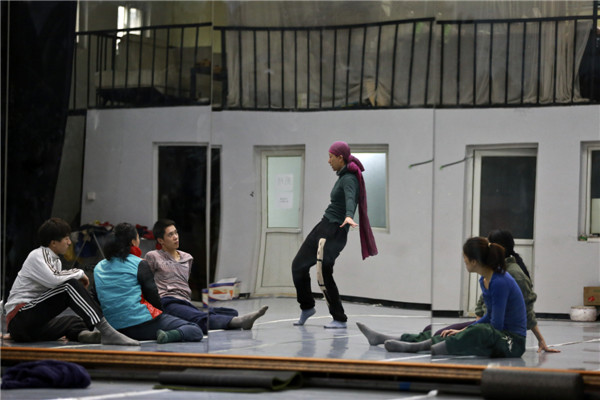
Dancer-choreographer Hou Ying instructs young dancers at a rehearsal of her production Tu Tu in Beijing. [Photo by Feng Yongbin/China Daily] |
At a late-afternoon rehearsal in a vast studio at Hou Ying Dance Theater on Beijing's outskirts, one of the dancers suddenly sprains her ankle. Hou Ying, the company's founder and dancer-choreographer, comes over to check the injury and tells her to rest.
"It's just weeks to go before the show. Each of the dancers is irreplaceable and I have to make sure of their physical and emotional condition," Hou says.
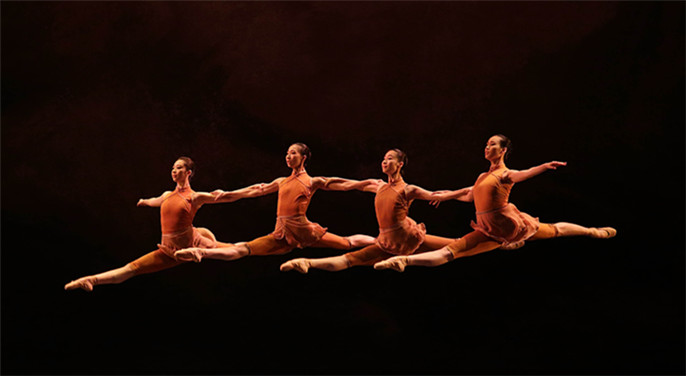
She is talking about the upcoming dance work, Tu Tu, one of her most ambitious choreographic undertakings, which will be staged in Beijing this weekend.
Over the past decade, Hou, in her 40s, has earned a reputation as one of the most inventive and sophisticated dancer-choreographers of the country.
Among the first generation of contemporary dancers in China, Hou has been with the internationally acclaimed Shen Wei Dance Art in New York for seven years. In 2008, she returned to China with Shen to create the eight-minute dance work The Picture, which was performed at the opening ceremony of the Olympic Games in Beijing.
Her fellow dancer's sprain reminds her of a serious spinal injury Hou had in 2007, when she danced with Shen Wei Dance Art.
She had to rest for a year in bed and the idea of Tu Tu started to take shape.
In 2009, Hou returned to China and created Tu Tu, by collaborating with Guangdong Modern Dance Company, the first professional modern dance company in China.
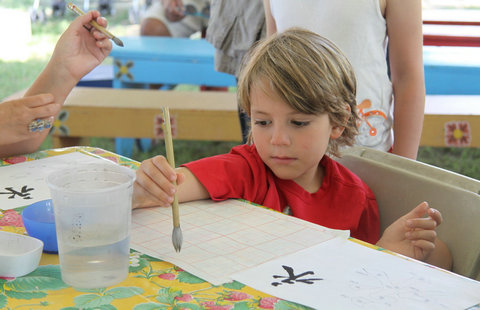
As the title of the work implies-the first tu refers to the action of painting and the second tu means picture, Hou combined abstract body movements with various colors to paint pictures onstage.
However, in the new version, which Hou remade in 2014, she deleted the elements of color and kept the abstract body movements. Last July, the work premiered at the Open Look St. Petersburg International Dance Festival, a major annual contemporary dance festival in Russia. In early November, the work was staged in Changchun in Jilin province and Guangzhou in Guangdong province.
"The six dancers all wear deep gray clothes, and the stage is colorless. I want the audiences to feel the transparent lines portrayed through the body movements, which are simple but filled with energy," she says.
The change in the work came from Hou's perspective about contemporary dance, which has reached a new level. The old version of Tu Tu, she says, was full of youth, and the new interpretation, like Hou herself, is much calmer and full of her artistic personality.
Hou recalls that she has been interested in lines and colors since she was a student.
"All my best friends were from the department of fine arts. I liked watching them paint and do sculptures as well as listening to them talk," recalls Hou.
Born in Changchun, Hou was trained in traditional Chinese classic dance since she was young. However, in 1995, Hou decided to change her way of dancing and joined the Guangdong Modern Dance Company.
Her first choreographic work, Night of Spirit, won the top prize at a Belorussian modern dance competition in 1996.
"She was a legend in the company because of her sophisticated skills. She also shocked us by shaving her head and eyebrows right after she joined us," recalls Willy Tsao, who founded the Guangdong company in 1992.
Hou still wears neat short hair, which, as she says, makes her feel independent and open.
In 2001, Hou was supported by Asian Culture Council to go to the United States, where she studied with dance masters such as Jose Limon and Trisha Brown.
In 2011, she founded Hou Ying Dance Theater in Beijing and created works such as Interface, Infinite and The Moment.
To concentrate on her choreography, Hou rarely takes commission jobs, noting that contemporary dance is still a minority taste in China.
"As an artist, you have to believe in your work and your instinct. Whenever my work is being staged, I sit among the audience and enjoy it," she says. "It's my own language."
If you go
7:30 pm, Saturday and Sunday. Century Theater, 40 Liangmaqiao Road, Chaoyang district, Beijing. 136-8332-3152.
|
|
|
|
|
|
|
|

Copyright 1995 - . All rights reserved. The content (including but not limited to text, photo, multimedia information, etc) published in this site belongs to China Daily Information Co (CDIC). Without written authorization from CDIC, such content shall not be republished or used in any form. Note: Browsers with 1024*768 or higher resolution are suggested for this site.
License for publishing multimedia online 0108263 Registration Number: 130349 







 Raymond Zhou:
 Pauline D Loh:
 Hot Pot
 Eco China
 China Dream
 China Face