Sharing great writing of China
 |
|
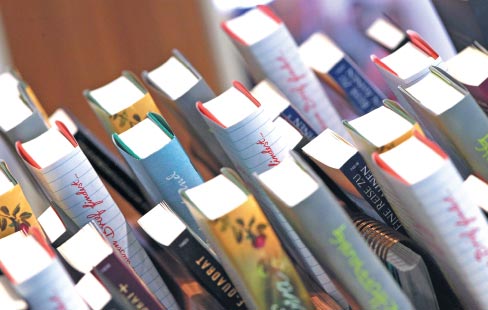
International events like the Frankfurt Book Fair in Germany now offer a good platform for Chinese authors to reach out to global readers. [Photo/VCG] |
"We know Canadian contemporary literature much better than they know ours," says Bai Ye, director of the China Contemporary Literature Study Association, at a recent forum in Beijing on cultural translation and studies.
Bai relates a story from about 10 years ago, when Liu Zhenyun, writer of I Didn't Kill My Husband and The Cook, the Crook, and the Real Estate Tycoon, and Bai went to a literary event at a Confucius Institute in Canada.
Bai had a dialogue with a famous Canadian critic at the event. As they discussed Canadian literature, Bai gave examples of several authors that he liked. The Canadian critic, on the other hand, could not think of any Chinese writer that she read.
"She told me to wait and she would think of one that she really loved. She didn't think of the name until we dined together later. It was Li Bai," he says.
That almost hit Bai like a blow, because the poet Li lived in the Tang Dynasty (618-907).
"I study only Chinese literature, but I read a lot of foreign literary works. Obviously, foreign readers know nothing about Chinese literature. And I think it's time for us to change that situation," Bai says.
The major purpose of the recent forum, hosted at Beijing Language and Culture University by China Culture Translation and Studies Support, a platform for cultural cooperation, was to discuss how to translate and introduce excellent contemporary Chinese literary works to overseas readers.
In China, more than 7,000 writers have registered with the China Writers Association, creating more than 3,000 novels each year. But only some 200-plus Chinese writers have been introduced overseas.
Mai Jia, author of Decoded and In the Dark, is the only contemporary Chinese writer whose works have been translated into 27 languages, says another participant at the forum, Xu Baofeng. Xu is executive director of the Chinese Culture Communication and Translation Center.
 |
|
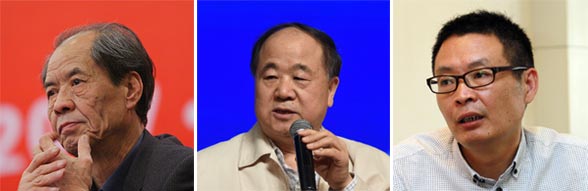
(From left to right) Chen Zhongshi, author of The Plain of White Deer, Mo Yan, a Nobel laureate known for Red Sorghum and Mai Jia, author of Decoded and In the Dark. [Photo provided to China Daily] |
Xu says there should have been more Chinese writers read by overseas readers, since "they create really great works".
Bai says foreign readers now tend to read stories about modern urban life in China rather than tales set in rural areas in old times, such as Mo Yan's Red Sorghum.
Last year, when prizewinning writer Chen Zhongshi-best known for The Plain of White Deer-died, translator Eric Abrahamsen told China Daily that the novel had not been translated into English because readers, having read mainly stories about rural China, wanted to read something about people in modern cities.
Abrahamsen is the founder of Paper Republic, a company devoted to translating Chinese literature and introducing it to the West.
Bai says that writers now being introduced to readers abroad are mainly from generations born before 1970.
"We promote overseas what we think are excellent works, but many foreign readers want to read the historical progress in the last 40 years since the reform and opening-up started. What kind of sea change has taken place in China, how it happened, and how it has influenced people from different walks of life, materially and psychologically," Bai says. "However, we don't have such novels. So I think we should first create some excellent works on such topics as migrant workers and make a collection."
Lu Min, 44, vice-chairman of the writers association in Jiangsu province, dismisses such writings.
"I once met representatives of a German copyright-trading company. They told me they wanted to read about urban Chinese life rather than rural life," she says.
But can literature be custom-made like other products? she asked.
"They want to learn about Chinese society through literature, which should be the function of the media," she says.
"But they should expect less ideological content from our literature. In literature, we write down our consideration about life and death, love, desire, our plight and our pursuit of the beautiful life, which are the eternal themes of literature."