Four distinguished speakers trace evolution of ancient texts
 |
|
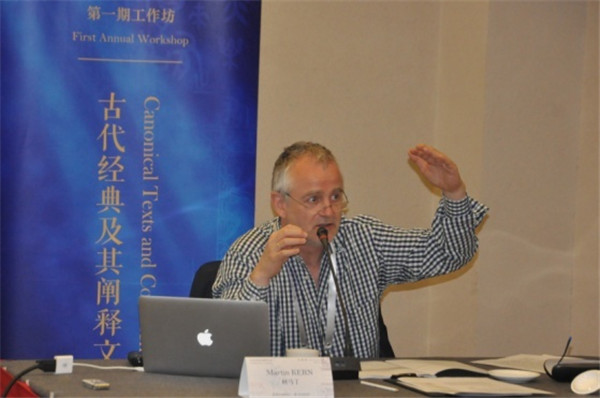
Professor Martin Kern from Princeton University, director of the center, addresses the workshop. [Photo provided to China Daily] |
Professor Glenn W. Most from Scuola Normale Superiore di Pisa delivered a lecture in which he traced the early history of the Homeric epics from oral to written texts, and how by the fifth century BC, the ancient Greeks could not conceive of their classical texts without thinking of particular authors (a striking difference to ancient China). Most highlighted that the reading of an ancient Greek text together with its commentary would have required not one person but at least two, who would read aloud together. He also discussed the question of allegoresis, in which certain passages were "decoded" as allegories to mean something altogether different — a fruitful observation that allowed for productive comparisons with ancient China.
Professor Denis Feeney from Princeton University delivered the lecture on June 22 about Latin canons and commentaries, and the importance of the Greek commentary tradition for Latin literature. As Feeney pointed out, after the Greeks, the Romans were the only ones in Western antiquity who developed their own literature, starting in 240 BC with the first translation of a text from Greek into Latin. From then on, Roman literature and Roman commentary always followed the Greek model. Most interestingly, however, Roman literature developed radically different from both Greek and Chinese literature, as it was neither sponsored by the imperial state as it was in China or by kings it was in Greece with the royal library of Alexandria, but entirely by individual authors whose work was sponsored by prominent patrons. In most cases, these extraordinary individuals were not originally Roman citizens but came as multilingual foreigners to Rome where they worked as slaves, servants, or tutors to their patrons.
Following the four days of lectures, a full day was given to the students to present their own work in light of what they had learned over the course of the week. The workshop concluded with another plenary session on Saturday where the four professors recalled the important themes of the week and praised the smooth organization by Renmin University and the wonderful contributions of the students throughout the week.
The next such workshop for PhD students from around the world, again hosted at Renmin University of China by its International Center for the Study of Ancient Text Cultures, will take place in January 2018.