Secrets of the Nobel Prize in Literature
 |
|
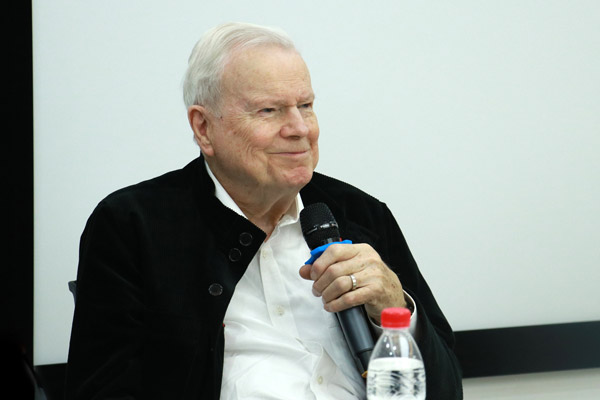
Espmark, former chairman of the Nobel Committee for Literature, speaks during a lecture at Beijing Language and Culture University, Beijing, Nov 17, 2017. [Photo provided to Chinaculture.org] |
Literature as international
Espmark suggested the notion of international literature, which combines a writer's cultural roots with inspirations abroad.
"I think it's rather in a meeting between foreign influence and domestic tradition that great literature is born," he said.
Many masterpieces in the 20th century, according to Espmark, are active results of those meetings, among which are works by British poet T. S. Eliot, who mixed French symbolism and domestic metaphysical poetry and won the Nobel Prize in 1948.
"But my best example is Mo Yan," he said. Like Colombian novelist Garcia Marquez and American writer William Faulkner, Mo, the Nobel Prize laureate, found a way to utilize his domestic material for literary purposes.
"This shows that foreign influence must not be something that dominates you, but something makes you find your own identity," he said.
Chinese writers and the Nobel Prize
The Nobel Prize Committee has been paying attention to Chinese literature much earlier before Mo Yan. "The first candidate [in China] to be discussed was Lu Xun in 1936," Espmark said. "But he was too modest and declined the nomination."
The second example is novelist Shen Congwen, author of Long River and Border Town, who was slated to win the Nobel Prize in Literature in 1988. But Shen passed away in May before he could be honored.
Mo Yan, "who with hallucinatory realism merges folk tales, history and the contemporary", won the prize in 2012 and became the very first Chinese writer on the list of Nobel Prize laureates.
As a literary historian and prolific writer himself, Espmark highly values reading as an eye-opening process. "Reading enables you to get into another person’s life. It widens your scope."
During his earlier trips to China, Espmark met several contemporary Chinese literati, including household names such as Ba Jin, Ai Qing, and Wang Meng.
"Many Chinese writers have been known to the Academy and the Swedish public," he said. "I advise members of Chinese literature societies, professors of Chinese language and literature to send in their proposals (for the Nobel Prize)."