|
|
What appear to be two deer are in fact two halves of one after the process of plastination. Photos by Eric Jou / China Daily |
 |
|
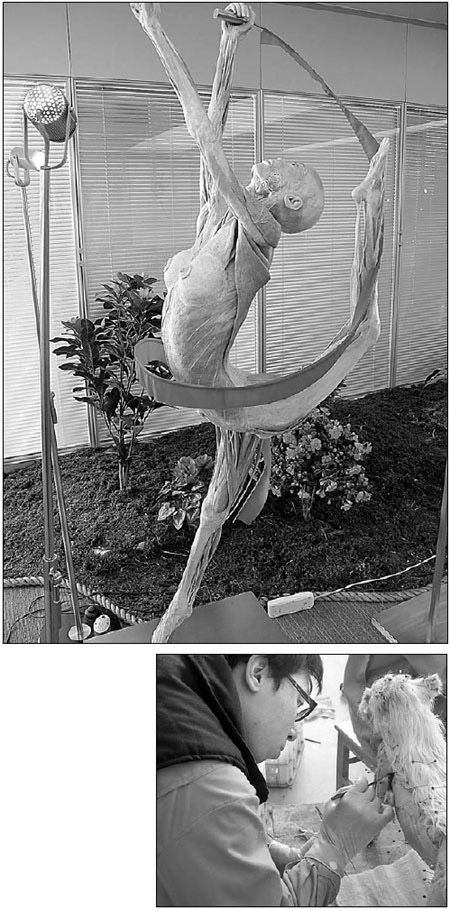
With a new focus on preserving marine animals, Hoffen is moving away from displaying human bodies. |
After a controversial run in the US, Hoffen is focusing on preserving more animals than humans. Eric Jou reports.
In the middle of a dusty road beyond Dalian, Liaoning province, is the Mysterious Life Museum, an unpromising name that belies a nondescript brick-and-mortar warehouse. Inside, an eeriness presides. There are three floors of installations of bodies, both human and animal. The entire museum, in fact, is filled with preserved human and animal remains, the handiwork of Dalian Hoffen Bio-Technique Co, the very same company that created the controversial show in the United States titled Bodies Exhibition.
Founded in Dalian by professor Sui Hongjin in 2004, Hoffen specializes in preserving remains in a process called plastination. The art of plastination, pioneered by Sui's teacher and competitor Gunther Von Hagens in the late 1970s, preserves human and animal remains in a semi-plastic form.
Hoffen is one of three companies that specializes in bio-plastination techniques; another is the Institute of Plastination run by Von Hagens.
To Sui, a medical school professor and mortician, the point of human plastination is all for science.
"Each specimen is different. Even among people, every person is different," Sui said. "Understanding these differences is very important in science, and looking at specimens is perhaps more helpful than looking at models because they are more realistic."
Bodies, Hoffen's most famous and its most controversial exhibition, has been touring the world since 2006. It showcased the human body through various specimens in plastination - some were splayed open to show certain body parts, others showcased diseases and illnesses. At the Dalian exhibit, a human body is represented only by its circulatory system through plastination. There are also bodies with chest cavities cut open to show cancer and heart problems. A blackened lung was another can't-miss installation, used to display the consequences of cigarette smoking.
"When we showed that lung in the states, we put a rubbish bin right next to the glass case," said Jing Shaobo. "The Americans would see it and pitch their cigarettes. In China we didn't get the same response."
While Hoffen's exhibition in the US was declared a success, it was without incident. In 2008, news reports and rumors alleged that Hoffen was using the discarded cadavers of convicts. These rumors, which were proven false, have damaged Hoffen and the art of plastination.
Jing, the planning director at Hoffen who has been with the company since 2010, says that Hoffen is now moving toward more animal-related plastinations, not because of past issues with human installations, but because the current trend is to look at marine life.
"We're currently working on a big order for marine specimens. They are very popular right now," Jing said. "That whale that washed up a while ago, we were trying to get the rights to the body to create a specimen."
But in their push for marine and animal exhibitions, Jing said their plastinations require actual animal carcasses.
Jing talked about how Hoffen was in talks with officials from Yancheng in Jiangsu province for a beached whale in March. Unfortunately, the whale was damaged overnight by locals harvesting the meat. Hoffen still does not have a whale specimen.
Jing said the process of plastination takes anywhere from eight to 10 steps and up to a year before a specimen is ready for display.
The first process of plastination is to fix the specimen in a pose or a look. The bodies are then either dissected or sawed in half to pinpoint the areas that are to be showcased. Once a focus has been decided, the resulting remains are then dehydrated, degreased and "impregnated" with various chemicals that result in plastination.
After the bodies have become "plastic", they are put through further hardening. The end result after months and months of work is a specimen ready for display.
Prepared specimens can show anything from a full creature to the layers of what an animal looks like. One exhibit that will be on display soon is of a raccoon dog leaping forward. The series first shows the animal's skeleton, then the dog's muscles and finally the animal in full fur.
Other specimens on display at Hoffen's Museum of Mysterious Life include alligators and various birds.
While plastinations can technically last forever and are very popular in museums, Jing is cautious when he loans out Hoffen's specimens for exhibit.
"We're working on more exhibits in China but the problem right now is that the museums aren't ready," Jing said. "I can exhibit a shark with food content still in its stomach and when the show is over, there won't be anything left in its stomach."
|
|
|
|
|
|
|

Copyright 1995 - . All rights reserved. The content (including but not limited to text, photo, multimedia information, etc) published in this site belongs to China Daily Information Co (CDIC). Without written authorization from CDIC, such content shall not be republished or used in any form. Note: Browsers with 1024*768 or higher resolution are suggested for this site.
License for publishing multimedia online 0108263 Registration Number: 20100000002731 


















 Raymond Zhou:
 Pauline D Loh:
 Hot Pot
 Eco China
 China Dream
 China Face