|
|
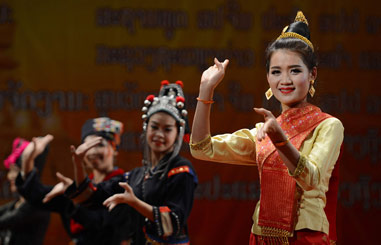
From left to right: Chinese Pipa master Wu Yuxia plays on stage in Tianjin in 2010.[Photo by Cao Tong] Vladimir Ashkenazy conducts the Sydney Symphony Orchestra. [Photo provided to chinadaily.com.cn] |
What would you discover were you to Google the number of Chinese students of western instruments, such as the violin, and those who study traditional ones, for example the erhu, a two-stringed Chinese violin, as it is known in the West?
It is estimated that there are 10 million violin students, but just over 600 thousand erhu enthusiasts in China, although the proportion of the latter has seen a rapid increase in the past decade.
“There are 40 million people learning the piano here in China. The population in Australia is 20 million,” said Rory Jeffes, Managing Director of the Sydney Symphony Orchestra, during his recent trip to Beijing. He sees a “huge” market prospect for classical music in China.
Chinese children are usually pushed into studying an instrument to achieve a competitive edge in the hypercompetitive school system, but some take up music simply because they wish to.
Piano, violin and guitar are among the top choices for most.
It is not uncommon to read in the media about Chinese contestants winning championships in famous international classical music competitions, and this is a clear signal that China is cultivating virtuosos who can compete worldwide.
Although traditional Chinese music has little recognition abroad, westerners have probably heard of Wu Man - the Grammy-nominated master of the pipa, a four-string plucked Chinese instrument, known as a Chinese lute in the West.
The first person to receive a master’s degree in pipa, Wu Man, at the age of 27, penniless, and speaking no English, took her instrument to New York in 1990, when China unleashed a wave of musicians to the West.
Wu said in a media interview with the Los Angeles Times that curiosity drove her to move to the States. "I wanted to learn, wanted to know what the world was like outside China. The Chinese government had closed the door for so many years. In the early '80s, they opened the door to the West. It was the most exciting period. I was at a conservatory in Beijing; Isaac Stern visited and gave a master class, and some groups from Europe came. I was like a sponge; it really opened my mind."
She has worked on soundtracks for films such as Ang Lee’s Eat Drink Man Woman, and was the first Chinese musician to play at the White House, when President Bill Clinton invited her to perform.
A flow of Chinese musicians went abroad in the 1980s and 90s as a result of China’s reform and opening-up after 1978.
Sun Yi, the Associate Concertmaster of the Sydney Symphony Orchestra is one of them.
Born into a family of amateur musicians in 1968 in Hunan, China, he started to play the violin under parental decree when he was aged seven, during the “cultural revolution” (1966-76).
It was a period when western classical music was forbidden in public. Instead, revolutionary Chinese operas were prevalent, according to 53-year-old Benjamin Li, a Beijing-born violinist from the Sydney Symphony Orchestra.
“Draw the curtain, shut the door, install the mute, and then I can practice Beethoven privately,” Li recalled.
In 1988, Sun was admitted to China’s venerable Shanghai Conservatory of Music, where “I was so lucky to be able to learn chamber music.”
“Even during the first few years after 1978, there were only two professional orchestras in Beijing and Shanghai apiece,” said Li. “That’s why Sun said he learned mainly solo performances instead of orchestral music.”
After graduating from the Conservatory in 1993, Sun joined the Shanghai Symphony Orchestra and held the position of Concertmaster in 1996.
In the same year, Sun visited specialists in classical music during his tour of Australia. He believes this experience offered him a window into the orchestral world.
Despite being a concertmaster back home, Sun felt his knowledge was far from complete.
At the end of 1997, he moved to Australia to complete a Master’s in Music at the Australian Institute of Music.
In 2002, Sun joined the Australian Opera and Ballet Orchestra as its Associate Concertmaster and was later recruited by the Sydney Symphony Orchestra, holding the same position, in 2007.
China’s orchestral strength admittedly still ranks below its western counterparts. “The China National Symphony Orchestra takes a month to rehearse a new production, while the Sydney Symphony Orchestra practices only twice within a week before a new show is premiered,” said Benjamin Li.
Starting in 2012, Sun Yi, Benjamin Li and other musicians from the Sydney Symphony Orchestra will be invited to teach Chinese students in Guangzhou under a governmental cultural agreement between China and Australia.
But what about China’s own traditions?
During the past decades, the development of Chinese national music has followed two different paths.
On the one hand, demand for training has skyrocketed in the past ten years; on the other, in the domestic market a growing chasm has emerged between audiences and composers.
There are at least one million students of the guzheng, a Chinese plucked zither, but this is a small number in comparison to those playing western instruments. This may change in the future.
As incomes improve, more urban people can afford to buy traditional Chinese instruments, which are generally less-expensive than western ones.
There is a thirst for traditional culture, a natural result of higher living standards and a government devoted to reviving Chinese traditions.
Hou Weiping, 26, who works for the China Daily website, is learning to play the guqin, listed by UNESCO as an intangible cultural heritage item.
“Initially I wanted to buy a guitar to practice as a pastime,” Hou said.
But an accidental visit to a training school for guqin convinced her to change her mind.
Situated within an office building in downtown Beijing, the practice room is decked out with artificial hills, murmuring flowing water, a pond stocked with fish, and the fragrance of burning incense.
“I couldn’t imagine there could be such a traditional place in such a bustling city as Beijing,” she said.
When the guqin was strummed, Hou felt an inner peace, forgetting all her troubles.
Despite a resurgence in students learning traditional Chinese instruments, the instrumental music market in China is dominated by western compositions.
“The domestic tendency to write Chinese music using western composition skills has directly brought about the market depression in recent years,” said Xi Qiang, President of the China National Orchestra. “It looks like a man wearing a suit with a traditional Chinese cap.”
Learning doesn’t have to equate to duplication. Fusing with western elements, modern Chinese works are meant to be produced with their own music language. It is essential to remember the direction of modern Chinese arts and the demands of its audiences, Xi observed.
According to Xi, China’s Ministry of Culture is planning to establish an exclusive fund, in an effort to foster cultural exchanges between the nine artistic houses affiliated with it—the China National Orchestra is among them—and overseas countries.
Chinese instrumental music may not be as popular as western music, even on home turf, but it is definitely a part of the musical tapestry of the world.
A Chinese scientist from the Ming Dynasty (1368-1644) devised a twelve-tone temperament, which was later broadly adopted in western music; the Chinese guqin piece Liu Shui, otherwise known as Flowing Water was taken together with pieces from other cultures by NASA into space in 1977, representing the artistic achievements of human beings; daluo, a Chinese gong, is widely used in western orchestras. There are many such examples of Chinese music playing some role beyond the Middle Kingdom.
And there will be many more.

|
|
|
|
|
|
|
|

Copyright 1995 - . All rights reserved. The content (including but not limited to text, photo, multimedia information, etc) published in this site belongs to China Daily Information Co (CDIC). Without written authorization from CDIC, such content shall not be republished or used in any form. Note: Browsers with 1024*768 or higher resolution are suggested for this site.
License for publishing multimedia online 0108263 Registration Number: 130349 















 Raymond Zhou:
 Pauline D Loh:
 Hot Pot
 Eco China
 China Dream
 China Face