Exhibition showcases Tang and Song dynasty arts








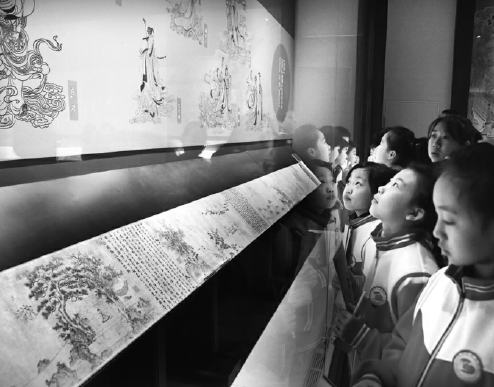
Revealing the glamor of the Tang (618-907) and Song (960-1279) dynasties-the cultural pinnacles of ancient China-one of the nation's most prominent painting and calligraphy exhibitions this year opened to the public at the Liaoning Provincial Museum in Shenyang on Wednesday.
The three-month event, entitled Atop the Mountains: Exhibition of the Eight Great Masters of the Tang and the Song Dynasties, focuses on "the eight great masters", a household cultural term referring to Liu Zongyuan and Han Yu from the Tang Dynasty, plus Ouyang Xiu, Su Xun and his two sons Su Shi and Su Zhe, along with Wang Anshi and Zeng Gong, all from the Song Dynasty. The term hails their unparalleled status in Chinese arts and literature.
"Their spirits can also inspire us today," said Wang Xiaowen, director of the Liaoning Provincial Museum. "They represent Chinese literati's temperament and show how intellectuals contributed to the overall development of our country throughout history."
For the highlighted event, 115 exhibits-mainly paintings, calligraphy, ancient books, stone rubbing pieces and ceramics-were displayed to recall the glorious era of outstanding literati. Eighty-four articles are from the museum's own collection, and the rest are on loan from key venues nationwide including the National Museum of China and the Shanghai Museum, Wang said.
The event is also China's first exhibition collectively introducing the eight masters through cultural relics that have been handed down as a result of about 1,000 years of continuous efforts.
The exhibit shouldn't focus on just their literary achievements, said Dong Baohou, deputy director of the museum and also the curator of the exhibition. "Their virtue, loyalty and patriotism should also be fully showcased."
Some of the eight are known for their rocky life paths, such as being banished from officialdom despite their upright and devoted attitudes toward serving the country. They turned to literature and art to reveal their optimism and unfulfilled ambition.
Many of the pieces have rarely been seen by the public before, because they are considered to be very precious. For example, an exhibited scrolling script by Ouyang Xiu showed the artist's long pursuit of excellence while improving his works with diligence.
Su Shi, an iconic name in Chinese poetry and calligraphy, also displayed his talent through an ink wash painting on silk. Though he was mostly known as a major advocate for so-called literati painting, which later became a crucial genre in Chinese fine art, his own paintings hardly remain. Another display of character calligraphy is the longest remnant of Su Shi's handwritten work.
Dong regarded them as "the most renowned matrix of literati in ancient China".
"Through the artworks, people can resonate with their eventful lives and noble personalities," he said.
The art pieces, including portraits of the masters that were drawn during the Qing Dynasty (1644-1911) that are on loan from the National Museum, showed how generations of Chinese people venerated their legacy.
"Though these images can always be seen on the internet when you search their names, the original portraits have never been publicly displayed," Dong said.
Other artists paid homage to the masters' works in their own ways.
Red Cliff, a displayed scroll painting, was how the celebrated Ming Dynasty (1368-1644) artist Qiu Ying honored Su Shi's most famous prose the Red Cliff Ode.
In addition, a milestone painting in Chinese fine art history, Auspicious Cranes, was drawn in 1112 by Zhao Ji, a Song emperor who was gifted in arts but was a bewildered ruler.
Coincidentally, Su Zhe-the most contemporary of the eight masters-died that year. Dong said his death marked the end of a cultural epoch.
The Liaoning Provincial Museum is home to numerous top-tier ancient paintings and calligraphy, many of which were once housed as part of a royal collection in the Forbidden City in Beijing and taken to Northeast China by the last emperor, Aisin-Gioro Puyi.
To celebrate the exhibition, the museum also opened to the public at night for the first time on Wednesday. Virtual guided tours of the exhibition and an academic symposium on the eight masters will also follow.
Zhang Tongtong contributed to this story.
Contact the writers at wangkaihao@chinadaily.com.cn
- Talent meets opportunity at Hunan recruitment event in Beijing
- China-Central Asia agricultural alliance launches in Xinjiang
- Xi addresses Global Leaders' Meeting on Women
- North China's barren salt flats turn into rice fields, tourist attractions
- Dunhuang: Where ancient treasures meet global partnerships
- Xinjiang through my eyes: Musician on the grassland