 |
|
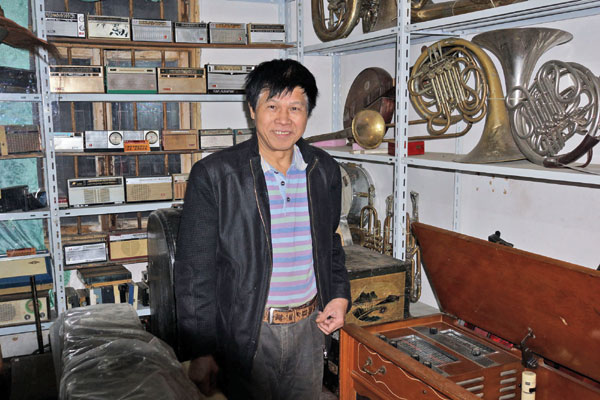
Xie Zhikuan at his home-appliance museum in Liuzhou, Guangxi Zhuang autonomous region. Huo Yan / China Daily |
Private museums, displaying everything from antique furniture to vouchers to stones, have sprung up across China in recent years.
Private museums have existed in Europe and the US for decades, with some, such as the Guggenheim in New York, drawing visitors from around the world. In China, the concept is in its infancy by comparison, but beginning to flourish. Most private museums in China are no larger than a couple of rooms displaying the owner's collection, sometimes without any entrance charge.
Xie Zhikuan is the owner of such a museum in Liuzhou, one of China's oldest industrial bases, in South China's Guangxi Zhuang autonomous region.
Xie began to collect radios 20 years ago, before expanding to television sets, record players and home appliances, until they eventually took over his three-story house. Objects that can usually only be seen in old movies are now packed into every room.
|
|
Space is so limited that Xie has stacked parts of the collection in corners, covered by a thick layer of dust. At first glance his home looks like an abandoned warehouse.
Xie's home-appliance museum reflects the problem most private museum owners in China face: While they love collecting and showing their collections, they lack the money and space to create a sustainable business.
Luo Xiaojun, executive editor-in-chief of 21 Century Business Insights, who is compiling a white paper on private museums in China, says many are not yet "proper" museums.
"A real private museum should have stable sources of funding, but currently most Chinese ones are funded from the owners' pocket money, so they are not sustainable," he says.
Under Chinese law, private museums are categorized as "private non-enterprises", which technically means they can enjoy tax breaks, subsidies and other favorable government policies. But this is not yet happening in many parts of China, particularly in rural areas where the local economy is not developed enough to support these initiatives.
|
|
|
|
|
|
|
|


Copyright 1995 - . All rights reserved. The content (including but not limited to text, photo, multimedia information, etc) published in this site belongs to China Daily Information Co (CDIC). Without written authorization from CDIC, such content shall not be republished or used in any form. Note: Browsers with 1024*768 or higher resolution are suggested for this site.
License for publishing multimedia online 0108263 Registration Number: 20100000002731 



















 Raymond Zhou:
 Pauline D Loh: My Chinese Kitchen
 Ye Jun:
 China Face
 Hot Pot
 Eco China