Exploring identities


 |
|
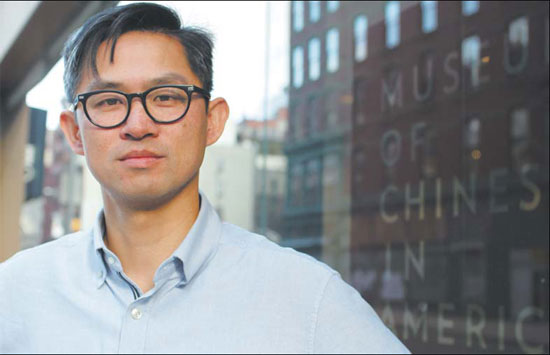
Museum of Chinese in America curator Herb Tam at his museum in New York City. Provided to China Daily |
Museum curator Herb Tam uses art to explore the dynamic, variegated experience of Asians in the US, Kelly Chung Dawson reports from New York.
Before he moved to the New York City borough of Queens in 2004, Herb Tam had always defined himself as Chinese. "Asian-American" was a label that felt removed from his upbringing in San Francisco's Chinatown and, later, the predominantly white suburbs of the Bay Area.
However, suddenly surrounded by Chinese-speaking immigrants in Queens' heavily Asian neighborhood of Flushing, Tam realized the overlap between his experience and that of, say, a second-generation Korean-American might be wider than he imagined.
|
|
"My relationship with being Chinese became more complicated when I moved to a Chinese community," says Tam, who was born in Hong Kong and moved to the United States as an infant. "It made me rethink the whole notion of being Chinese; it shifted my ideas of Chinese-ness," he says.
"This concept of an Asian-American community took on greater significance when I realized that I might share more in common with someone with parents from Japan who had lived in the US for most of his or her life. They might have a more similar belief system, or face the same types of discrimination. That's when Asian-American-ness became a concrete idea for me."
As curator of the Museum of Chinese in America, which opened in 1980 in Manhattan's Chinatown, Tam regularly confronts the shifting contours of ethnic and cultural identity among communities that include Chinese-Americans and newer immigrants. The museum in recent years has shifted from a historical focus toward exploration of Chinese and Asian-American contemporary culture, partly due to Tam's influence.
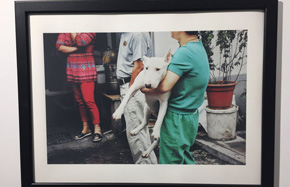
Recent exhibitions at the New York museum include America Through a Chinese Lens, a survey of photography by Chinese and Chinese-American artists; the dual presentation Marvels and Monsters: Unmasking Asian Images in US Comics and Alt.Comics: Asian American Artists Reinvent the Comic; and a series of installations by the conceptual artist Lee Mingwei.
Panel discussions at MOCA, as the museum is known, have touched on topics such as basketball player Jeremy Lin, the history of Asian-American grassroots political activism and Chinese slam poetry.
Eugenie Tsai, curator of contemporary art at the 118-year-old Brooklyn Museum, says Tam represents a new generation of curators and arts critics who are focused on global culture.
|
|
"He is keenly aware of the ties between Chinese Diaspora communities around the world," Tsai says. "He can't be pigeonholed as a curator who is only interested in Asian-American art; he has a broader, contemporary perspective with specialized, focused interests. Within this new generation of curators, there's an awareness of how the world has expanded, and I think Herb's outlook is very much shaped by that."
Tam was born in Hong Kong in 1974, shortly after his parents left the Chinese mainland. Like many contemporaries, the family's intended destination was the United States.
During the "cultural revolution" (1966-76), Tam's parents had been sent to work in the Chinese countryside for little remuneration, and the US represented for them the idea that hard work could result in a life of one's choosing, he says. Two months after Tam's birth, the family relocated to San Francisco.
As a child, he played in Chinatown's sweatshops, while his mother sewed clothing and his father delivered groceries. Later, his parents opened a coin laundry in the suburbs, then a dry-cleaning chain; Tam and his sister worked shifts.
As one of just a few Chinese families in San Mateo, a city about a half-hour drive from San Francisco, they regularly experienced racism, Tam says. Even after moving to the slightly more diverse suburb of Milbrae, he and his relatives found racial divides hard to avoid.
"I just thought that's how white people were," he says. "When you're a kid you have sore spots, and they become huge. For so long I thought all of white America was racist."
He gravitated toward rap music because of its anti-establishment posture, and started drawing; both influences would later resurface in his work. In college, he studied graphic design and art. Tam soon realized he could give voice to his anger about what he calls "institutional lies and forms of racism, and the ways that specific groups of people have controlled social institutions and functions".