A fascination with wood


 |
|
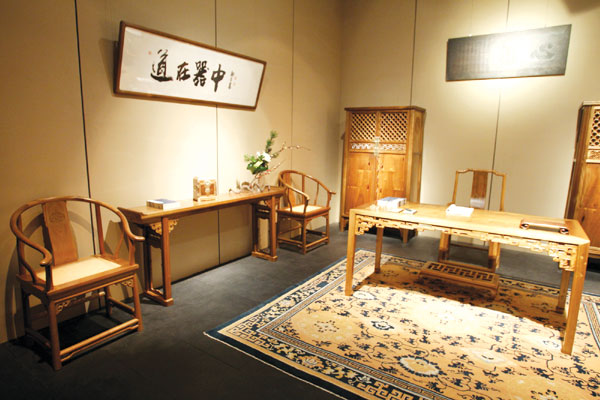
A Ming-style study: Four Chinese characters in the calligraphy work are dao zai qi zhong, or "wisdom in what you use". Photos by Wang Jing and Provided to China Daily |
"The cabinet had been especially designed for scholars who were presumably interested in nothing but burying their noses in classics and often absent-minded beyond the pages," Mi says. "With its doors designed thus, a lazybones' cupboard offered protection to the beloved books that may be otherwise neglected by their absent-minded owners."
Forgetful or not, the scholars were often single-minded about one other thing, and that was to study hard so they could rise above the rest and earn a position in court. This craving for that high office is manifested in a common piece of furniture in the study - dubbed the "official's hat chair".
"During the Ming Dynasty (1368-1644), officials wore a certain headgear with tight-fitting black cap with two extended wing-like flaps," explained Mi. "When one sits on an official's hat chair, the top rail of the chair's S-shaped backrest extends from both sides of the head like wings on an official's cap."
The message is very clear - study hard and aim high.
If there is one particular group traditional Chinese wood culture attracts, it is the literati class whose members have been a highly introspective breed, judging by the furniture pieces they have inspired.
However, according to Mi, the ultimate proponent and practitioner of the country's furniture-making tradition was no bookworm or wallflower but someone who acted on power and will. He was Zhu Youxiao, the 15th emperor of the Ming Dynasty who reigned briefly from 1620 to 1627.
Known as the "Carpenter Emperor", Zhu had apparently found more personal fulfillment with a carpenter's saw than an emperor's seal.
He spent most of his day sweating in the court workshop, and the young emperor craved recognition from his peers and the market, like most serious artisans. At his order, completed pieces were taken outside the palace to be sold at local markets.
One man's obsession has spawned a trend. Carpentry was increasingly viewed as an artistic pursuit, and a noble engagement. Celebrated personalities of the time made and signed their furniture pieces the same way they placed their seals on paintings and calligraphy works.
The dominant style formed during this period, famously known as the "Ming Style", eschewed any superfluous decoration for a deliberate minimalism, or an understated luxury to use the modern lexicon.
"The style is a direct reaction to all the sumptuousness of the preceding era, and is underwritten by the belief that while sophistication exacts the eye, simplicity trains the mind," says Gao Shuzhen, founder of the Nanmu Studio which is behind the National Museum show.
"And that ideal triumphed during the Ming Dynasty."
Although style temporarily yielded to a much more elaborate and ornate aesthetic during the Qing Dynasty (1644-1911) which followed, "Ming Style" has reinforced itself as the current paragon of classical Chinese furniture-making especially as modern collectors and connoisseurs initiated a society-wide search for "our cultural roots".
As for his father's sage saying about "wood cultivating people", the 41-year-old Mi has finally arrived at his own conclusion.
"A master carpenter and his chosen piece of wood - they both have their own temperaments. The relationship between them can be best described as a love affair. The craftsman is determined to turn natural beauty into a work of art with timeless appeal, investing countless hours of hard work and total concentration of mind and soul," Mi says.
"By doing so, he brings out the best in himself and becomes complete."
Contact the writer at zhaoxu@chinadaily.com.cn.
|
|
|