Legacy of a railroad


 |
|
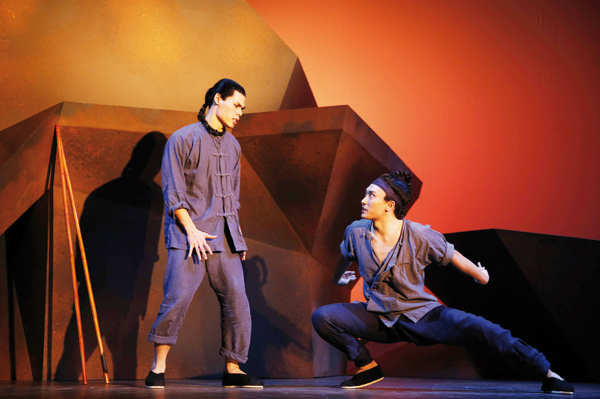
The Dance and the Railroad features two characters, Lone and Ma, Chinese laborers who built the Transcontinental Railroad in the US in the 19th century. |
Prominent Chinese-American playwright David Henry Hwang makes his long-overdue debut in the Chinese mainland, presenting a snippet of immigrant history and a theme ready to resonate with an increasingly mobile population, writes Raymond Zhou.
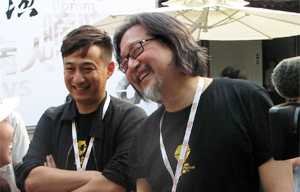
David Henry Hwang was reticent about his expectations for his first outing in the Chinese mainland - for his plays, that is. The debut of The Dance and the Railroad at Wuzhen Theater Festival, which ran May 9-19, arrived with little fanfare, but theater professionals were reminded that the first Chinese-American winner of a Tony Award had actually never seen any of his works produced in a mainland venue - until now.
Set in 1867 when Chinese laborers were building the Transcontinental Railroad, the play features two characters on a California mountaintop. The elder one, Lone, practices his Chinese opera routine while the younger one, Ma, implores him to teach the skills for the role of Gwan Gung (or Guan Gong in standard pinyin). The two are opposites in more ways than age discrepancy. Ma starts as an optimist about the prospect of making money in the new world; Lone is not. Lone despises his co-workers, calling them "dead"; Ma tries to convince him to join them. Their attitudes towards the strike happening in the background are totally different, and that difference is reversed by the end of the play, with the younger Ma more cynical and the erstwhile cynical Lone more accepting of the resolution.
Hwang reveals that the strike as a plot element was inspired by a 1968 student strike at San Francisco State University to call for Asian-American studies, and some of the source materials came from projects that later evolved into New York's Museum of Chinese in America and the Asian-American Studies Department of the University of California at Los Angeles.
The Dance and the Railroad, Hwang's second play, premiered in 1981. For the revival, he incorporated research and discoveries made in the past 30 years. The shortening of the daily work hours from 10 to 8, as mentioned in the original version, turned out to be "not true". The subsequent raise of weekly wage by $5, which is still a crucial piece of information in the current version, was "not related to the strike" as the owners of the railroad insisted.
Hwang considers himself "part of the movement of the American culture of 1970s through 1990s" that is popularly known as "multiculturalism". He started his career with the "Trilogy of Chinese America" plays that depict the immigrant experience at various stages and facets. His mentor, Sam Shepard, encouraged him to "write for the subconscious and the unconscious", and immigration and assimilation as subject matters came naturally.
At a forum of the Wuzhen Theater Festival, Hwang answered questions from the audience about whether his focus on Asian America helped perpetrate a stereotype. He acknowledged that he is familiar with this kind of criticism. "One person or a handful of people cannot represent a whole race, ethnicity or community," he emphasizes. "Only a rich diversity of writers can reflect the diversity of the society at large."
It used to be only Caucasian writers could get into the mainstream, but nowadays ethnic writers, especially the young generation, may no longer be constrained by their ethnicities. Instead of a "Chinese-American writer", one may be called an "avant-garde writer" by the press. "Everybody gets labeled now," Hwang laughs, but the label may not be one's ethnicity any more.
Hwang is acutely aware of the history of Asian-Americans' arduous rise on the theater stage and the resurfacing of the "yellow-face" phenomenon, that is, white actors taking on the roles of Asians. The 1958 staging of Flower Drum Song was the first time Asian-American actors appeared prominently on Broadway. When Jonathan Pryce rejoined the cast of Miss Saigon when it moved from London to New York in 1991, Hwang was one of many Asian-American artists who protested against the casting - for a role specified as Eurasian nonetheless.
|
|
|
| Wuzhen dares to dream big |
Versatile singer leads Nabucco cast with performance of highest artistry |