Legacy of a railroad


 |
|
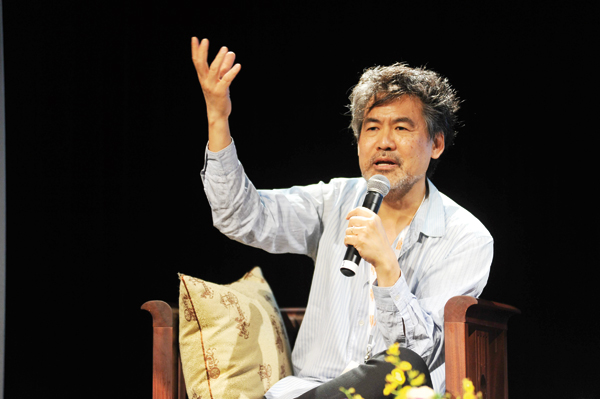
David Henry Hwang talks about his play, which centers on the lives of Asian-Americans, at the Wuzhen Theater Festival in Wuzhen, Zhejiang province. Li Yan / For China Daily |
"Artistic freedom is important," Hwang says. "People should be able to cast whoever they like. Likewise, people should also be able to express their feelings against such casting if they want to." He notes that a 2012 Royal Shakespeare Company production of The Orphan of Zhao cast only three East Asians, and those in somewhat degrading roles.
Ironically, a yellow face is hardly the kind of topic that provokes those inside China, who are so accustomed to Chinese actors dying their hair yellow and wearing fake noses to play Caucasian roles on stage that they would not raise an eyebrow but may burst into laughter when the makeup and mannerisms are so obviously non-Asian as to appear ludicrous. The concern of many Chinese is the lack of visibility of Asians in Hollywood blockbusters and the recent appearances of Chinese superstars in insultingly short roles.
As China takes a more central role on the global stage, China-related stories emerge with more frequency in the cultural landscape of Western countries. "There are some 30-40 Monkey King stories in production," he illustrates. Audience attitudes have also changed, notes Hwang, from curiosity to all kinds of reactions.
Hwang himself is developing a project based on the legendary kung fu master Bruce Lee, whom he views as "the first popular manifestation of new China". Hwang started that in the mid-1990s, but "just couldn't get the tone right." Two years ago, he settled on a play with dance but no songs. "Every time we made Bruce Lee sing, it came out sounding like South Park." Now, the "dancical" (in contrast to "musical") that incorporates martial-arts movements is set to open in New York at the beginning of 2014.
Hwang cautions that, despite his success on Broadway, especially for M Butterfly, "Broadway represents a tiny slice of American theater," and much of the country's theatrical excellence never heads for the Great White Way, for one reason or another. But he is very much resolved about the so-called conflicts between "universality" and "specificity". "A work becomes more universal by being more specific," he says.
This may be true, but a Chinese-American playwright, as an ethnic minority, is often judged by what he writes about rather than how he writes about it. If he settles for an ethnic story, he can be praised for promoting ethnic culture or lambasted for exploiting exoticness. If he chooses a non-ethnicity-specific story, he could be derided for forgetting his roots or lauded for attempting to break into the mainstream. In China, writers stand out more for their hometowns than for their ethnicities. People hardly noticed that Lao She was Manchurian and Shen Congwen an ethnic Miao, but we all know one created great stories set in old Beijing and the other posthumously turned the border town of Fenghuang (bordering Hunan and Guizhou provinces) into a wildly popular tourist destination.
Indeed, exoticness alone won't carry an artistic work very far. Beneath the glitz and mystique of Peking Opera and diplomatic life, M Butterfly espouses the politics of race and sex, which is universal. The two-hander Dance and the Railroad has at its core the dynamics of mind control. It is about the crossing of paths that many experience in less outlandish settings. I have encountered China's own migrant workers in places like Guangzhou and Beijing having similar generational clashes over an assortment of issues, including the prospect of staying on as urbanites.
What appears as exotic in the US, such as the operatic physical flourishes, merges into the cultural background once viewed in China, revealing the deeper essence of Hwang's play, which, as I interpret it, is conflicting attitudes when one is displaced from one's roots and is faced with an unknown future. You don't have to be a Chinese or an American to identify with that.
|
|
|
| Wuzhen dares to dream big |
Versatile singer leads Nabucco cast with performance of highest artistry |