Take-Out Multiculturalism


In conversations with a Swedish dramaturg and an immigration lawyer, the German playwright Ronald Schimmelpfennig was challenged to incorporate two themes into a new work: an anti-naturalist style of production, and the subject of illegal immigration in Germany. "Why not write a play about it?", the lawyer asked him.
 |
|
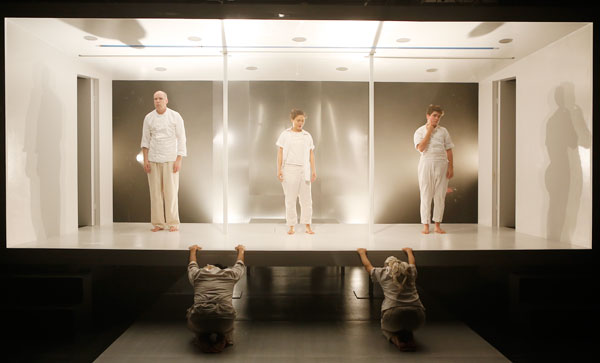
Actors Stephen Duff Weber, K.K. Moggie, Noah Galvin (in top row), Peter Kim and Welker White (on floor) portray sixteen character in "The Golden Dragon". Photo provided to China Daily. |
The resulting piece, "The Golden Dragon", has been translated into more than 20 languages and is playing at New York's New Ohio Theatre through this weekend. Set in the kitchen and dining floor of a "Chinese-Thai-Vietnamese" restaurant, and in various apartments in the same building, Schimmelpfennig's piece features five actors nimbly filling the roles of sixteen characters. Forty-eight rapid-fire scenes lead the audience through an emotional argument between a woman and her cuckolded husband, dinner between a pair of seemingly oblivious flight attendants, an old man lamenting the passage of time, and an allegory about an ant and a long-suffering cricket forced into prostitution. Threaded throughout is the story of an undocumented young immigrant, whose painful toothache ends with an epic journey to his homeland, China, and a meeting with the family he left behind.
The play is preceded by a "sound walk," for which audience members are invited to take an introductory walk around the neighborhood with provided MP3 players.
"Here in New York we walk into a take-out restaurant and we don't even think about interacting with the people there," said director Ed Iskander, who is also the founder of theater company Exit Pursued by a Bear. "So many of these interactions are transactional, and the idea that we should be looking under the surface of these lives is the first domino that falls. In every relationship depicted in the play, there's a colonizer and a colonized. Our human ecology is dependent on those power systems as a structure, and in the same way that an ecology would destruct if bees went instinct, these people can be viewed as the bees."
Sound designer Jeremy Bloom, who in cooperation with sound artist Katie Down created what Iskander calls the play's "insane, virtuosic" live soundscape, was inspired by the material's handling of stereotypes.
"It takes these ideas of East vs. West, these supposed opposites, and turns them inside out to show that it's not so simple," he said. "All these people are literally living on top of one another, and they're passing each other constantly, and not only are they living different lives, but their lives are also very different from what each projects onto one another."
Bloom works with various real-life kitchen tools and utensils to create the frenetic chaos of a real restaurant. Unlike most productions, in which sound artists are brought in toward the end of rehearsal to contribute background noise, Bloom rehearsed with the actors every day.
Although New York audiences might assume the location of the restaurant is Manhattan, the city is never mentioned, in hopes of creating a universal, fabled quality, Iskander said. Set against this backdrop, the rapid character-switching also contributes to a dreaminess further underscored by the casting of both white and Asian actors in roles that are repeatedly described as being of Asian ethnicity. Schimmelpfennig has described this choice as both a deliberate statement, and one born of a scarcity of Asian actors in Germany.
"The play shows the story from the white westerners' point of view against the 'other'," he said in a post-show panel discussion at London's Arcola Theatre in 2011. "Casting White Western actors is a specific technique to make them play the opposite to create more identification. We cannot pretend to be Chinese, and there are no or very few Chinese actors in Germany. Therefore you need the actors just to say who they are. 'I am Chinese'".
California's La Jolly Playhouse faced criticism for its casting of Caucasian actors in a Chinese play last year, as the Asian American community bemoaned the dearth of roles for non-White actors. Iskander, an Indonesian citizen of Chinese background, is attuned to that controversy, but felt that in this case the use of non-Asian actors was a way to promote "a global dialogue, rather than a specific ethnic dialogue," he said. "I think about the issues that affect Asian Americans all the time."
Although he was born in Indonesia, he attended boarding school in England and spent the majority of his childhood feeling like the odd one out, he said. "That separation lives with me on a daily basis, and the disconnection dealt with in the play is a universal journey not specific to race or class. And yet, what you're also confronted with here is the human connections we form anyway, a human virtuosity that's profoundly enchanting and meaningful."